Human Work
Charlotte Perkins Gilman
THE CLASSIC COLLECTION · 1911
"Moving the Mountain" by Charlotte Perkins Gilman is a novel written in the early 20th century, specifically around 1911. The story explores a future society where a man, John Robertson, awakens after thirty years of unconsciousness, discovering a dramatically altered world shaped by the empowerment of women and societal changes. The narrative reflects on themes of gender roles, societal progress, and the potential for a changed human condition. At the start of the novel, we meet John Robertson, who has been found lost and disoriented in Tibet after a long absence. He is reunited with his sister, Nellie, who reveals the wild changes that have taken place while he was gone. As he grapples with the shock of waking up in a time that has progressed greatly beyond his last memories, he learns about the advancements in women's rights and societal transformations that have taken place. Through John's perspective, we are introduced to his bewilderment about the social dynamics, especially regarding the roles of women in this new world, leading to a complex exploration of identity, progress, and the nature of change in human society.
Introduction adapted from the source catalogue; source summaries may be automatically generated.
Free to read · English · 48,306 words · No account needed
MAKE TIME FOR A GOOD BOOK
On by default. Untick to stop anonymous reading totals. Each page counts after 10 seconds in view. How this works.
Anonymous counting is on unless you have switched it off.
Now I paced the deck and considered the facts I had observed--the perfect ventilation of the vessel, the absence of the smell of cooking and of bilge water, the dainty convenience and appropriate beauty of all the fittings and furnishings, the smooth speed and steadiness of her.
The quarters of the crew I found as remarkable as anything else about the vessel; indeed the forecastle and steerage differed more from what I remembered than from any other part. Every person on board had a clean and comfortable lodging, though there were grades of distinction in size and decoration. But any gentleman could have lived in that "foks'le" without discomfort. Indeed, I soon found that many gentlemen did. I discovered, quite by accident, that one of the crew was a Harvard man. He was not at all loath to talk of it, either--was evidently no black sheep of any sort.
Why had he chosen this work?
Oh, he wanted the experience--it widened life, knowing different trades.
Why was he not an officer then?
He didn't care to work at it long enough--this was only experience work,
you see.
I did not see, nor ask, but I inferred, and it gave me again that feeling as if the ground underfoot had wiggled slightly.
Was that old dream of Bellamy's stalking abroad? Were young men portioned out to menial service, willy-nilly?
It was evidently not a universal custom, for some of the sailors were much older men, and long used to the business. I got hold of one who seemed more like the deckhands of old days, though cleaner and more cheerful; a man who was all of sixty.
Yes he had followed the sea from boyhood. Yes, he liked it, always had liked it, liked it better now than when he was young.
He had seen many changes? I listened carefully, though I asked the
question lightly enough.
Changes! He guessed he had. Terbacca was better for one thing--I was relieved to see that men still smoked, and then the jar came again as I remembered that save for this man, and one elderly officer, I had not seen anyone smoking on the vessel.
"How do you account for it?" I asked the old Yankee. "For tobacco's
being better?"
He grinned cheerfully.
"Less run on it, I guess," said he. "Young fellers don't seem to smoke no more, and I ain't seen nobody chewing for--well, for ten years back."
"Is it cheaper as well as better?"
"No, sir, it ain't. It's perishing high. But then, wages is high, too,"
he grudgingly admitted.
"Better tobacco and better wages--anything else improved?"
"Yes, sir-ee! Grub's better, by square miles--and 'commodations--an' close. Make better stuff now.
Your reading position is saved on this browser. Take it to another device with a library code. Reading pages adapt to text, rather than matching a printed edition.
Charlotte Perkins Gilman
Charlotte Perkins Gilman
Charlotte Perkins Gilman
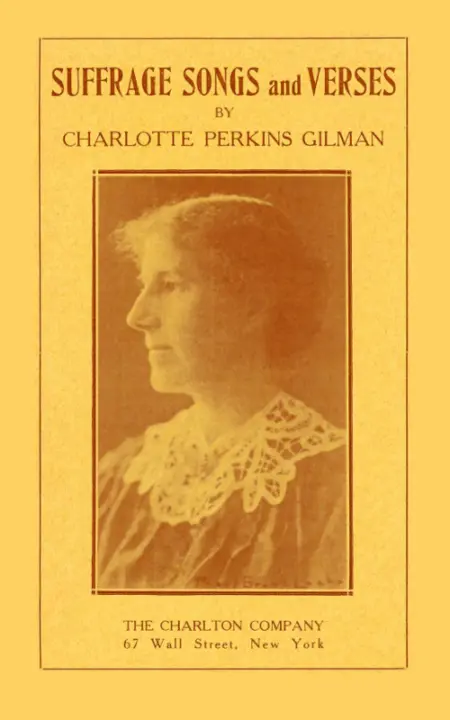
Charlotte Perkins Gilman
BEHIND THE BOOK
This eBook is for the use of anyone anywhere in the United States and most other parts of the world at no cost and with almost no restrictions whatsoever. You may copy it, give it away or re-use it under the terms of the Project Gutenberg License included with this eBook or online at www.gutenberg.org. If you are not located in the United States, you will have to check the laws of the country where you are located before using this eBook. Read the source licence.
The original source file, including credits and licence, is retained by this library. Request an original-format copy at no charge. Please include the book title and Project Gutenberg identifier #66864.
KEEP YOUR CURIOSITY GOING
Coulson Kernahan

Maurice Baring
Frances Wright
Cécile Tormay
Francis Greenleaf Allinson & Anne C. E. (Anne Crosby Emery) Allinson

Frederic Jesup Stimson