
The Diary of a Goose Girl
Kate Douglas Smith Wiggin
THE CLASSIC COLLECTION · 1911
"Mother Carey's Chickens" by Kate Douglas Smith Wiggin is a novel written during the late 19th century. The story centers around the Carey family, particularly the nurturing figure of Mother Carey, who embarks on a journey that leaves her children to manage their daily lives and responsibilities on their own. As they navigate their feelings of loss and the challenges of growing up, the siblings—Nancy, Gilbert, Kathleen, and their charming younger brother Peter—are affectionately referred to as “Mother Carey’s chickens,” symbolizing their bond and loyalty to one another in the absence of their mother. At the start of the novel, readers are introduced to the family dynamic as Mother Carey prepares for a trip to care for her ailing husband, Captain Carey. The children’s emotions are vividly portrayed as they deal with both the fear of separation and the weight of newfound responsibilities. As each child navigates their roles—Gilbert’s adventures, Nancy’s leadership, and Peter's innocent antics—the narrative elegantly sets the stage for the themes of love, sacrifice, and growth within a close-knit family facing adversity. This opening effectively establishes the warmth and depth of the characters, inviting readers to engage with their journey ahead.
Introduction adapted from the source catalogue; source summaries may be automatically generated.
Free to read · English · 72,943 words · No account needed
MAKE TIME FOR A GOOD BOOK
On by default. Untick to stop anonymous reading totals. Each page counts after 10 seconds in view. How this works.
Anonymous counting is on unless you have switched it off.
The Honorable Lemuel Hamilton sat in the private office of the American Consulate in Breslau, Germany, one warm day in July. The post had been brought in half an hour before, and he had two open letters on the desk in front of him. It was only ten o'clock of a bright morning, but he looked tired and worn. He was about fifty, with slightly grey hair and smoothly shaven face. He must have been merry at one time in his life, for there were many nice little laughing-wrinkles around his eyes, but somehow these seemed to have faded out, as if they had not been used for years, and the corners of his mouth turned down to increase the look of weariness and discontent.
A smile had crept over his face at his old friend Bill Harmon's spelling and penmanship, for a missive of that kind seldom came to the American Consulate. When the second letter postmarked Beulah first struck his eye, he could not imagine why he should have another correspondent in the quaintly named little village. He had read Nancy's letter twice now, and still he sat smoking and dreaming with an occasional glance at the girlish handwriting, or a twinkle of the eye at the re-reading of some particular passage. His own girls were not ready writers, and their mother generally sent their messages for them. Nancy and Kitty did not yet write nearly as well as they talked, but they contrived to express something of their own individuality in their communications, which were free and fluent, though childlike and crude.
"What a nice girl this Nancy Carey must be!" thought the American Consul. "This is such a jolly, confidential, gossipy, winsome little letter! Her first 'business letter' she calls it! Alas! when she learns how, a few years later, there will be no charming little confidences; no details of family income and expenditures; no tell-tale glimpses of 'mother' and 'Julia.' I believe I should know the whole family even without this photograph!--The lady sitting in the chair, to whom the photographer's snapshot has not done justice, is worthy of Nancy's praise,--and Bill Harmon's. What a pretty, piquant, curly head Nancy has! What a gay, vivacious, alert, spirited expression. The boy is handsome and gentlemanly, but he'll have to wake up, or Nancy will be the man of the family. The girl sitting down is less attractive. She's Uncle Allan's daughter, and" (consulting the letter) "Uncle Allan has nervous prostration and all of mother's money." Here Mr. Hamilton gave vent to audible laughter for the third time in a quarter of an hour. "Nancy doesn't realize with what perfection her somewhat imperfect English states the case," he thought. "I know Uncle Allan like a book, from his resemblance to certain other unfortunate gentlemen who have nervous prostration in combination with other people's money. Let's see! I know Nancy; friendly little Nancy, about fifteen or sixteen, I should judge; I know Uncle Allan's 'Julia,' who hems in photographs, but not otherwise; I know Gilbert, who is depressed at having to make his own way; the small boy, who 'is the nicest of us all'; Kitty, who beat all the others in getting to mother's shoulder; and the mother herself, who is beautiful, and doesn't say 'Bosh' to her children's ideas, and refuses to touch the insurance money, and wants Gilbert to show what 'father's son' can do without anybody's help, and who revels in the color and joy of a yellow wall paper at twenty cents a roll! Bless their simple hearts! They mustn't pay any rent while they are bringing water into the kitchen and making expensive improvements! And what Hamilton could be persuaded to live in the yellow house? To think of any one's wanting to settle down in that little deserted spot, Beulah, where the only sound that ever strikes one's ear is Osh Popham's laugh or the tinkle of a cow bell! Oh! if my own girls would write me letters like this, letting me see how their minds are growing, how they are taking hold of life, above all what is in their hearts! Well, little Miss Nancy Carey! honest, outspoken, confidential, clever little Nancy, who calls me her 'dearest Mr. Hamilton' and thanks me for letting her live in my yellow house, you shall never be disturbed, and if you and Gilbert ever earn enough money to buy it, it shall go to you cheap! There's not one of my brood that would live in it--except Tom, perhaps--for after spending three hundred dollars, they even got tired of dancing in the barn on Saturday nights; so if it can fall into the hands of some one who will bring a blessing on it, good old Granny Hamilton will rest peacefully in her grave!"
Your reading position is saved on this browser. Take it to another device with a library code. Reading pages adapt to text, rather than matching a printed edition.
Kate Douglas Smith Wiggin
Kate Douglas Smith Wiggin
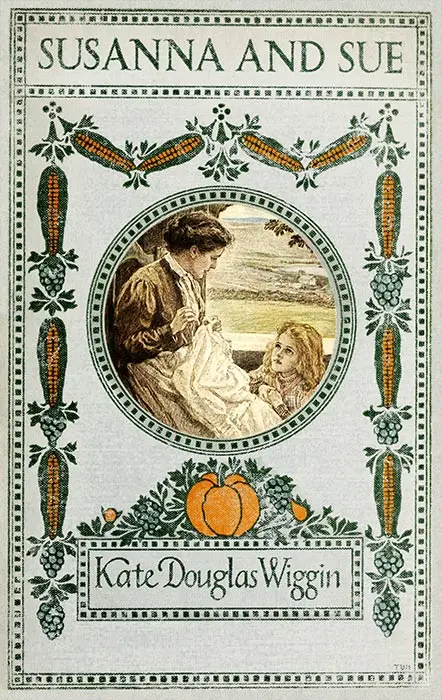
Kate Douglas Smith Wiggin
Kate Douglas Smith Wiggin & Nora Archibald Smith
BEHIND THE BOOK
This eBook is for the use of anyone anywhere in the United States and most other parts of the world at no cost and with almost no restrictions whatsoever. You may copy it, give it away or re-use it under the terms of the Project Gutenberg License included with this eBook or online at www.gutenberg.org. If you are not located in the United States, you will have to check the laws of the country where you are located before using this eBook. Read the source licence.
The original source file, including credits and licence, is retained by this library. Request an original-format copy at no charge. Please include the book title and Project Gutenberg identifier #10540.
KEEP YOUR CURIOSITY GOING
Coulson Kernahan

Maurice Baring
Frances Wright
Cécile Tormay

Frederic Jesup Stimson

W. H. P. (William Henry Pope) Jarvis