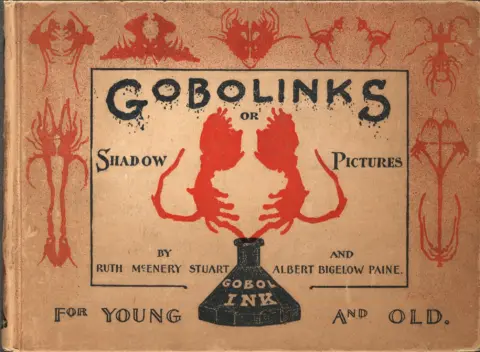
Gobolinks; or, Shadow Pictures for Young and Old
Ruth McEnery Stuart & Albert Bigelow Paine
THE CLASSIC COLLECTION · 1898
"Moriah's Mourning and Other Half-Hour Sketches" by Ruth McEnery Stuart is a collection of short stories written in the late 19th century. The sketches revolve around life in the plantation communities, focusing on the humorous and poignant experiences of African American characters, particularly reflecting on their customs, relationships, and societal norms. The opening story introduces Moriah, a widow who, despite her recent loss, becomes the topic of lively gossip when she announces her intention to remarry just a month after her husband's death. At the start of the collection, the stage is set through Moriah's character, who embodies a strong sense of individuality and resilience. The narrative follows her decision to marry Pete, a widower, emphasizing the community's reactions to her quick transition from mourning to new beginnings. Moriah’s pragmatic and humorous approach to grief reveals the nuanced dynamics of love, loss, and social expectations among the plantation folk. The blend of humor and social commentary in these opening pages suggests that the collection will explore deeper themes of mortality, relationship dynamics, and cultural practices in a light-hearted yet insightful manner.
Introduction adapted from the source catalogue; source summaries may be automatically generated.
Free to read · English · 37,467 words · No account needed
MAKE TIME FOR A GOOD BOOK
On by default. Untick to stop anonymous reading totals. Each page counts after 10 seconds in view. How this works.
Anonymous counting is on unless you have switched it off.
"Yes, and here I am. That's where the shoe pinches. Ha! and by way of literal illustration, speaking of the mal-adjustments of life, witness this boot."
The speaker languidly extended his right foot.
"The fellow who first wore it had bunions, blast him, and I come into his bunion-bulge with a short great toe. As a result, here I am in New York in December, instead of absorbing sunshine and the odor of violets in Jackson Square in New Orleans, with picturesqueness and color all about me. No man could start South with such a boot as that.
"I do most cordially hope that the beastly vulgarian who shaped it has gone, as my friend Mantalini would express it, 'to the demnition bow-wows.' You see the beauty of the Bellamy business is that all callings are equally worthy. As a social factor I should have made a record, and would probably have gone into history as a wit."
"Condemn the history! You'd have gone into life, Humphrey. That's enough. You'd have gone into the home--into your own bed at night--into dinner in a dress-coat--into society, your element--into posterity in your brilliant progeny, paterfamilias--"
"Enough, Colonel. There are some things--even from an old comrade like
yourself--"
"Beg pardon, Humphrey. No offence meant, I assure you.
"It's only when life's fires are burning pretty low that we may venture to stir the coals and knock off the ashes a little.
"For myself, I don't mind confessing, Humphrey, that there have been women--Don't start; there isn't even a Yule-log smouldering on my heart's hearth to-day. I can stir the smoking embers safely. I say there have been women--a woman I'll say, even--a nursemaid, whom I have seen in this park--a perfect Juno. She was well-born I'd swear, by her delicate ears, her instep, her curved nostrils--"
"Did you ever approach your goddess near enough to catch her curved
articulation, Colonel? Or doubtless it flowed in angles, Anglo-Saxon
pura."
"You are flippant, Humphrey. I say if this woman had had educational advantages and--and if my affairs had looked up a little, well--there's no telling! And yet, to tell you this to-day does not even warm my heart."
"Nor rattle a skeleton within its closet?"
"Not a rattle about me, sir, excepting the rattle of these beastly newspapers on my chest. Have a smoke, Humphrey?"
The Colonel presented a handful of half-burned cigar-stubs.
"No choice. They're all twenty-five-centers, assorted from a Waldorf
lot."
"Thanks."
Humphrey took three. The Colonel, reserving one for his own use, dropped the rest into his outer pocket.
And now eleven men passed, smoking, eleven unapproachables, before one
dropped a burning stump.
Your reading position is saved on this browser. Take it to another device with a library code. Reading pages adapt to text, rather than matching a printed edition.
Ruth McEnery Stuart & Albert Bigelow Paine

Ruth McEnery Stuart
Ruth McEnery Stuart
Ruth McEnery Stuart
BEHIND THE BOOK
This eBook is for the use of anyone anywhere in the United States and most other parts of the world at no cost and with almost no restrictions whatsoever. You may copy it, give it away or re-use it under the terms of the Project Gutenberg License included with this eBook or online at www.gutenberg.org. If you are not located in the United States, you will have to check the laws of the country where you are located before using this eBook. Read the source licence.
The original source file, including credits and licence, is retained by this library. Request an original-format copy at no charge. Please include the book title and Project Gutenberg identifier #20438.
KEEP YOUR CURIOSITY GOING
Coulson Kernahan

Maurice Baring
Frances Wright
Cécile Tormay

Frederic Jesup Stimson

W. H. P. (William Henry Pope) Jarvis