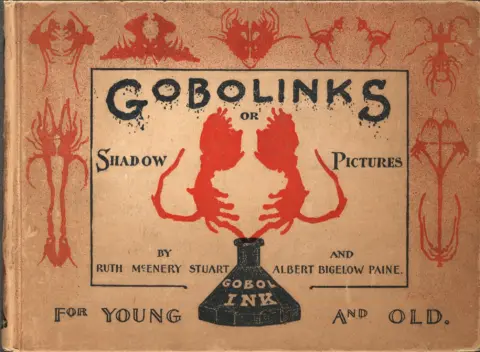
Gobolinks; or, Shadow Pictures for Young and Old
Ruth McEnery Stuart & Albert Bigelow Paine
THE CLASSIC COLLECTION · 1898
"Moriah's Mourning and Other Half-Hour Sketches" by Ruth McEnery Stuart is a collection of short stories written in the late 19th century. The sketches revolve around life in the plantation communities, focusing on the humorous and poignant experiences of African American characters, particularly reflecting on their customs, relationships, and societal norms. The opening story introduces Moriah, a widow who, despite her recent loss, becomes the topic of lively gossip when she announces her intention to remarry just a month after her husband's death. At the start of the collection, the stage is set through Moriah's character, who embodies a strong sense of individuality and resilience. The narrative follows her decision to marry Pete, a widower, emphasizing the community's reactions to her quick transition from mourning to new beginnings. Moriah’s pragmatic and humorous approach to grief reveals the nuanced dynamics of love, loss, and social expectations among the plantation folk. The blend of humor and social commentary in these opening pages suggests that the collection will explore deeper themes of mortality, relationship dynamics, and cultural practices in a light-hearted yet insightful manner.
Introduction adapted from the source catalogue; source summaries may be automatically generated.
Free to read · English · 37,467 words · No account needed
MAKE TIME FOR A GOOD BOOK
On by default. Untick to stop anonymous reading totals. Each page counts after 10 seconds in view. How this works.
Anonymous counting is on unless you have switched it off.
The observer who passed from casual contemplation of their unkempt locks to a closer scrutiny perceived, even in passing them, that their shoes were not mates, while the distinct bagging at the knees of their trousers was somewhat too high in one case, and too low in the other, to encompass the knees within which were slowly, but surely, gaining tardy secondary recognitions at points more or less remote from the first impressions.
One pair was a trifle short in the legs, while the other--they of the too-low knee-marks--were turned up an inch or two above the shoes: a style which in itself may seem to savor of affectation, and yet, taken with the wearer on this occasion, dispelled suspicion.
It seemed rather a cold day to sit on a bench in Madison Square, and yet our two gentlemen, after making a casual tour of the walks, sat easily down; and, indeed, though passers hurried by in heavy top-coats and furs, it seemed quite natural that these gentlemen should be seated.
One or two others, differing more or less as individuals from our friends, but evidently members of the same social caste, broadly speaking, were also sitting in the square, apparently as oblivious to the cold as they.
"The hardest thing to bear," the taller one, he of the short trousers, was saying, as he dropped his shapely wrist over the iron arm of the bench, "the hardest thing for the individual, under the present system, is the arbitrariness of the assignments of life. The chief advantage of the Bellamy scheme seems to me to be in its harmonious adjustments, so to speak. Every man does professionally what he can best do. If you and I had been reared under that system, now--"
"What, think you, would Bellamy the prophet have made of you, Humphrey?"
"Well, sir, his government would have taken pains to discover and develop my tendency, my drift--"
"Ah, I see. I should judge that nature had endowed you with a fine bump of drift, Humphrey. But has it not been rather well cared for? The trouble with drifting is, so say the preachers, that it necessarily carries one downstream."
"To the sea, the limitless, the boundless, the ultimatum--however, this is irrelevant and frivolous. I am serious--and modest, I assure you--when I speak of my gifts. I have, as you know, a pronounced gift at repartee. Who knows what this might have become under proper development? But it has been systematically snubbed, misunderstood, dubbed impertinence, forsooth."
"If I remember aright, it was your gift of repartee that--wasn't it something of that sort which severed your connection with college?"
Your reading position is saved on this browser. Take it to another device with a library code. Reading pages adapt to text, rather than matching a printed edition.
Ruth McEnery Stuart & Albert Bigelow Paine

Ruth McEnery Stuart
Ruth McEnery Stuart
Ruth McEnery Stuart
BEHIND THE BOOK
This eBook is for the use of anyone anywhere in the United States and most other parts of the world at no cost and with almost no restrictions whatsoever. You may copy it, give it away or re-use it under the terms of the Project Gutenberg License included with this eBook or online at www.gutenberg.org. If you are not located in the United States, you will have to check the laws of the country where you are located before using this eBook. Read the source licence.
The original source file, including credits and licence, is retained by this library. Request an original-format copy at no charge. Please include the book title and Project Gutenberg identifier #20438.
KEEP YOUR CURIOSITY GOING
Coulson Kernahan

Maurice Baring
Frances Wright
Cécile Tormay

Frederic Jesup Stimson

W. H. P. (William Henry Pope) Jarvis