THE CLASSIC COLLECTION✦Life and Work in Benares and Kumaon, 1839-1877CLASSIC FREE BOOKS
Life and Work in Benares and Kumaon, 1839-1877
James Kennedy
THE CLASSIC COLLECTION · 1852
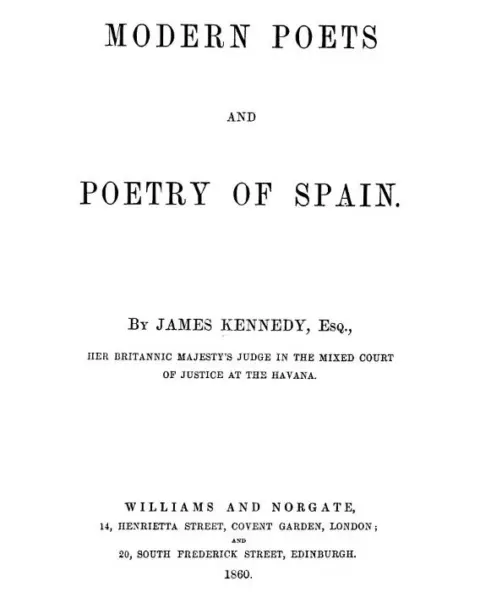
"Modern Poets and Poetry of Spain" by James Kennedy et al. is a historical account written in the mid-19th century. This work aims to provide insights into Spanish poetry, focusing particularly on modern poets, their contributions, and their cultural significance. It seeks to bridge the understanding between Spanish literary art and English readers through both critical analysis and translated examples of notable works. The opening of the book sets the stage for Kennedy's exploration of Spanish poetry by referencing the influence of historical events, such as the Moorish domination, and their legacy on the literary landscape. Kennedy reflects on the shortcomings of previous travelers and authors in adequately portraying the vibrant mental culture of Spain. He emphasizes the necessity of understanding a nation's literature as a window into its civilization. The introduction establishes the author’s intent to enrich English literary knowledge by showcasing contemporary Spanish poets through their biographies and selected translations, ultimately demonstrating the unique quality and historical context that Spanish poetry has to offer.
Introduction adapted from the source catalogue; source summaries may be automatically generated.
Free to read · English · 92,928 words · No account needed
MAKE TIME FOR A GOOD BOOK
On by default. Untick to stop anonymous reading totals. Each page counts after 10 seconds in view. How this works.
Anonymous counting is on unless you have switched it off.
For readers unacquainted with the Spanish language, it may be perhaps most advisable, in this place, to affix a few short instructions for the proper pronunciation of such names and words as are to be found in the following pages.
1. The vowels in Spanish have each invariably their peculiar sound; not as in English, where each has two or more sounds, making them in fact so distinct as strictly requiring to be designated by different characters, or after the manner of the Hebrew points. Thus a has always the broad open sound found in the English words arm, arrack.
e, long or short, as in the English words ere, ever.
i and y, as in machine, syntax.
o, long or short, as in ore, host, hostage.
u has uniformly the sound of oo in food. The Celtic sound of this vowel, preserved in France and Portugal, is unknown in Spain, and also in the Basque or Biscayan language.
2. Of the consonants, b has a softer sound than in English, and approaches to v, which again is made to sound like b. Thus the city of the Havana is, in Spanish spelling, La Habana, and the river Bidasoa is written Vidasoa.
c, before a, o, u, is to be pronounced hard, as in English; before e or i, it is to be sounded like th in thin, though in the provinces this pronunciation is giving way to the French and English mode of sounding the letter. Thus the name of the great Roman orator is pronounced Thithero. ch has always the soft sound it usually has in English, as in chat, check, chin, choke, chum.
d, at the end of a word, is generally pronounced like th: thus Madrid is Madrith; ciudad, a city, is pronounced thiudath; otherwise, both d and t are spoken as in English, or slightly more dentally.
f has the same sound as in English.
g is an aspirate, like our h, more or less guttural, according to the word. The soft sound of this letter, as in gem, left by the Celts in Italy and Portugal, is unknown in Spain, as is also the soft sound of the letter j.
h may be said to be invariably a silent letter, and seems only
used to prevent two vowels running into each other, so as to form a
diphthong.
j is a very harsh guttural, like the Hebrew Cheth. Thus Juan (John) is to be pronounced strongly, Hwan; Josè (Joseph) also strongly, Hosè.
The letters k, l, m, n, p, are the same as in English.
q or qu has the sound of our k: thus que (that) is the same as
the Italian che.
Your reading position is saved on this browser. Take it to another device with a library code. Reading pages adapt to text, rather than matching a printed edition.
BEHIND THE BOOK
This eBook is for the use of anyone anywhere in the United States and most other parts of the world at no cost and with almost no restrictions whatsoever. You may copy it, give it away or re-use it under the terms of the Project Gutenberg License included with this eBook or online at www.gutenberg.org. If you are not located in the United States, you will have to check the laws of the country where you are located before using this eBook. Read the source licence.
The original source file, including credits and licence, is retained by this library. Request an original-format copy at no charge. Please include the book title and Project Gutenberg identifier #53671.
KEEP YOUR CURIOSITY GOING
Cécile Tormay

Moritz Busch
John L. Ransom
Frances Wright
Cécile Tormay

Mabel Potter Daggett