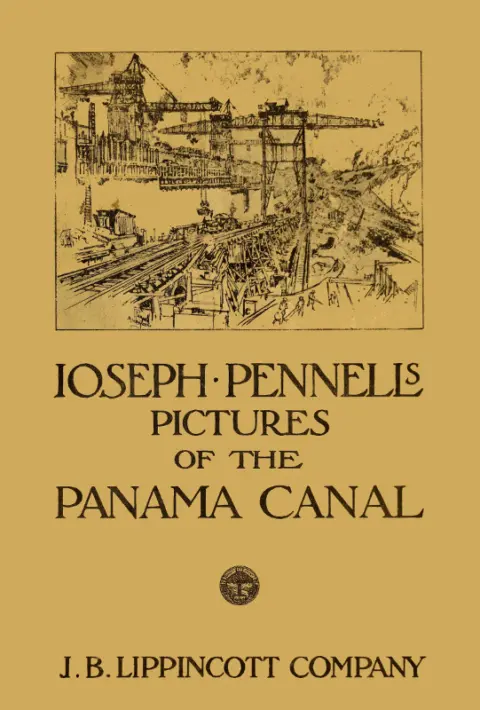
Joseph Pennell’s Pictures of the Wonder of Work Reproductions of a Series of Drawings, Etchings, and Lithographs, Made by Him about the World, 1881-1915, with Impressions and Notes by the Artist
Joseph Pennell
THE CLASSIC COLLECTION · 1895
"Modern Illustration" by Joseph Pennell is an analytical account of the art of illustration written in the late 19th century. The work explores the development of illustration techniques from historical and contemporary perspectives, emphasizing the evolution of artistic styles and methods across various countries, including England, France, Germany, and America. This publication serves as both a critique and a celebration of illustration, considering both the artistic merit and the practical challenges faced by illustrators. The opening of the book starts with an acknowledgment of the editor's request for a discussion on contemporary illustration, and the author’s reflections on the contributions of prominent artists and engravers to the field. Pennell outlines the transformation of illustration as an art form, tracing its roots back to early illustrations and discussing the significant impact of notable artists such as Goya and Bewick. He credits modern illustration with gaining popularity through better reproduction techniques and highlights the importance of collaboration between artists and engravers. The premise sets the stage for a deeper exploration of the significance of illustration in society and its journey through different artistic movements.
Introduction adapted from the source catalogue; source summaries may be automatically generated.
Free to read · English · 33,079 words · No account needed
MAKE TIME FOR A GOOD BOOK
On by default. Untick to stop anonymous reading totals. Each page counts after 10 seconds in view. How this works.
Anonymous counting is on unless you have switched it off.
I have tried to show the methods of modern illustration, and to give a sketch of its present conditions. It would be absurd to prophesy its future, though I believe it will have a very brilliant one. Much of the work that is being turned out to-day is beneath contempt; much of it is done by young men who are absolutely uneducated, and an illustrator requires education as much as an author; much of it is done by people who are too careless, or too stupid, to read or to understand the MSS. which they illustrate. Thus, in looking through late numbers of a magazine, I learn that all the policemen in New York wear patent leather shoes; while from another I find that when people are very poor in France, they rock their babies in log cabin cradles, cook their meals on American stoves and sit upon Chippendale chairs.
But it is a pleasure to turn from budding geniuses of this sort and photographic hacks; from the gentlemen who copy the imperfections of the woodcut of the Middle Ages; from the people who enlarge the borders of their magazines with decorations that neither belong to our own time, nor are good examples of any other; from those who have succeeded in making a certain portion of the world believe that clumsy eccentricity is a cloak for all the sins in the artistic calendar, to illustrators who are calmly and quietly pursuing their profession, and producing work which may even drag other portions of the magazine or book, to which they contribute, to an unmerited immortality.
I do not pretend to foretell what the ultimate form of the book of the future, or of the magazine either, may be. But I do believe that illustration is as important as any other branch of art, will live as long as there is any love for art, long after the claims of the working classes have been forgotten, and the statues of the statesmen, who are the newspaper heroes of to-day, have crumbled into dust, unless preserved because a sculptor of distinction produced them.
Illustration is an important, vital, living branch of the fine arts, and it will flourish for ever.
Abbey, E. A., "Herrick," 123;
"Old Songs" and "Quiet Life," 106, 124;
"She Stoops to Conquer," 124;
"Shakespeare," 124.
"Abbotsford" Waverley Novels, 26.
Ache, Caran d', 66;
"Courses dans l'Antiquité," "Carnet de Chéques," "Albums,"
etc., 67, 79.
Adams, J. A., 29.
Albrecht, E., 78.
Alexander, Miss, xvii.
Allers, C. W., 78.
Allingham, W., "The Music Master," 88.
Ally Sloper's Half Holiday, 103.
American illustration, xv, 30-32, 113, 130.
American Tract Society, 29.
Amicis, E. de, 70.
Andersen's "Fairy Tales," 108.
Andrew, 25.
Angelico, Fra, 3.
Angerer and Göschl, 72.
Anning Bell, R., 105.
Aquatint, 38.
"Arabian Nights" (Lane), 24;
(Dalziel), 91, 101.
Architectural drawing, 111.
Your reading position is saved on this browser. Take it to another device with a library code. Reading pages adapt to text, rather than matching a printed edition.
Joseph Pennell
Joseph Pennell & Elizabeth Robins Pennell

Joseph Pennell

Joseph Pennell
BEHIND THE BOOK
This eBook is for the use of anyone anywhere in the United States and most other parts of the world at no cost and with almost no restrictions whatsoever. You may copy it, give it away or re-use it under the terms of the Project Gutenberg License included with this eBook or online at www.gutenberg.org. If you are not located in the United States, you will have to check the laws of the country where you are located before using this eBook. Read the source licence.
The original source file, including credits and licence, is retained by this library. Request an original-format copy at no charge. Please include the book title and Project Gutenberg identifier #40322.
KEEP YOUR CURIOSITY GOING

Charles G. (Charles Griffith) Ross
Hannah Webster Foster

Emily Lawless
Edwin Hamlin Carr

Charles De Lano Hine
Andrew Ure