THE CLASSIC COLLECTION✦An outlaw’s diary: the CommuneCLASSIC FREE BOOKS
An outlaw’s diary: the Commune
Cécile Tormay
THE CLASSIC COLLECTION · 1909
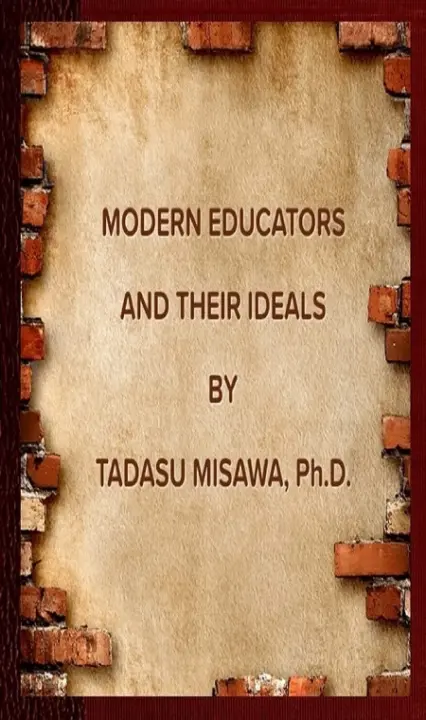
"Modern educators and their ideals" by Tadasu Misawa is a scholarly survey of educational philosophy written in the early 20th century. It outlines the ideals and methods of major reformers and philosophers to guide students of pedagogy, teachers, and interested parents, presenting their key ideas through concise exposition and curated excerpts.
The opening of the book sets its purpose: to summarize influential modern educators sympathetically, avoid heavy criticism, and provide accessible bibliographies. The introduction traces the lineage of Western educational ideals from Greece and Rome through Christianity and the Middle Ages to the Renaissance and Reformation, highlighting Luther’s democratic push for universal, practical schooling and Bacon’s call for empiricism. The first chapter on Comenius blends Reformation piety with realistic method, advocating universal, early, sense-based, and systematically graded schooling centered on the vernacular and practical aims. The next chapter contrasts Locke’s pragmatic, gentlemanly education: health and habit first, character before book learning, gentle discipline grounded in esteem rather than the rod, rich but practical studies, and a preference for a good tutor and home over crowded schools. The beginning of the Rousseau chapter pivots to a “return to Nature,” insisting that children be allowed to be children, that instruction be delayed until readiness, that learning come from things rather than words, and that education follow distinct developmental stages under the joint influences of nature, men, and circumstances.
Introduction adapted from the source catalogue; source summaries may be automatically generated.
Free to read · English · 72,850 words · No account needed
MAKE TIME FOR A GOOD BOOK
On by default. Untick to stop anonymous reading totals. Each page counts after 10 seconds in view. How this works.
Anonymous counting is on unless you have switched it off.
On the part of the academic teacher the university is not to be looked upon as the place for merely communicating book contents in a slightly modified form; the university stands for the advancement of science and the scientific spirit; not mere repetition nor a little trimming up of the old and known, but the bringing forth of the new, and the extension of the frontier of knowledge. The academic teacher must always be an investigator and producer. Fichte advises that no one should stay in that calling “in which the fountain of youth does not still flow on with an unimpaired vigor.” “Let him,” he says, “faithfully intrust himself to its current so long as it will bear him forward; when it leaves him, then let him be content to retire from this ever-shifting scene of onward movement--let him separate the dead from the living” (5: p. 307). Readiness of communication, on the one hand, and plasticity to foreign modes of thought and new ideas, on the other, is required of him.
Fichte’s schemes both for popular education and the university were too Utopian to be immediately adopted. Actual reforms were carried out by those of more practical talents, and according to more practical conceptions. But the world is now coming to realize the worth of the vision embodied in his “economic” or “citizenship” education; and as to his high academic ideal, it has gradually won the victory in the most advanced universities of to-day.
1. +Barnard, Henry.+ Pestalozzi and His Educational System. Bardeen, Syracuse, N. Y., 1906. 751 pages.
2. +Duproix, Paul.+ Kant et Fichte et le Problème de l’Education. Second edition. Alcan, Paris, 1897. 260 pages.
3. +Fichte, Johann Gottlieb.+ Reden an die deutsche Nation.
Sämtliche Werke. 8 vols. Veit, Berlin, 1845-1846. Vol. VII, pp.
259-499.
4. ---- Aphorismen über Erziehung aus dem Jahre, 1804. Sämtliche Werke. Vol. VIII, pp. 353-360.
5. ---- Vocation of the Scholar. On the Nature of the Scholar. Popular Works of J. G. Fichte. 2 vols. Trübner, London, 1889. Vol. I, pp. 149-317.
6. ---- Deducirter Plan zu Berlin zu errichtenden höheren Lehranstalt. Sämtliche Werke. Vol. VIII, pp. 97-219.
7. +Gutmann, S. Hirsch.+ J. G. Fichte’s soziale Pädagogik.
Scheitlin, Bern, 1907. 100 pages.
8. +Heman, Friedrich.+ Geschichte der neueren Pädagogik. Zickfeldt, Osterwieck, 1904. 436 pages.
9. +Keferstein, Horst.+ J. G. Fichte’s pädagogische Schriften und Ideen. Richler, Wien, 1883. 238 pages.
10. +Rein, Georg Wilhelm+, editor. Encyklopädisches Handbuch der Pädagogik. 8 vols. Beyer, Langensalza, 1895-1906. Vol. II.
11. +Scherer, Heinrich.+ Die Pädagogik in ihrer Entwicklung im Zusammenhange mit dem Kultur- und Geistesleben und ihrem Einfluss auf die Gestaltung des Erziehungs- und Bildungswesens. Vol. II. Die Pädagogik als Wissenschaft von Pestalozzi bis zu Gegenwart. 3 parts. Brandstetter, Leipzig, 1897-1908.
Your reading position is saved on this browser. Take it to another device with a library code. Reading pages adapt to text, rather than matching a printed edition.
BEHIND THE BOOK
This eBook is for the use of anyone anywhere in the United States and most other parts of the world at no cost and with almost no restrictions whatsoever. You may copy it, give it away or re-use it under the terms of the Project Gutenberg License included with this eBook or online at www.gutenberg.org. If you are not located in the United States, you will have to check the laws of the country where you are located before using this eBook. Read the source licence.
The original source file, including credits and licence, is retained by this library. Request an original-format copy at no charge. Please include the book title and Project Gutenberg identifier #77974.
KEEP YOUR CURIOSITY GOING
Cécile Tormay

Moritz Busch
John L. Ransom
Frances Wright
Cécile Tormay

Mabel Potter Daggett