THE CLASSIC COLLECTION✦An outlaw’s diary: the CommuneCLASSIC FREE BOOKS
An outlaw’s diary: the Commune
Cécile Tormay
THE CLASSIC COLLECTION · 1909
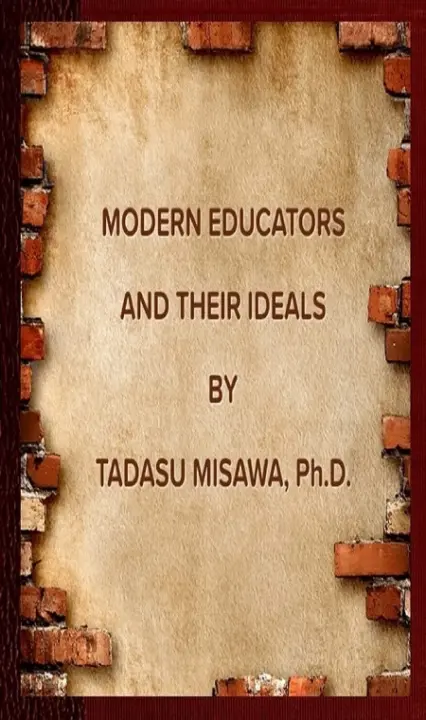
"Modern educators and their ideals" by Tadasu Misawa is a scholarly survey of educational philosophy written in the early 20th century. It outlines the ideals and methods of major reformers and philosophers to guide students of pedagogy, teachers, and interested parents, presenting their key ideas through concise exposition and curated excerpts.
The opening of the book sets its purpose: to summarize influential modern educators sympathetically, avoid heavy criticism, and provide accessible bibliographies. The introduction traces the lineage of Western educational ideals from Greece and Rome through Christianity and the Middle Ages to the Renaissance and Reformation, highlighting Luther’s democratic push for universal, practical schooling and Bacon’s call for empiricism. The first chapter on Comenius blends Reformation piety with realistic method, advocating universal, early, sense-based, and systematically graded schooling centered on the vernacular and practical aims. The next chapter contrasts Locke’s pragmatic, gentlemanly education: health and habit first, character before book learning, gentle discipline grounded in esteem rather than the rod, rich but practical studies, and a preference for a good tutor and home over crowded schools. The beginning of the Rousseau chapter pivots to a “return to Nature,” insisting that children be allowed to be children, that instruction be delayed until readiness, that learning come from things rather than words, and that education follow distinct developmental stages under the joint influences of nature, men, and circumstances.
Introduction adapted from the source catalogue; source summaries may be automatically generated.
Free to read · English · 72,850 words · No account needed
MAKE TIME FOR A GOOD BOOK
On by default. Untick to stop anonymous reading totals. Each page counts after 10 seconds in view. How this works.
Anonymous counting is on unless you have switched it off.
When the second greatest educational work in the seventeenth century appeared in 1693, the world was only a generation and a half older than when it saw the “Great Didactic.” While we find in Comenius a strange mixture of mediæval and modern thinking, Locke’s “Some Thoughts concerning Education” reflects entirely modern conceptions and tendencies. But the differences between the two works are not wholly due to the difference of the times; they are due more to that of the men themselves and their nationalities.
Though born a Slav, Comenius represents, in his personality and pedagogy, the idealistic and theorizing genius of the German nation. Locke, on the contrary, is a typical Englishman, and perfectly embodies the practical genius of that people. Compare the titles of the two books referred to above. How elaborate and ornate is the one and how homely the other! One might compare the former to a great piece of architecture, built up stone by stone with exactness of sequence and plan. Every detail is manifestly studied and follows a scheme previously laid out. The latter, on the contrary, is like a painting, or a work of artisanship, if you please. There is the design, unity and harmony, but these lie in the artist’s experience or mental make-up, and develop themselves as he moves his hand. Comenius’s pedagogy starts with the highest ideal of humanity, and then proceeds to consider how each and all can be made to conform to it. His plans and practical recommendations are also, in general, more of deductions from his basal hypothesis or philosophy than inductions from the considerations of the actual conditions and problems. With Locke the procedure is very different: a particular boy concerning whose education he was consulted is the starting-point. This boy has to grow up in a particular age, environment, and social class, and must be fitted to all these actual conditions. Not the ultimate end of the race, but the particular destiny of a real boy, his mentality, the best educative forces conducing to the possibly perfect fulfillment of his destiny, are to be the chief considerations. Comenius was a practical as well as theoretical reformer in education, but he was, above all, a scholarly priest, probably the best type that his age could produce. Locke was a great original thinker, the father of English psychology. But he was, essentially, and in its highest sense, a man of the world. In spite of his physical weakness, which hindered him from an active participation in the social and political affairs of his country, he was always concerned and identified with them. Thus the Christian citizenship at which he aimed was not a gazing from the stepladder of this earthly life toward the distant vision of heavenly perfection, but a vigorous, efficient, working and living with others as a child of this world. There is no bold brilliancy in his educational thoughts, but they are full of living truths which come only from the actual broad experience of life, and so can be applied to real life. There is in them no soaring transcendentalism. Yet if we intelligently follow his leadership, we shall find that it does not lack a glow of idealism which can illumine our earthly path. It is a sound philosophy of a sound personality who has seen the wide living world with his own eyes, and expressed his views with the scrupulous conscientiousness and the sincerity of conviction--a perfect product of great common sense. Leibniz, the great German philosopher, who recognized Locke’s Essay on “Human Understanding,” as “one of the most beautiful and most esteemed work” of his time, was disposed to rate his “Thoughts on Education” still higher. Even to-day, after we have become familiar with a host of great and modern thinkers, he finds such an admirer as Professor Laurie, of Edinburgh, who thinks “that no educational writer surpasses him.” Rousseau’s indebtedness to him is a well-known fact, and through Rousseau his influence extends to the whole continental development of educational thought down to the present day. As to the wide and deep effect which his thought directly exerted upon England there can be no question. Oscar Browning, of Cambridge, believes that Locke’s ideas “determine the character of our most characteristic educational institution, the English public school” (2: p. 118). And yet Locke had little interest in the public school of his day. England produced in him her ideal type of a gentleman, and he, as the incarnation of her genius, has formed the gentlemen of England.
Your reading position is saved on this browser. Take it to another device with a library code. Reading pages adapt to text, rather than matching a printed edition.
BEHIND THE BOOK
This eBook is for the use of anyone anywhere in the United States and most other parts of the world at no cost and with almost no restrictions whatsoever. You may copy it, give it away or re-use it under the terms of the Project Gutenberg License included with this eBook or online at www.gutenberg.org. If you are not located in the United States, you will have to check the laws of the country where you are located before using this eBook. Read the source licence.
The original source file, including credits and licence, is retained by this library. Request an original-format copy at no charge. Please include the book title and Project Gutenberg identifier #77974.
KEEP YOUR CURIOSITY GOING
Cécile Tormay

Moritz Busch
John L. Ransom
Frances Wright
Cécile Tormay

Mabel Potter Daggett