THE CLASSIC COLLECTION✦An outlaw’s diary: the CommuneCLASSIC FREE BOOKS
An outlaw’s diary: the Commune
Cécile Tormay
THE CLASSIC COLLECTION · 1909
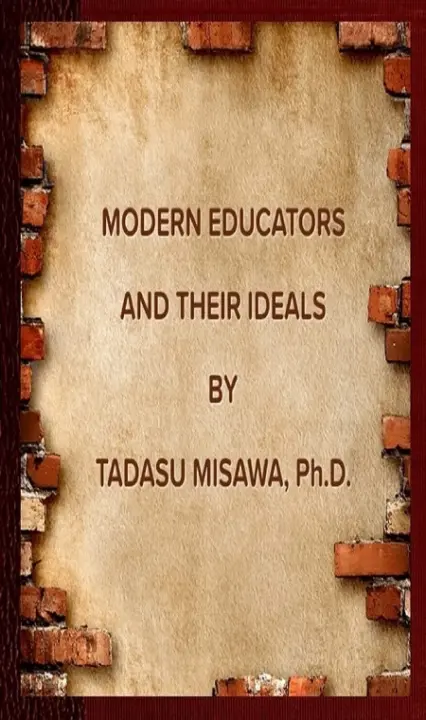
"Modern educators and their ideals" by Tadasu Misawa is a scholarly survey of educational philosophy written in the early 20th century. It outlines the ideals and methods of major reformers and philosophers to guide students of pedagogy, teachers, and interested parents, presenting their key ideas through concise exposition and curated excerpts.
The opening of the book sets its purpose: to summarize influential modern educators sympathetically, avoid heavy criticism, and provide accessible bibliographies. The introduction traces the lineage of Western educational ideals from Greece and Rome through Christianity and the Middle Ages to the Renaissance and Reformation, highlighting Luther’s democratic push for universal, practical schooling and Bacon’s call for empiricism. The first chapter on Comenius blends Reformation piety with realistic method, advocating universal, early, sense-based, and systematically graded schooling centered on the vernacular and practical aims. The next chapter contrasts Locke’s pragmatic, gentlemanly education: health and habit first, character before book learning, gentle discipline grounded in esteem rather than the rod, rich but practical studies, and a preference for a good tutor and home over crowded schools. The beginning of the Rousseau chapter pivots to a “return to Nature,” insisting that children be allowed to be children, that instruction be delayed until readiness, that learning come from things rather than words, and that education follow distinct developmental stages under the joint influences of nature, men, and circumstances.
Introduction adapted from the source catalogue; source summaries may be automatically generated.
Free to read · English · 72,850 words · No account needed
MAKE TIME FOR A GOOD BOOK
On by default. Untick to stop anonymous reading totals. Each page counts after 10 seconds in view. How this works.
Anonymous counting is on unless you have switched it off.
Fifteen years after the death of Luther the world received into its lap another gifted child, this time to work out reformation in the field of science. The Reformation together with Humanism restored the ideal of the total man. But their intellectual outlook was still chiefly limited to the attainments of the ancient world. Therefore, they soon degenerated into a new scholasticism on the one hand, and a linguistic formalism on the other. Then came Francis Bacon to preach the gospel of knowledge, of true knowledge. For this “father of English philosophers” the aim of knowledge “is no mere felicity of speculation, but the real business and fortune of the human race.” Indeed, “men have entered into a desire of learning and knowledge sometimes from a natural curiosity and inquisitive appetite; sometimes to entertain their minds with variety and delight; sometimes for ornament and reputation, and sometimes to enable them to victory of wit and contradiction, and most times for lucre and profession” (2: p. 42). This abuse of learning was the greatest evil of the mediæval and Renaissance scholarship. The vocation of scholars is “to give a true account of their gift of reason, to the benefit and use of men” (2: p. 42). Knowledge must generate, bear fruit; her function is to satisfy the needs of human life, to increase men’s control over Nature, and to enrich and ennoble his enjoyments. This can be attained not by a mere mastery of vain words and letters, or of tricks of the syllogism, but only by humble, diligent, and methodical inquiries into the great “volume of God’s works.” “Man is but the servant and interpreter of nature: what he does and what he knows is only what he has observed of Nature’s order in fact and thought; beyond this he knows nothing and can do nothing. For the chain of causes cannot by any force be loosed or broken, nor can nature be commanded except by being obeyed. And so those twin objects, human knowledge and human power, do really meet in one; and it is from ignorance of causes that operation fails” (13: p. 48). The first-hand experience of living Nature and induction from it alone provide us real knowledge and truth, and nothing else. “It cannot be that axioms established by argumentation should avail for the discovery of new works; since the subtlety of nature is greater many times over than the subtlety of argument. But axioms duly and orderly formed from particulars easily discover the way to new particulars, and thus render science active” (13: pp. 46-47). According to this standard of true knowledge, “all the received systems are but so many stage plays, representing worlds of their own creation after an unreal and scenic fashion” (13: pp. 56-57). Our age is far older than that of the ancient people. Why should we bear the bondage of immature, inexperienced minds? “The wisdom which we have derived principally from the Greeks is but like the boyhood of knowledge, and has the characteristic property of boys: it can talk, but it cannot generate; for it is fruitful of controversies, but barren of works” (13: p. 54). Turn your eyes from the antiquated record of the past to the infinite reality of living nature. The key to open its secret is in your hands. The sphere of conquest here is vast and inexhaustible; its pleasure is noble and insatiable. Thus rings out the scientific Sermon on the Mount. The real goal is shown, a broad new highway opened; science being vitalized by reunion with the infinite reality of living nature and the ever-progressive life of humanity marches to her never-ending conquest. Knowledge rescued from the depths of ignominy and impotence is raised to its heavenly seat; the ideal of omniscience, coupled with omnipotence, has ever since become the aspiration and motive power of the modern world. Although Bacon did not concern himself with the direct problems of education, a conception such as the above could not but introduce a new tendency into it. If we may call Luther the father of Protestant education, Bacon should be called the father of scientific education, both of which, when broadly interpreted, characterize the modern period of the Western education.
Your reading position is saved on this browser. Take it to another device with a library code. Reading pages adapt to text, rather than matching a printed edition.
BEHIND THE BOOK
This eBook is for the use of anyone anywhere in the United States and most other parts of the world at no cost and with almost no restrictions whatsoever. You may copy it, give it away or re-use it under the terms of the Project Gutenberg License included with this eBook or online at www.gutenberg.org. If you are not located in the United States, you will have to check the laws of the country where you are located before using this eBook. Read the source licence.
The original source file, including credits and licence, is retained by this library. Request an original-format copy at no charge. Please include the book title and Project Gutenberg identifier #77974.
KEEP YOUR CURIOSITY GOING
Cécile Tormay

Moritz Busch
John L. Ransom
Frances Wright
Cécile Tormay

Mabel Potter Daggett