THE CLASSIC COLLECTION✦An outlaw’s diary: the CommuneCLASSIC FREE BOOKS
An outlaw’s diary: the Commune
Cécile Tormay
THE CLASSIC COLLECTION · 1909
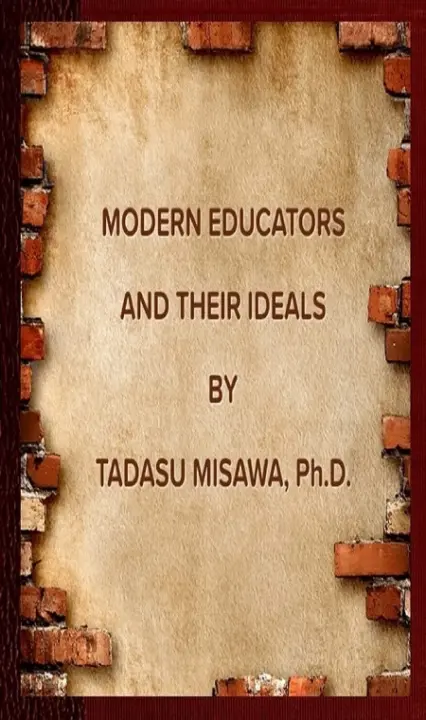
"Modern educators and their ideals" by Tadasu Misawa is a scholarly survey of educational philosophy written in the early 20th century. It outlines the ideals and methods of major reformers and philosophers to guide students of pedagogy, teachers, and interested parents, presenting their key ideas through concise exposition and curated excerpts.
The opening of the book sets its purpose: to summarize influential modern educators sympathetically, avoid heavy criticism, and provide accessible bibliographies. The introduction traces the lineage of Western educational ideals from Greece and Rome through Christianity and the Middle Ages to the Renaissance and Reformation, highlighting Luther’s democratic push for universal, practical schooling and Bacon’s call for empiricism. The first chapter on Comenius blends Reformation piety with realistic method, advocating universal, early, sense-based, and systematically graded schooling centered on the vernacular and practical aims. The next chapter contrasts Locke’s pragmatic, gentlemanly education: health and habit first, character before book learning, gentle discipline grounded in esteem rather than the rod, rich but practical studies, and a preference for a good tutor and home over crowded schools. The beginning of the Rousseau chapter pivots to a “return to Nature,” insisting that children be allowed to be children, that instruction be delayed until readiness, that learning come from things rather than words, and that education follow distinct developmental stages under the joint influences of nature, men, and circumstances.
Introduction adapted from the source catalogue; source summaries may be automatically generated.
Free to read · English · 72,850 words · No account needed
MAKE TIME FOR A GOOD BOOK
On by default. Untick to stop anonymous reading totals. Each page counts after 10 seconds in view. How this works.
Anonymous counting is on unless you have switched it off.
Ziegler, in his “History of Pedagogy,” epitomizes Kant’s most important influence on the general trend of thought as the remodeling of our concept of the universe, the introduction of exact and critical thinking, the exaltation of mathematical instruction, the substitution of morality of conscience for the morality of eudemonism or prudence, the last-mentioned being probably the greatest and most lasting one. Ziegler tells us further that “the categorical imperative” has since become “the steel and iron in our blood” (18: p. 282), and that the German victory in the war for independence owes its debt above all others to Kant and Fichte. As to his position in the history of pedagogy itself, we may say, with Dr. Ernst Temming, that “the German Rationalistic Pedagogy (Aufklärungspädagogik) found in Kant both its founder and undaunted representative” (17: p. 4). Like Locke in England and Rousseau in France, he, with Basedow in Germany, can be said to have firmly established education on the human basis, making moral culture independent of positive Christianity, and religion subordinate to education. Moreover, by proclaiming from the honored chair of Königsberg University his grand concept of the education of humanity, he gave to the contemporary and subsequent generations of scholars a stimulus to take up pedagogy as a work worthy of philosophers.
1. +Buchner, Edward Franklin.+ The Educational Theory of Immanuel Kant. (Translation of “Ueber Pädagogik” and fragmental remarks on education by Kant.) Lippincott, Philadelphia and London, 1904. 309 pages.
2. +Churton, Annette.+ Kant on Education. (Translation of “Ueber Pädagogik.”) Kegan Paul, Trench, Trübner & Co., London, 1899. 121 pages.
3. +Duproix, Paul.+ Kant et Fichte et le problème de l’éducation. Second edition. Alcan, Paris, 1897. 260 pages.
4. +Garbovicianu, Petru.+ Die Didaktik Basedow’s im Vergleiche zur Didaktik des Comenius. Bucarest, Leipzig, 1887. 82 pages.
5. +Göring, Hugo.+ Ausgewählte Schriften, mit Basedow’s Biographie. Beyer, Langensalza, 1880. 519 pages.
6. +Heman, Friedrich.+ Geschichte der neueren Pädagogik. Zickfeldt, Osterwieck, 1904. 436 pages.
7. +Lang, Ossian H.+ Basedow: His Educational Work and Principles. Kellogg, New York, 1891. 29 pages.
8. +Monroe, Paul.+ A Text-book in the History of Education. Macmillan & Co., New York and London, 1905. 772 pages.
9. +Pinloche, Joachim Auguste.+ La Réforme de l’éducation en Allemagne au Dixhuitième Siècle, Basedow et le Philanthropinisme. Colin, Paris, 1889. 397 pages.
10. +Quick, Robert Hebert.+ Essays on Educational Reformers. Appleton, New York, 1890. 560 pages. The same (International Education Series), 1903. 568 pages.
11. +Raumer, Karl von.+ Geschichte der Pädagogik vom Wiederaufblühen klassischer Studien bis auf unsere Zeit. 5 vols. Bertelsmann, Gütersloh, 1882-1897.
12. +Rein, Georg Wilhelm+, editor. Encyklopädisches Handbuch der Pädagogik. 8 vols. Beyer, Langensalza, 1895-1906. Vol. VI.
Your reading position is saved on this browser. Take it to another device with a library code. Reading pages adapt to text, rather than matching a printed edition.
BEHIND THE BOOK
This eBook is for the use of anyone anywhere in the United States and most other parts of the world at no cost and with almost no restrictions whatsoever. You may copy it, give it away or re-use it under the terms of the Project Gutenberg License included with this eBook or online at www.gutenberg.org. If you are not located in the United States, you will have to check the laws of the country where you are located before using this eBook. Read the source licence.
The original source file, including credits and licence, is retained by this library. Request an original-format copy at no charge. Please include the book title and Project Gutenberg identifier #77974.
KEEP YOUR CURIOSITY GOING
Cécile Tormay

Moritz Busch
John L. Ransom
Frances Wright
Cécile Tormay

Mabel Potter Daggett