THE CLASSIC COLLECTION✦The Disappearing EyeCLASSIC FREE BOOKS
The Disappearing Eye
Fergus Hume
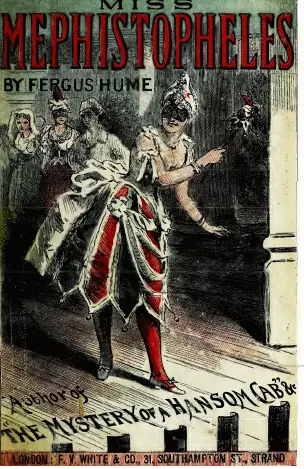
THE CLASSIC COLLECTION · 1880
"Miss Mephistopheles: A Novel" by Fergus Hume is a fictional work written in the late 19th century. The story unfolds in Melbourne, Australia, featuring characters like Keith Stewart, a young man with literary aspirations, and Ezra Lazarus, a journalist. Their lives intersect with the complexities of the theatre scene and a woman known as "Caprice," who is both a celebrated actress and the mother of a child saved from danger by Keith. The opening of the novel introduces a dreary, rainy evening in Melbourne, emphasizing the discomfort felt by the characters but juxtaposing it with vibrant discussions between them. The beginning focuses on Keith and Ezra as they share insights into their ambitions and the women in their lives—particularly Caprice. The narrative presents their contrasting backgrounds: Keith's struggles and romantic ideals versus Ezra's more grounded perspective. As the two men contemplate their lives, a dramatic moment unfolds when Keith heroically saves a child, a pivotal event that brings him into the orbit of Caprice. This scene sets the stage for the exploration of themes like ambition, love, and the darker corners of society that the characters navigate.
Introduction adapted from the source catalogue; source summaries may be automatically generated.
Free to read · English · 63,753 words · No account needed
MAKE TIME FOR A GOOD BOOK
On by default. Untick to stop anonymous reading totals. Each page counts after 10 seconds in view. How this works.
Anonymous counting is on unless you have switched it off.
The young Jew smiled bitterly.
"I also was not in my father's confidence," he said, "so know
nothing."
"There was some gold and silver money also in the safe," said Keith to Naball, knocking the ashes off his cigarette.
"Humph! that's not much guide," replied the detective; "it's the notes I want--if I could only find the numbers of those notes--where did they come from?"
"A man at Ballarat, called Forbes."
"Oh! I'll write to Mr. Forbes of Ballarat," said Naball, making a note, "but if those notes are put in circulation, do you know of any means by which I can identify them?"
Keith shook his head, then suddenly gave a cry.
"Yes; I can tell you how to identify one of the notes."
"That will be quite sufficient," said the detective eagerly. "How?"
"That boy, Isaiah," said Stewart, "he's great on backing horses, and frequently tells me about racing. When I was making up my cash on that night, the notes were lying on the desk, and as the door of Mr. Lazarus' room was open, Isaiah was afraid to speak aloud about his tip, so he wrote it down."
"But how can that identify the bank-note?" asked the perplexed
detective.
"Because the young scamp wrote his tip, 'Back Flat-Iron,' on the back
of a ten-pound note."
"In pencil?" asked Naball.
"No; in ink!"
"So one of the notes that were stolen has the inscription 'Back
Flat-Iron' on the back of it?"
"Exactly!"
Naball scribbled a line or two in his pocket-book, and shut it with a
snap.
"If that note goes into circulation," he said, in a satisfied tone, "I'll soon trace it to its original holder."
"And then?" asked Ezra.
"And then," reiterated Naball quietly, "I'll lay my hands on the man who killed your father. And now, Mr. Stewart, I want to ask you a few questions about yourself."
"Go on!" said Keith imperturbably; "I hope you don't think I killed
Lazarus?"
"I think--nothing," replied Naball quietly; "I only want to find out as much as I can. You were at the Bon-Bon Theatre on that night?"
"Yes; talking to Mr. Mortimer."
"Any one else with you?"
"Yes," replied Ezra, "I was, and Caprice; we left about half-past
eleven."
"And you, Mr. Stewart?"
"I left at half-past twelve."
"Where did you go then?"
"I was excited over some business I had done, and strolled about the
city."
"Anywhere in particular?"
"No. I went along Collins Street, up William Street, round about the Law Courts, and then came down Bourke Street, on my way home."
"How long were you thus wandering about?"
Your reading position is saved on this browser. Take it to another device with a library code. Reading pages adapt to text, rather than matching a printed edition.
Fergus Hume

Fergus Hume

Fergus Hume
Fergus Hume
BEHIND THE BOOK
This eBook is for the use of anyone anywhere in the United States and most other parts of the world at no cost and with almost no restrictions whatsoever. You may copy it, give it away or re-use it under the terms of the Project Gutenberg License included with this eBook or online at www.gutenberg.org. If you are not located in the United States, you will have to check the laws of the country where you are located before using this eBook. Read the source licence.
The original source file, including credits and licence, is retained by this library. Request an original-format copy at no charge. Please include the book title and Project Gutenberg identifier #55378.
KEEP YOUR CURIOSITY GOING
Coulson Kernahan

Maurice Baring
Frances Wright
Cécile Tormay

Frederic Jesup Stimson

W. H. P. (William Henry Pope) Jarvis