THE CLASSIC COLLECTION✦The Disappearing EyeCLASSIC FREE BOOKS
The Disappearing Eye
Fergus Hume
THE CLASSIC COLLECTION · 1880
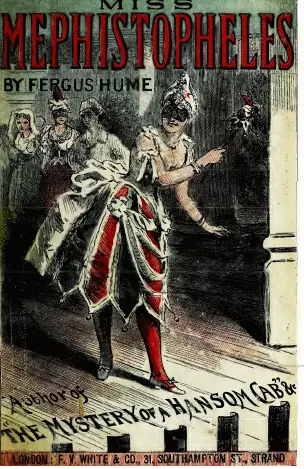
"Miss Mephistopheles: A Novel" by Fergus Hume is a fictional work written in the late 19th century. The story unfolds in Melbourne, Australia, featuring characters like Keith Stewart, a young man with literary aspirations, and Ezra Lazarus, a journalist. Their lives intersect with the complexities of the theatre scene and a woman known as "Caprice," who is both a celebrated actress and the mother of a child saved from danger by Keith. The opening of the novel introduces a dreary, rainy evening in Melbourne, emphasizing the discomfort felt by the characters but juxtaposing it with vibrant discussions between them. The beginning focuses on Keith and Ezra as they share insights into their ambitions and the women in their lives—particularly Caprice. The narrative presents their contrasting backgrounds: Keith's struggles and romantic ideals versus Ezra's more grounded perspective. As the two men contemplate their lives, a dramatic moment unfolds when Keith heroically saves a child, a pivotal event that brings him into the orbit of Caprice. This scene sets the stage for the exploration of themes like ambition, love, and the darker corners of society that the characters navigate.
Introduction adapted from the source catalogue; source summaries may be automatically generated.
Free to read · English · 63,753 words · No account needed
MAKE TIME FOR A GOOD BOOK
On by default. Untick to stop anonymous reading totals. Each page counts after 10 seconds in view. How this works.
Anonymous counting is on unless you have switched it off.
"Oh, yes, it is," retorted Mortimer; "it gives you a chance. Now, look here, I've no desire to take advantage of my position, which, as you see, is a very strong one."
"In what way?" asked Caprice, elevating her eyebrows.
Mortimer explained in his slow voice as follows,--"I can write home to London and get successful plays with big reputations already made."
"Yes, and pay big prices for them."
"That may be," replied the manager imperturbably; "but if I give a good price I get a good article that is sure to recoup me for my outlay. I don't say that 'Faust Upset' isn't good, but at the same time it's an experiment. Australians don't like their own raw material."
"They never get the chance of seeing it," said Keith bitterly; "you of course look at it from a business point of view, as is only proper, but seeing that you draw all your money from Colonial pockets, why not give Colonial brains a chance?"
"Because Colonial brains don't pay, Colonial pockets do," said Mortimer coolly; "besides, I am giving you a chance, and that at considerable risk to myself. I will put on this burlesque in good style because Caprice is dead set on it; but business is business, and I can't afford to lose money on an untried production."
"Suppose it turns out a great success," said Ezra, "we, the authors, only make six pounds a week, while you take all the profits."
"Certainly," retorted Mortimer; "I've taken the risk."
"Then if we make a great success of this burlesque," said Keith, "you will give us better terms for the next thing we write?"
"Well, yes," said the manager, in a hesitating manner; "but, of course, though your position is improved, mine is still the same."
"I understand; as long as you have the run of the London market, you can treat Colonial playwrights as you choose?"
"You've stated the case exactly."
"It's an unfair advantage."
"No doubt, but business is business. I hold the trump card."
"It's a bad lookout for the literary and musical future of Australia when such men as you hold the cards," said Ezra gloomily; "but it's no use arguing the case. I've heard all this sort of thing before. The Australians are too busy making money to trouble about such a contemptible thing as literary work."
"I'll tell you what, Mortimer," broke in Caprice, "give them two
pounds a night for the piece."
"Not I."
"Yes you will, or I don't show at the Bon-Bon."
"You forget your engagement, my dear," said Mortimer complacently.
Your reading position is saved on this browser. Take it to another device with a library code. Reading pages adapt to text, rather than matching a printed edition.
Fergus Hume

Fergus Hume

Fergus Hume
Fergus Hume
BEHIND THE BOOK
This eBook is for the use of anyone anywhere in the United States and most other parts of the world at no cost and with almost no restrictions whatsoever. You may copy it, give it away or re-use it under the terms of the Project Gutenberg License included with this eBook or online at www.gutenberg.org. If you are not located in the United States, you will have to check the laws of the country where you are located before using this eBook. Read the source licence.
The original source file, including credits and licence, is retained by this library. Request an original-format copy at no charge. Please include the book title and Project Gutenberg identifier #55378.
KEEP YOUR CURIOSITY GOING
Coulson Kernahan

Maurice Baring
Frances Wright
Cécile Tormay

Frederic Jesup Stimson

W. H. P. (William Henry Pope) Jarvis