THE CLASSIC COLLECTION✦The Disappearing EyeCLASSIC FREE BOOKS
The Disappearing Eye
Fergus Hume
THE CLASSIC COLLECTION · 1880
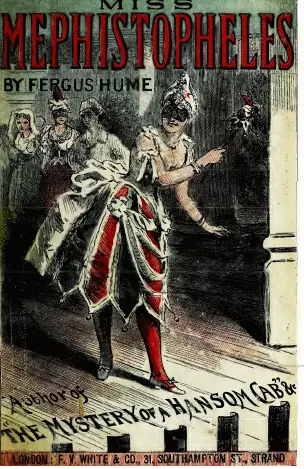
"Miss Mephistopheles: A Novel" by Fergus Hume is a fictional work written in the late 19th century. The story unfolds in Melbourne, Australia, featuring characters like Keith Stewart, a young man with literary aspirations, and Ezra Lazarus, a journalist. Their lives intersect with the complexities of the theatre scene and a woman known as "Caprice," who is both a celebrated actress and the mother of a child saved from danger by Keith. The opening of the novel introduces a dreary, rainy evening in Melbourne, emphasizing the discomfort felt by the characters but juxtaposing it with vibrant discussions between them. The beginning focuses on Keith and Ezra as they share insights into their ambitions and the women in their lives—particularly Caprice. The narrative presents their contrasting backgrounds: Keith's struggles and romantic ideals versus Ezra's more grounded perspective. As the two men contemplate their lives, a dramatic moment unfolds when Keith heroically saves a child, a pivotal event that brings him into the orbit of Caprice. This scene sets the stage for the exploration of themes like ambition, love, and the darker corners of society that the characters navigate.
Introduction adapted from the source catalogue; source summaries may be automatically generated.
Free to read · English · 63,753 words · No account needed
MAKE TIME FOR A GOOD BOOK
On by default. Untick to stop anonymous reading totals. Each page counts after 10 seconds in view. How this works.
Anonymous counting is on unless you have switched it off.
"Ugh! I hate the idea of being cribbed and confined in an office; it's such an artificial existence. However, beggars can't be choosers, so tell me all about it."
"My father wants a clerk," said Ezra deliberately, "and if I recommended you I think you could get the position."
"Humph! And what is your father's occupation?"
"Not a very aristocratic one,--a pawnbroker."
Keith stopped short, and looked at his companion in surprise.
"I can't imagine you being the son of a pawnbroker," he said in a
puzzled tone.
"Why not?" asked Ezra serenely. "I must be the son of some one."
"Yes; but a pawnbroker, it's so horribly un-poetical. Your father ought to have been a man of letters--of vague speculations and abstruse theories--a modern Rabbi Judah holding disputations about the Talmud."
Lazarus shrugged his shoulders, and walked slowly onward, followed by
his companion.
"My dear lad, the days of Maimonides are past, and we are essentially a money-making race. The curse which Jehovah pronounced on the Jews was the same as that of Midas--they turn everything they touch into gold."
"A pleasant enough punishment."
"Midas did not find it so; but to resume--my father, Jacob Lazarus, has his shop in Russell Street, so I will speak to him to-day, and if he is agreeable, I will take you with me to-morrow. I've no doubt you'll get the billet, but the wages will be small."
"At all events, they will keep body and soul together till I find my
El Dorado."
"You refer to literary fame, I suppose. How did you first take to
writing?"
"I think you asked me that question last night," said Keith, smiling, "and I told you I couldn't explain. Like Pope, I lisped in numbers, and the numbers came. I've no doubt they were sufficiently bad. I'm sure I don't know why all authors begin with verse; perhaps it's because rhymes are so easy--fountain suggests mountain, and dove is invariably followed by love."
"Have you had any articles accepted since your arrival in Melbourne?"
"One or two, but generally speaking, no one acknowledges that a possible Shakespeare or Dickens is embodied in me. I've sent plays to managers, which have been declined on the plea that all plays come from London. I have seen editors, and have been told there was no room on the press--publishers have seen me, and pointed out that a colonial novel means ruination--encouraging for the future brainworkers of Australia, isn't it?"
"We must all serve our apprenticeship," answered Lazarus quietly. "The longest lane has a turning."
"No doubt; but my particular lane seems devilish long."
Your reading position is saved on this browser. Take it to another device with a library code. Reading pages adapt to text, rather than matching a printed edition.
Fergus Hume

Fergus Hume

Fergus Hume
Fergus Hume
BEHIND THE BOOK
This eBook is for the use of anyone anywhere in the United States and most other parts of the world at no cost and with almost no restrictions whatsoever. You may copy it, give it away or re-use it under the terms of the Project Gutenberg License included with this eBook or online at www.gutenberg.org. If you are not located in the United States, you will have to check the laws of the country where you are located before using this eBook. Read the source licence.
The original source file, including credits and licence, is retained by this library. Request an original-format copy at no charge. Please include the book title and Project Gutenberg identifier #55378.
KEEP YOUR CURIOSITY GOING
Coulson Kernahan

Maurice Baring
Frances Wright
Cécile Tormay

Frederic Jesup Stimson

W. H. P. (William Henry Pope) Jarvis