THE CLASSIC COLLECTION✦The Disappearing EyeCLASSIC FREE BOOKS
The Disappearing Eye
Fergus Hume
THE CLASSIC COLLECTION · 1880
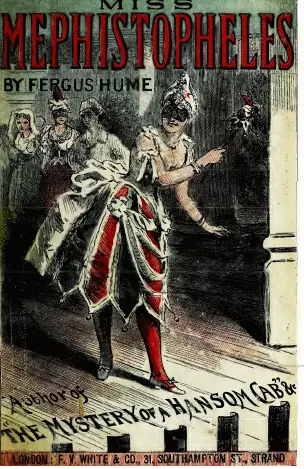
"Miss Mephistopheles: A Novel" by Fergus Hume is a fictional work written in the late 19th century. The story unfolds in Melbourne, Australia, featuring characters like Keith Stewart, a young man with literary aspirations, and Ezra Lazarus, a journalist. Their lives intersect with the complexities of the theatre scene and a woman known as "Caprice," who is both a celebrated actress and the mother of a child saved from danger by Keith. The opening of the novel introduces a dreary, rainy evening in Melbourne, emphasizing the discomfort felt by the characters but juxtaposing it with vibrant discussions between them. The beginning focuses on Keith and Ezra as they share insights into their ambitions and the women in their lives—particularly Caprice. The narrative presents their contrasting backgrounds: Keith's struggles and romantic ideals versus Ezra's more grounded perspective. As the two men contemplate their lives, a dramatic moment unfolds when Keith heroically saves a child, a pivotal event that brings him into the orbit of Caprice. This scene sets the stage for the exploration of themes like ambition, love, and the darker corners of society that the characters navigate.
Introduction adapted from the source catalogue; source summaries may be automatically generated.
Free to read · English · 63,753 words · No account needed
MAKE TIME FOR A GOOD BOOK
On by default. Untick to stop anonymous reading totals. Each page counts after 10 seconds in view. How this works.
Anonymous counting is on unless you have switched it off.
There was a lamp on the table with a heavy shade, which concentrated all the light into a circle, and Kitty's pale face, with its aureole of fair hair seen in the powerful radiance, appeared strange and unreal. Dark circles under her heavy eyes, faint lines round the small mouth, and the weary look now habitual to her, all combined to give her face a wan and spiritual look which made even Mortimer shiver as he looked at her.
"Hang it, Kitty," he said roughly, "don't look so dismal. You ought to
see a doctor."
"What for?" she asked listlessly. "I'm quite well."
"Humph! I don't think so. You've been going down the hill steadily the last few months. Look how thin you are--a bag of bones."
"So was Rachel," replied Caprice, with a faint smile.
"Well, she didn't live very long. Besides, you ain't Rachel," growled Mortimer, "and I don't want you to get ill just now."
"No, you could hardly supply my place," said Caprice, with a sneer. "Don't you bother yourself, Mortimer, I'm not going to die yet. When I do I sha'n't be sorry; life hasn't been so pleasant to me that I should wish to live."
"I don't know what you want," grumbled the manager; "you've got all
Melbourne at your feet."
"I can't say much for Melbourne's morality, then," retorted Caprice bitterly; "circumstances have made me what I am, but I'm getting tired of the cakes and ale business. If I could only secure the future of my child, I'd turn religious."
"Mary Magdalen!"
"Yes, a case of history repeating itself, isn't it?" she replied, with
a harsh laugh.
"Strange!" said Mortimer, scrutinising her narrowly; "the worse a woman is in her youth, the more devout she becomes in her old age."
"On the authority of M. de la Rochefoucauld, I suppose," answered
Caprice; "old age gives good advice when it no longer can give bad
example."
"Who told you that?"
"A man you never knew--Vandeloup."
"I don't know that my not being acquainted with him was much to be
regretted."
"No, I don't think it was," replied Caprice coolly; "he had twice your brains--to know him was a liberal education."
"In cheap cynicism, gad, you've been an apt pupil."
Kitty laughed, and, rising from her seat, began to walk to and fro.
"I wish those boys would come," she said restlessly; "I want to go
home."
"Then go," said Mortimer; "you needn't stay."
"Oh, yes, I need," she replied; "I want to see that they get good
terms for their play."
"I'll give them a fair price," said Mortimer; "but I'm not going to be so liberal as you expect."
Your reading position is saved on this browser. Take it to another device with a library code. Reading pages adapt to text, rather than matching a printed edition.
Fergus Hume

Fergus Hume

Fergus Hume
Fergus Hume
BEHIND THE BOOK
This eBook is for the use of anyone anywhere in the United States and most other parts of the world at no cost and with almost no restrictions whatsoever. You may copy it, give it away or re-use it under the terms of the Project Gutenberg License included with this eBook or online at www.gutenberg.org. If you are not located in the United States, you will have to check the laws of the country where you are located before using this eBook. Read the source licence.
The original source file, including credits and licence, is retained by this library. Request an original-format copy at no charge. Please include the book title and Project Gutenberg identifier #55378.
KEEP YOUR CURIOSITY GOING
Coulson Kernahan

Maurice Baring
Frances Wright
Cécile Tormay

Frederic Jesup Stimson

W. H. P. (William Henry Pope) Jarvis