THE CLASSIC COLLECTION✦The Disappearing EyeCLASSIC FREE BOOKS
The Disappearing Eye
Fergus Hume
THE CLASSIC COLLECTION · 1880
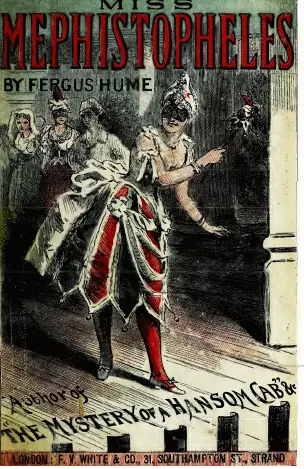
"Miss Mephistopheles: A Novel" by Fergus Hume is a fictional work written in the late 19th century. The story unfolds in Melbourne, Australia, featuring characters like Keith Stewart, a young man with literary aspirations, and Ezra Lazarus, a journalist. Their lives intersect with the complexities of the theatre scene and a woman known as "Caprice," who is both a celebrated actress and the mother of a child saved from danger by Keith. The opening of the novel introduces a dreary, rainy evening in Melbourne, emphasizing the discomfort felt by the characters but juxtaposing it with vibrant discussions between them. The beginning focuses on Keith and Ezra as they share insights into their ambitions and the women in their lives—particularly Caprice. The narrative presents their contrasting backgrounds: Keith's struggles and romantic ideals versus Ezra's more grounded perspective. As the two men contemplate their lives, a dramatic moment unfolds when Keith heroically saves a child, a pivotal event that brings him into the orbit of Caprice. This scene sets the stage for the exploration of themes like ambition, love, and the darker corners of society that the characters navigate.
Introduction adapted from the source catalogue; source summaries may be automatically generated.
Free to read · English · 63,753 words · No account needed
MAKE TIME FOR A GOOD BOOK
On by default. Untick to stop anonymous reading totals. Each page counts after 10 seconds in view. How this works.
Anonymous counting is on unless you have switched it off.
"What a woman generally does say--everything but the truth. Going to
see her?"
"Yes," said Fenton, paying his cab fare; "can I do anything?"
"Two things," observed Naball quietly: "in the first place, let me have your cab; and in the second, give this to Caprice with my compliments," and he handed the crescent of diamonds to Fenton.
"Why didn't you give it to her yourself?" asked Fenton, taking it.
"Because she said it wasn't hers," replied Naball, getting into the cab. "I can't do anything more in the matter; it's a beautiful case spoiled."
"Why spoiled?" asked Fenton, pausing at the gate.
"Because there's a woman in it," replied Naball; "good-bye!" and the cab drove off in a cloud of dust, leaving Fenton at the gate looking in a puzzled manner at the diamond crescent.
"Why the deuce did she deny this being hers?" he asked himself as he opened the gate. "I know it well--I ought to, considering I paid for it--there's some game in this."
He rang the bell, which was answered by Bliggings, who, in reply to his question as to whether Kitty was at home, burst out into a volley of language.
"Oh, gracious an' good 'eavens, missus 'ave bin talkin' to a lady this mornin', and is that upset as never was--chalk is black to her complexing, and penny hices 'ot to the chill of her feets."
"Humph!" said Fenton, entering the house and leisurely taking off his hat, "just tell your mistress I want to see her."
"Oh, gracious an' good 'eavens!" cried Bliggings, "she's a-lyin' down in company with a linseed poultase an' a cup of tea, both bein' good for removin' 'eadaches."
"Great Scot!" said Fenton impatiently, pushing the voluble Bliggings aside, "I'll go and see her straight off myself."
He went upstairs and knocked at the sitting-room door. Hearing a faint voice telling him to come in, he entered the room, which he found in semi-darkness, with the pungent aroma of eau de cologne pervading the atmosphere.
"What do you want?" asked Kitty fretfully, thinking it was the
servant.
"To see you," replied Fenton gruffly.
"Oh, it's you!" cried Caprice, sitting up on the sofa, looking pale and wan in her white dress. "I'm glad of that--I've just seen that Naball, and he's been accusing me of stealing my own jewels."
"Well, did you?" asked Fenton complacently.
"Of course I didn't," she retorted angrily; "why should I? Naball thinks I did it to replace the money Malton stole."
"How did he find out that?" asked Fenton, who knew quite well he had
told him about it himself.
Your reading position is saved on this browser. Take it to another device with a library code. Reading pages adapt to text, rather than matching a printed edition.
Fergus Hume

Fergus Hume

Fergus Hume
Fergus Hume
BEHIND THE BOOK
This eBook is for the use of anyone anywhere in the United States and most other parts of the world at no cost and with almost no restrictions whatsoever. You may copy it, give it away or re-use it under the terms of the Project Gutenberg License included with this eBook or online at www.gutenberg.org. If you are not located in the United States, you will have to check the laws of the country where you are located before using this eBook. Read the source licence.
The original source file, including credits and licence, is retained by this library. Request an original-format copy at no charge. Please include the book title and Project Gutenberg identifier #55378.
KEEP YOUR CURIOSITY GOING
Coulson Kernahan

Maurice Baring
Frances Wright
Cécile Tormay

Frederic Jesup Stimson

W. H. P. (William Henry Pope) Jarvis