THE CLASSIC COLLECTION✦The Disappearing EyeCLASSIC FREE BOOKS
The Disappearing Eye
Fergus Hume
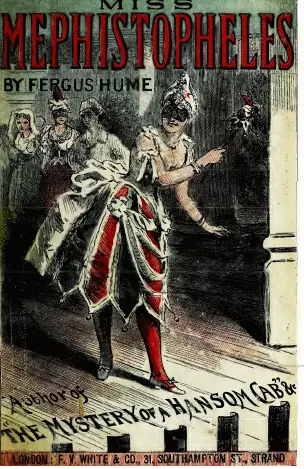
THE CLASSIC COLLECTION · 1880
"Miss Mephistopheles: A Novel" by Fergus Hume is a fictional work written in the late 19th century. The story unfolds in Melbourne, Australia, featuring characters like Keith Stewart, a young man with literary aspirations, and Ezra Lazarus, a journalist. Their lives intersect with the complexities of the theatre scene and a woman known as "Caprice," who is both a celebrated actress and the mother of a child saved from danger by Keith. The opening of the novel introduces a dreary, rainy evening in Melbourne, emphasizing the discomfort felt by the characters but juxtaposing it with vibrant discussions between them. The beginning focuses on Keith and Ezra as they share insights into their ambitions and the women in their lives—particularly Caprice. The narrative presents their contrasting backgrounds: Keith's struggles and romantic ideals versus Ezra's more grounded perspective. As the two men contemplate their lives, a dramatic moment unfolds when Keith heroically saves a child, a pivotal event that brings him into the orbit of Caprice. This scene sets the stage for the exploration of themes like ambition, love, and the darker corners of society that the characters navigate.
Introduction adapted from the source catalogue; source summaries may be automatically generated.
Free to read · English · 63,753 words · No account needed
MAKE TIME FOR A GOOD BOOK
On by default. Untick to stop anonymous reading totals. Each page counts after 10 seconds in view. How this works.
Anonymous counting is on unless you have switched it off.
On this dreary Sunday night Ezra let his fingers wander over the piano, vaguely following his thoughts, and the result was a queer mingling of melodies--now a bizarre polonaise of Chopin, with its fantastic blending of patriotic joy and despairing pain, then a rush of stormy chords, preluding a Spanish dance, instinct with the amorous languor and fierce passion of the south. Outside, the shrill wind could be heard sweeping past, a sheet of rain would lash wildly against the windows, and at intervals the musical thunder of the organ sounded from the adjacent church.
Keith smoked away steadily and listened drowsily to the pleasant mingling of sounds, until Ezra began to play the Traviata music, with its feverish brilliancy and undercurrent of sadness. Then he suddenly started, clenched his hand, and taking his pipe from his mouth, heaved an impatient sigh, upon hearing which, Lazarus stopped playing, and turned slowly round.
"A link of memory?" he said, in his soft voice, referring to the
music.
Stewart replaced his pipe, blew a thick wreath of smoke, and sighed
again.
"Yes," he replied, after a pause; "it recalls to me--a woman."
Ezra laughed half sadly, half mockingly.
"Always the Eternal feminine of George Sand."
Keith sat up cross-legged in front of the fire and shrugged his
shoulders.
"Don't be cynical old chap," he said, glancing round; "I'm sick of hearing the incessant railing against women--good heavens! are we men so pure ourselves, that we can afford to cast stones against the sex to which our mothers and sisters belong."
"I did not mean to be cynical," replied Ezra, clasping his hands round one of his knees, "I only quoted Sand, because when a man is thinking, it is generally--a woman.
"Or a debt--or a crime--or a sorrow," interposed the other quickly; "we can ring the changes on all of them."
"Who is cynical now?" asked the Jew, with a smile.
"Not I," denied Keith, emphatically, drawing hard at his pipe; "or if I am, it is only that thin veneer of cynicism, under which we hide our natural feelings now-a-days; but the music took me back to the time when 'Plancus was consul'--exactly twelve months ago."
"Bah! Plancus is consul still; don't be downhearted, my friend; you are still in the pleasant city of Prague."
"Pleasant? that is as it may be. I think it a very disagreeable city without money. Bohemianism is charming in novels, but in real life it is generally a hunt after what Murger calls that voracious animal, the half-crown."
"And after women!"
"Ah, bah! Lais and Phryne; both charming, but slightly improper, not
to say expensive."
Your reading position is saved on this browser. Take it to another device with a library code. Reading pages adapt to text, rather than matching a printed edition.
Fergus Hume

Fergus Hume

Fergus Hume
Fergus Hume
BEHIND THE BOOK
This eBook is for the use of anyone anywhere in the United States and most other parts of the world at no cost and with almost no restrictions whatsoever. You may copy it, give it away or re-use it under the terms of the Project Gutenberg License included with this eBook or online at www.gutenberg.org. If you are not located in the United States, you will have to check the laws of the country where you are located before using this eBook. Read the source licence.
The original source file, including credits and licence, is retained by this library. Request an original-format copy at no charge. Please include the book title and Project Gutenberg identifier #55378.
KEEP YOUR CURIOSITY GOING
Coulson Kernahan

Maurice Baring
Frances Wright
Cécile Tormay

Frederic Jesup Stimson

W. H. P. (William Henry Pope) Jarvis