THE CLASSIC COLLECTION✦The Disappearing EyeCLASSIC FREE BOOKS
The Disappearing Eye
Fergus Hume
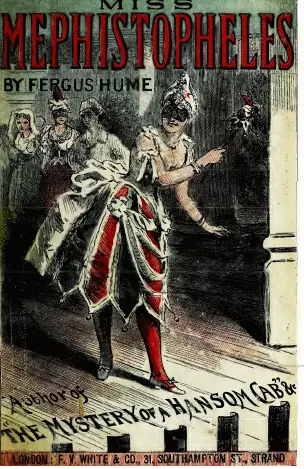
THE CLASSIC COLLECTION · 1880
"Miss Mephistopheles: A Novel" by Fergus Hume is a fictional work written in the late 19th century. The story unfolds in Melbourne, Australia, featuring characters like Keith Stewart, a young man with literary aspirations, and Ezra Lazarus, a journalist. Their lives intersect with the complexities of the theatre scene and a woman known as "Caprice," who is both a celebrated actress and the mother of a child saved from danger by Keith. The opening of the novel introduces a dreary, rainy evening in Melbourne, emphasizing the discomfort felt by the characters but juxtaposing it with vibrant discussions between them. The beginning focuses on Keith and Ezra as they share insights into their ambitions and the women in their lives—particularly Caprice. The narrative presents their contrasting backgrounds: Keith's struggles and romantic ideals versus Ezra's more grounded perspective. As the two men contemplate their lives, a dramatic moment unfolds when Keith heroically saves a child, a pivotal event that brings him into the orbit of Caprice. This scene sets the stage for the exploration of themes like ambition, love, and the darker corners of society that the characters navigate.
Introduction adapted from the source catalogue; source summaries may be automatically generated.
Free to read · English · 63,753 words · No account needed
MAKE TIME FOR A GOOD BOOK
On by default. Untick to stop anonymous reading totals. Each page counts after 10 seconds in view. How this works.
Anonymous counting is on unless you have switched it off.
"You seem to be pretty well acquainted with the scandal of Melbourne society," said Stewart as they went back to their seats.
"Of course, it is my duty; the press is ubiquitous. But tell me your
opinion of Caprice?"
"Judging by her acting to-night, she's a devil."
"Wait till the end of this act, and you'll swear she's an angel."
"Which will be correct?"
"Both--she's a mixture!"
The curtain again drew up, amid the shuffling of the audience settling themselves in their places, and represented a fête in the gardens of Cagliostra's palace, brilliant with coloured lights and fantastically-dressed people. According to the story, Cagliostra has obtained possession of his prize, and woos her successfully, when Prince Carnival enters and sings a ballad, "So Long Ago," in the hope of touching the heart of his false love.
Caprice, dressed in a tight-fitting costume of silk and velvet, which showed off her beautiful figure to perfection, stood in the centre of the stage with a sad smile, and sang the waltz-refrain of the song with great feeling.
"For it was long ago, love,
That time of joy and woe, love!
Yet still that heart of thine
Is mine, dear love, is mine!"
She gave to the jingling words a touch of pathos which was exquisitely
beautiful.
"I believe she feels what she sings," whispered Keith.
"If you knew her story you would scarcely wonder at that," said Ezra
bitterly.
The song was redemanded, but Caprice refused to respond, and, the clamour still continuing, she shrugged her shoulders and walked coolly up the stage.
"She's in a temper to-night," said Mortimer to Santon. "They can applaud till they're black in the face, but devil an answer they'll get from her, the jade! She isn't called Caprice for nothing."
And so it happened, for the audience, finding she would not gratify them, subsided into a sulky silence, and Caprice went coolly on with the dialogue. Cagliostra, repentant, surrenders the girl to Prince Carnival, and the opera ended with a repetition of the galop chorus, wherein Keith saw the sad-eyed woman of a few moments before once more a mocking jibing fiend, dancing and singing with a reckless abandon that half-fascinated and half-disgusted him.
"What a contradiction," said Keith, as they left the theatre; "one moment all tears, the next all laughter!"
"With a spice of the devil in both," replied Ezra cynically. "She is the Sphinx woman of Heine--her lips caress while her claws wound."
Your reading position is saved on this browser. Take it to another device with a library code. Reading pages adapt to text, rather than matching a printed edition.
Fergus Hume

Fergus Hume

Fergus Hume
Fergus Hume
BEHIND THE BOOK
This eBook is for the use of anyone anywhere in the United States and most other parts of the world at no cost and with almost no restrictions whatsoever. You may copy it, give it away or re-use it under the terms of the Project Gutenberg License included with this eBook or online at www.gutenberg.org. If you are not located in the United States, you will have to check the laws of the country where you are located before using this eBook. Read the source licence.
The original source file, including credits and licence, is retained by this library. Request an original-format copy at no charge. Please include the book title and Project Gutenberg identifier #55378.
KEEP YOUR CURIOSITY GOING
Coulson Kernahan

Maurice Baring
Frances Wright
Cécile Tormay

Frederic Jesup Stimson

W. H. P. (William Henry Pope) Jarvis