THE CLASSIC COLLECTION✦The Disappearing EyeCLASSIC FREE BOOKS
The Disappearing Eye
Fergus Hume
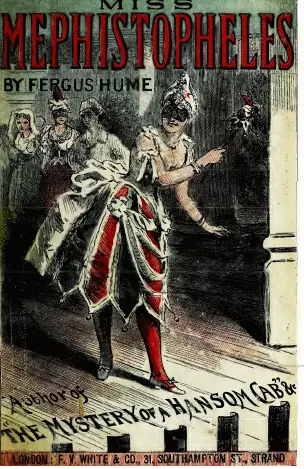
THE CLASSIC COLLECTION · 1880
"Miss Mephistopheles: A Novel" by Fergus Hume is a fictional work written in the late 19th century. The story unfolds in Melbourne, Australia, featuring characters like Keith Stewart, a young man with literary aspirations, and Ezra Lazarus, a journalist. Their lives intersect with the complexities of the theatre scene and a woman known as "Caprice," who is both a celebrated actress and the mother of a child saved from danger by Keith. The opening of the novel introduces a dreary, rainy evening in Melbourne, emphasizing the discomfort felt by the characters but juxtaposing it with vibrant discussions between them. The beginning focuses on Keith and Ezra as they share insights into their ambitions and the women in their lives—particularly Caprice. The narrative presents their contrasting backgrounds: Keith's struggles and romantic ideals versus Ezra's more grounded perspective. As the two men contemplate their lives, a dramatic moment unfolds when Keith heroically saves a child, a pivotal event that brings him into the orbit of Caprice. This scene sets the stage for the exploration of themes like ambition, love, and the darker corners of society that the characters navigate.
Introduction adapted from the source catalogue; source summaries may be automatically generated.
Free to read · English · 63,753 words · No account needed
MAKE TIME FOR A GOOD BOOK
On by default. Untick to stop anonymous reading totals. Each page counts after 10 seconds in view. How this works.
Anonymous counting is on unless you have switched it off.
"Simply in this way. I put her to bed when she was half-asleep, and she knew I was in the room with her. When I left, she fell asleep, and as her slumber was fitful, as I am sure it was, seeing she came downstairs, she no doubt woke up at the sound of the window being opened, and saw a man getting out. You know how an hour's sleep passes as a moment when one wakes, so I've no doubt Meg thought she'd just closed her eyes, and opened them again to see me getting out of the window."
"I understand," said Eugénie; "but who could it have been?"
"I believe it was Villiers," observed Keith thoughtfully. "He was about the house on that night; he was in want of money, so no doubt when Caprice left him in the supper-room, he walked upstairs to the bedroom, stole the diamonds, and left by the window. He could easily do this, as every one was in the drawing-room. Then Naball found that diamond clasp in his possession, or, at least, in the possession of the Chinaman to whom he sold it."
"But if he sold all those diamonds to old Lazarus, he must have got a good deal of money for them. Why did he not leave the country?"
Keith sighed.
"I'm sure I don't know. It seems all so mysterious," he said dismally. "What do you think should be done, Eugénie?"
"I think I'll see Naball again, or some other detective, and sift the whole affair to the bottom."
Keith looked at her with a pitying smile.
"My dear child, that will cost a lot of money, and you have not--"
Eugénie gave a laugh. She was not going to tell him just yet, so she
gave an evasive answer.
"I've got my salary," she said gaily. "Some of it was paid to me the
other day. See!" And taking out her purse, she emptied it into his
hand.
"Oh! what a lot of money," said Keith smiling. "A five-pound note, three sovereigns, and two one-pound notes."
"Which makes exactly ten pounds," remarked Eugénie, with a smile; "and
I'm going to pay it all away to Naball, to get you out of this
trouble."
Stewart, kissed her, and smoothed out the notes one after the other.
"It's no use, Eugénie," he said, offering her the notes back; "it will take more than that to help me; besides, you forget I have five hundred pounds in the bank."
"Yes," she said, turning away her face; "five hundred."
"And you'll have it--if--if I die."
She turned to him, and threw her arms round his neck.
Your reading position is saved on this browser. Take it to another device with a library code. Reading pages adapt to text, rather than matching a printed edition.
Fergus Hume

Fergus Hume

Fergus Hume
Fergus Hume
BEHIND THE BOOK
This eBook is for the use of anyone anywhere in the United States and most other parts of the world at no cost and with almost no restrictions whatsoever. You may copy it, give it away or re-use it under the terms of the Project Gutenberg License included with this eBook or online at www.gutenberg.org. If you are not located in the United States, you will have to check the laws of the country where you are located before using this eBook. Read the source licence.
The original source file, including credits and licence, is retained by this library. Request an original-format copy at no charge. Please include the book title and Project Gutenberg identifier #55378.
KEEP YOUR CURIOSITY GOING
Coulson Kernahan

Maurice Baring
Frances Wright
Cécile Tormay

Frederic Jesup Stimson

W. H. P. (William Henry Pope) Jarvis