THE CLASSIC COLLECTION✦The Disappearing EyeCLASSIC FREE BOOKS
The Disappearing Eye
Fergus Hume
THE CLASSIC COLLECTION · 1880
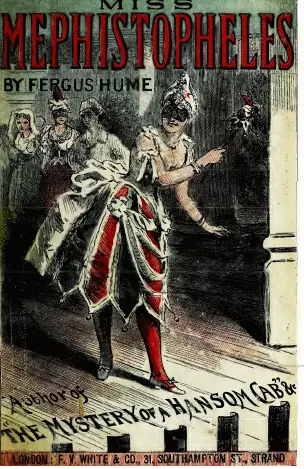
"Miss Mephistopheles: A Novel" by Fergus Hume is a fictional work written in the late 19th century. The story unfolds in Melbourne, Australia, featuring characters like Keith Stewart, a young man with literary aspirations, and Ezra Lazarus, a journalist. Their lives intersect with the complexities of the theatre scene and a woman known as "Caprice," who is both a celebrated actress and the mother of a child saved from danger by Keith. The opening of the novel introduces a dreary, rainy evening in Melbourne, emphasizing the discomfort felt by the characters but juxtaposing it with vibrant discussions between them. The beginning focuses on Keith and Ezra as they share insights into their ambitions and the women in their lives—particularly Caprice. The narrative presents their contrasting backgrounds: Keith's struggles and romantic ideals versus Ezra's more grounded perspective. As the two men contemplate their lives, a dramatic moment unfolds when Keith heroically saves a child, a pivotal event that brings him into the orbit of Caprice. This scene sets the stage for the exploration of themes like ambition, love, and the darker corners of society that the characters navigate.
Introduction adapted from the source catalogue; source summaries may be automatically generated.
Free to read · English · 63,753 words · No account needed
MAKE TIME FOR A GOOD BOOK
On by default. Untick to stop anonymous reading totals. Each page counts after 10 seconds in view. How this works.
Anonymous counting is on unless you have switched it off.
"Now, look here Miss Marchurst," said Naball rapidly, "it's no use beating about the bush--I know more than you think. You denied that you stole your own jewels, but I know you did, in order to pay the money embezzled by Malton. Lazarus's boy saw you go to his place during the week of the robbery, late at night. You did so in order to dispose of the jewels. The crescent I took from Villiers down Bourke Street was given to him by you as an accomplice; and I listened at that window to-day and heard Villiers say you were on the Russell Street premises on the night of the murder. Now, what do you say?"
Kitty, still on her feet, was deadly pale, but looked rapidly at
Naball.
"You have made up a very clever case," she said quietly; "but entirely wrong--yes, entirely. I did not take my own jewels, as I told you before, therefore I was unable to pay the money for Mr. Malton. I did go to see Lazarus one night during the week of the robbery, in order to get some money, but was unable to do so. I never gave the crescent to Villiers, as he will tell you; and lastly, as you overheard him state, I was at Lazarus's on the night of the murder, but did not think it necessary to state so. I went there after I left the Bon-Bon, and made no secret of my doing so, as my coachman can inform you. I found the door locked, and no light inside, so thinking the old man had gone to bed, I came away, and went home; so, you see, your very clever case means nothing."
"Is this true?" asked Naball, turning to Villiers.
"Is what true?" asked that gentleman angrily.
"What she says."
"Some of it. Well, yes, most of it."
"You'd better go a little further," said Kitty quietly, "and say all of it. Did I give you the diamond crescent?"
"No, you didn't."
"Then, who did?" asked Naball pertinaciously.
"I sha'n't tell you," growled Villiers.
"Oh, yes, you will," said the detective, "because if you know who stole the diamonds, you know the murderer of Lazarus."
"No, I don't," retorted Villiers savagely. "I tell you I saw her round about the place on that night, and I picked up the knife I gave you; that's all I know."
"Humph! we'll see about that."
"You are sure that the person who stole the diamonds committed the crime?" asked Caprice, with a strange smile on her pale lips.
"Well, I'm pretty sure; it looks uncommon like it."
"And you think I stole the diamonds?"
Your reading position is saved on this browser. Take it to another device with a library code. Reading pages adapt to text, rather than matching a printed edition.
Fergus Hume

Fergus Hume

Fergus Hume
Fergus Hume
BEHIND THE BOOK
This eBook is for the use of anyone anywhere in the United States and most other parts of the world at no cost and with almost no restrictions whatsoever. You may copy it, give it away or re-use it under the terms of the Project Gutenberg License included with this eBook or online at www.gutenberg.org. If you are not located in the United States, you will have to check the laws of the country where you are located before using this eBook. Read the source licence.
The original source file, including credits and licence, is retained by this library. Request an original-format copy at no charge. Please include the book title and Project Gutenberg identifier #55378.
KEEP YOUR CURIOSITY GOING
Coulson Kernahan

Maurice Baring
Frances Wright
Cécile Tormay

Frederic Jesup Stimson

W. H. P. (William Henry Pope) Jarvis