THE CLASSIC COLLECTION✦The Disappearing EyeCLASSIC FREE BOOKS
The Disappearing Eye
Fergus Hume
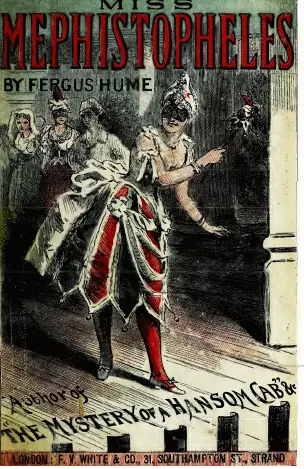
THE CLASSIC COLLECTION · 1880
"Miss Mephistopheles: A Novel" by Fergus Hume is a fictional work written in the late 19th century. The story unfolds in Melbourne, Australia, featuring characters like Keith Stewart, a young man with literary aspirations, and Ezra Lazarus, a journalist. Their lives intersect with the complexities of the theatre scene and a woman known as "Caprice," who is both a celebrated actress and the mother of a child saved from danger by Keith. The opening of the novel introduces a dreary, rainy evening in Melbourne, emphasizing the discomfort felt by the characters but juxtaposing it with vibrant discussions between them. The beginning focuses on Keith and Ezra as they share insights into their ambitions and the women in their lives—particularly Caprice. The narrative presents their contrasting backgrounds: Keith's struggles and romantic ideals versus Ezra's more grounded perspective. As the two men contemplate their lives, a dramatic moment unfolds when Keith heroically saves a child, a pivotal event that brings him into the orbit of Caprice. This scene sets the stage for the exploration of themes like ambition, love, and the darker corners of society that the characters navigate.
Introduction adapted from the source catalogue; source summaries may be automatically generated.
Free to read · English · 63,753 words · No account needed
MAKE TIME FOR A GOOD BOOK
On by default. Untick to stop anonymous reading totals. Each page counts after 10 seconds in view. How this works.
Anonymous counting is on unless you have switched it off.
Keith's evident desire that she should not accept the situation made her all the more determined to do so, and twelve o'clock the next day found her in the drawing-room of Caprice's house, waiting for the entrance of her future mistress.
When Kitty entered the room she could not help admiring the handsome woman before her, and on her part Eugénie was astonished to see the bright vivacity of the melancholy face, for Caprice's features were sad only when in repose.
The two women stood opposite to one another for a moment, mentally making up their minds about each other. Kitty was the first to speak.
"Miss Rainsford, I believe?"
"Yes; I came to see you about--about the situation."
"Governess for my little girl," said Kitty, nodding her head. "Yes, I want some one whom I can trust."
"I hope you will be able to trust me."
Caprice looked keenly at her, and then burst out into a torrent of
words.
"Yes, I think I can trust you--but the question is, will you take care of my child--I mean will you accept the trust? You have come from the country--you don't know who I am?"
"Yes, I do--Miss Marchurst."
"No! not Miss Marchurst--Caprice!"
She waited for a moment to see what effect this notorious name would have on her visitor, but, to her surprise, Eugénie simply bowed.
"Yes, I know," she replied.
Caprice arose and advanced towards her.
"You know," she exclaimed vehemently, "and yet can sit down in the same room with a woman of my character. Are you not afraid I'll contaminate you--do you not shrink from a pariah like me--no--you do not--great heavens!" with a bitter laugh, sitting down again; "and I thought the age of miracles was past--ah, bah! But you are only a girl, my dear, and don't understand."
Eugénie arose and crossed over to her.
"I do understand; I am a woman, and feel for a woman."
Kitty caught her hand and gave a gasping cry. "God bless you!" she
whispered, in a husky voice.
Then in a moment she had dashed the tears away from her eyes, and sat up again in her bright, resolute manner.
"No woman has spoken so kindly as you have for many years," she said quickly; "and I thank you. I can give you my child, and you will take care of her for me when I am far away."
"What do you mean?" asked Eugénie, puzzled.
"Mean--that I am not fit to live with my child, that I am going to
send her to England with you, that she may forget she ever had a
mother."
Your reading position is saved on this browser. Take it to another device with a library code. Reading pages adapt to text, rather than matching a printed edition.
Fergus Hume

Fergus Hume

Fergus Hume
Fergus Hume
BEHIND THE BOOK
This eBook is for the use of anyone anywhere in the United States and most other parts of the world at no cost and with almost no restrictions whatsoever. You may copy it, give it away or re-use it under the terms of the Project Gutenberg License included with this eBook or online at www.gutenberg.org. If you are not located in the United States, you will have to check the laws of the country where you are located before using this eBook. Read the source licence.
The original source file, including credits and licence, is retained by this library. Request an original-format copy at no charge. Please include the book title and Project Gutenberg identifier #55378.
KEEP YOUR CURIOSITY GOING
Coulson Kernahan

Maurice Baring
Frances Wright
Cécile Tormay

Frederic Jesup Stimson

W. H. P. (William Henry Pope) Jarvis