THE CLASSIC COLLECTION✦The Disappearing EyeCLASSIC FREE BOOKS
The Disappearing Eye
Fergus Hume
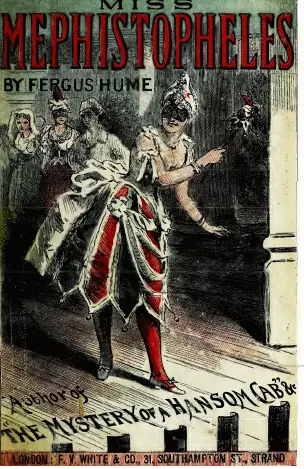
THE CLASSIC COLLECTION · 1880
"Miss Mephistopheles: A Novel" by Fergus Hume is a fictional work written in the late 19th century. The story unfolds in Melbourne, Australia, featuring characters like Keith Stewart, a young man with literary aspirations, and Ezra Lazarus, a journalist. Their lives intersect with the complexities of the theatre scene and a woman known as "Caprice," who is both a celebrated actress and the mother of a child saved from danger by Keith. The opening of the novel introduces a dreary, rainy evening in Melbourne, emphasizing the discomfort felt by the characters but juxtaposing it with vibrant discussions between them. The beginning focuses on Keith and Ezra as they share insights into their ambitions and the women in their lives—particularly Caprice. The narrative presents their contrasting backgrounds: Keith's struggles and romantic ideals versus Ezra's more grounded perspective. As the two men contemplate their lives, a dramatic moment unfolds when Keith heroically saves a child, a pivotal event that brings him into the orbit of Caprice. This scene sets the stage for the exploration of themes like ambition, love, and the darker corners of society that the characters navigate.
Introduction adapted from the source catalogue; source summaries may be automatically generated.
Free to read · English · 63,753 words · No account needed
MAKE TIME FOR A GOOD BOOK
On by default. Untick to stop anonymous reading totals. Each page counts after 10 seconds in view. How this works.
Anonymous counting is on unless you have switched it off.
"From what I've heard of the lady, I don't think it's likely," she
said quietly.
"Well, at all events, I suppose I'd better use the money."
"Yes; I suppose so."
"You're not very encouraging, Eugénie," said her lover angrily.
"Well," observed the girl deliberately, "if you think this money came from Caprice, I certainly would not touch it. Why don't you ask her?"
"I can't; she's been so disagreeable to me lately."
"Oh!"
Eugénie Rainsford was of a very jealous temperament, and she began to feel vaguely jealous of this actress whom Keith seemed to know so well. She remained silent for a few moments, during which Keith felt somewhat awkward. He was not in love with Kitty, nor, as far as he knew, was she in love with him, yet he saw that some instinct had warned Eugénie against this woman.
"Come, Eugénie," said Keith, putting his arm round her slender waist; "you mustn't be angry with me the first night we meet."
"I'm not angry," said the girl, turning her face towards him; "but I'd like to see this Caprice."
"So you shall, dear--on the stage."
"Why not in private?"
Keith frowned, and pulled his moustache in a perplexed manner.
"Well, she's hardly a fit person for a girl to see."
"Pshaw!" replied Eugénie impatiently; "I'm not a girl, but a woman, and am not afraid of anything like that, and besides--besides," with hesitation, "I'm going to see her."
"What do you mean?" asked Keith, abruptly withdrawing his arm.
"Nothing; only I saw an advertisement in the paper wanting a governess for a little girl. I answered it, and found it was Miss Marchurst who wanted a governess. She engaged me, and I'm going there to-morrow."
"No, no," cried Keith vehemently; "you must not--you shall not go."
Eugénie raised her eyes to his.
"Have you any reason for wishing me not to go?"
"Yes, every reason--she's a bad lot."
"I thought you knew her?"
"So I do, but men may know women of that class, and women like you may
not."
"I don't agree with you," said Eugénie, rising; "what is sauce for the goose is sauce for the gander, and if you persist in wishing me not to go, I'll begin to think you've some reason."
"I have none except what I've stated," said Keith doggedly.
"Then I'll go to-morrow," replied Eugénie quietly; "at all events, I've got the right to have a personal interview, whether I take the situation or not."
"You must not see her."
"That decides it," said Eugénie composedly; "I will."
"Eugénie, don't go, or I'll begin to think you don't trust me."
Your reading position is saved on this browser. Take it to another device with a library code. Reading pages adapt to text, rather than matching a printed edition.
Fergus Hume

Fergus Hume

Fergus Hume
Fergus Hume
BEHIND THE BOOK
This eBook is for the use of anyone anywhere in the United States and most other parts of the world at no cost and with almost no restrictions whatsoever. You may copy it, give it away or re-use it under the terms of the Project Gutenberg License included with this eBook or online at www.gutenberg.org. If you are not located in the United States, you will have to check the laws of the country where you are located before using this eBook. Read the source licence.
The original source file, including credits and licence, is retained by this library. Request an original-format copy at no charge. Please include the book title and Project Gutenberg identifier #55378.
KEEP YOUR CURIOSITY GOING
Coulson Kernahan

Maurice Baring
Frances Wright
Cécile Tormay

Frederic Jesup Stimson

W. H. P. (William Henry Pope) Jarvis