THE CLASSIC COLLECTION✦Letters to Persons Who Are Engaged in Domestic ServiceCLASSIC FREE BOOKS
Letters to Persons Who Are Engaged in Domestic Service
Catharine Esther Beecher

THE CLASSIC COLLECTION · 1873
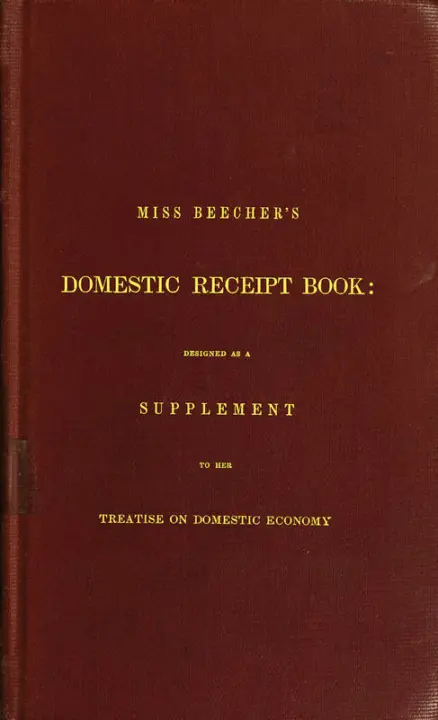
"Miss Beecher's Housekeeper and Healthkeeper" by Catharine Esther Beecher is a comprehensive guide on domestic management written in the late 19th century. The text serves as an extensive encyclopedia focusing on women's responsibilities as housekeepers, wives, and mothers, providing practical advice on economical cooking, health, and homemaking. The book includes over five hundred recipes aimed at promoting health and wellness through proper food preparation. The opening of the work outlines Beecher's intentions to offer valuable guidance to American homemakers, emphasizing the integration of health knowledge into daily household tasks. She expresses her desire to equip women with the knowledge to prepare economical yet healthful meals, share tested recipes, and uphold good domestic practices. Beecher shares her own experiences of recovery from ill health through adherence to the "laws of health," establishing a strong foundation for the importance of domestic labor as essential not just for sustaining a household but also for personal well-being and family education.
Introduction adapted from the source catalogue; source summaries may be automatically generated.
Free to read · English · 174,670 words · No account needed
MAKE TIME FOR A GOOD BOOK
On by default. Untick to stop anonymous reading totals. Each page counts after 10 seconds in view. How this works.
Anonymous counting is on unless you have switched it off.
The multiplication of recipes for cakes, pies, puddings, and desserts is troublesome and needless, inasmuch as a little generalization will reduce them to a comparatively small compass, and yet afford a large variety.
Cake is of three classes, as raised either by eggs, or by yeast, or by powders; and different proportions of flour, sugar, shortening, and wetting make the variety, as it appears in what follows.
General Directions.
Sift flour, roll sugar, sift spices, and prepare fruit beforehand. Break eggs that are to be whipped, one at a time, in a cup, and let none of the yelk go in. Have them cold, and you will get on faster.
Excepting dough-cake, never use the hand in making cake, but a wooden spoon, and in an earthen vessel.
The goodness of cake depends greatly on baking. If too hot at bottom, set the pan on a brick; if too hot at top, cover with paper. If top-crust is formed suddenly, it prevents what is below from rising properly; and so, when the oven is very hot, cover with paper.
When fruit is used, sprinkle the fruit with a little flour to keep it from sinking when baking. Some put fruit in in layers, one in the middle and another near the top, as this spreads it evenly. Put in the flour just before baking.
When using whites beaten to a froth separately, put in the last thing, so that the bubbles of air which make the lightness may be retained more perfectly. Bake as soon as the cake is ready.
Water is as good as milk for most cakes as well as for bread; a mixture of new and stale milk injures the cake.
Streaks in cake are made either by imperfect mixing, or unequal baking, or by sudden decrease of heat before the cake is done. Try when cake is done, by inserting a splinter or straw; if it comes out clean, the cake is done.
The best way to keep cake is in a tin box or stone jar.
Do not wrap cake or bread in a cloth.
In baking, move cake gently if you change its place, or it will fall in streaks. Cake is more nicely baked when the pan is lined with oiled paper, especially in old pans, which often give a bad taste to the bottom and sides of the cake.
Although it is unhealthful to use powders in bread for daily food, the small quantity used for cake will do no harm.
The cake most easily made is raised with soda and cream tartar or other baking powders, and many varieties can be made by the following recipes:
Your reading position is saved on this browser. Take it to another device with a library code. Reading pages adapt to text, rather than matching a printed edition.
Catharine Esther Beecher

Catharine Esther Beecher
Catharine Esther Beecher
Catharine Esther Beecher
BEHIND THE BOOK
This eBook is for the use of anyone anywhere in the United States and most other parts of the world at no cost and with almost no restrictions whatsoever. You may copy it, give it away or re-use it under the terms of the Project Gutenberg License included with this eBook or online at www.gutenberg.org. If you are not located in the United States, you will have to check the laws of the country where you are located before using this eBook. Read the source licence.
The original source file, including credits and licence, is retained by this library. Request an original-format copy at no charge. Please include the book title and Project Gutenberg identifier #55734.
KEEP YOUR CURIOSITY GOING

Charles G. (Charles Griffith) Ross
Hannah Webster Foster

Emily Lawless
Edwin Hamlin Carr

Charles De Lano Hine
Andrew Ure