Modern daughters
Alexander Black
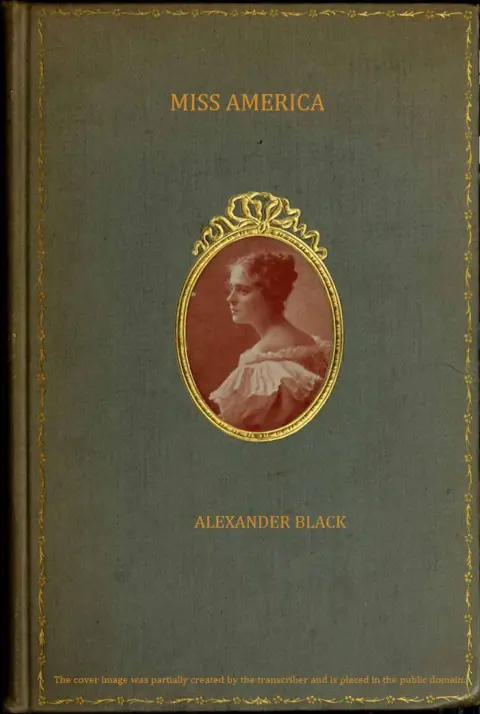
THE CLASSIC COLLECTION · 1898
"Miss America; Pen and Camera Sketches of the American Girl" by Alexander Black is a collection of sociological and artistic observations written in the late 19th century. The work aims to capture the essence of the American girl through both narrative reflections and photographic illustrations, exploring her role and perceived identity in society. The author skillfully discusses various archetypes of the American girl, while also delving into broader themes about femininity, beauty, and cultural expectations within the context of American life. The opening of the narrative sets the tone by acknowledging the challenge of defining the "American type" and highlights the complexities surrounding American femininity. Black discusses various perceptions of American women, from foreign observations to domestic interpretations, emphasizing the rich cultural tapestry that shapes their identities. He establishes a dialogue with the reader about the evolving nature of womanhood in America, introducing a character referred to as the Professor, who embodies modern, educated femininity. Their interactions reveal themes of independence, societal expectations, and the shifting landscape of gender roles, all while setting the stage for a deeper exploration of what it means to be an American girl in this transforming society.
Introduction adapted from the source catalogue; source summaries may be automatically generated.
Free to read · English · 32,486 words · No account needed
MAKE TIME FOR A GOOD BOOK
On by default. Untick to stop anonymous reading totals. Each page counts after 10 seconds in view. How this works.
Anonymous counting is on unless you have switched it off.
One day when the Professor had called a bachelor a bird without feet, and I had retorted that an old maid was a bird without wings, the Professor remarked significantly: “the old maid at least settles better,” and we fell to talking of settling as a proposition. Between the predicament of a bird who cannot fly and that of a bird who cannot alight, there might not be much of a choice, though the Professor did her utmost to prove that the bird condemned to perpetual flitting was in the more pitiful situation. But it occurred to me as significant that the man should dread to lose the privilege of flight, and the woman the privilege of settling. I wondered if there was anything more in it than the accident of contention.
We had agreed with Tolstoi, that “nothing complicates the difficulties of life so much as a lack of harmony between married people”; we had agreed that much of complication arose from a lack of antecedent harmony as to the matrimonial proposition.
“Do you not think, Professor,” I asked, “that much of the trouble comes--that most of the trouble comes--from the simple error of forgetting that an institution cannot be better than those who represent or expound it? Is there not a tendency, a very old one, doubtless, to expect that marriage, in itself, will somehow, transmute the participants? Can marriage be more of a success than people, or less of a failure than people? Marriage is a bond, with a benediction, if you like; but it is not a translation. Surely we cannot take from marriage more than we carry to it--unless it might be the reasonable and natural interest on the combined capital.”
Seeing that I was entirely serious, the Professor said: “My feeling always has been that the chief reason for the want of success in marriage and the deterrent spectacle it so often has presented, is the tradition that any legerdemain of sentiment or ritual can make two people one. Understand me, I believe wholly in the ideal of a spiritual oneness. I have no quarrel with the Scriptures on that score. But we cannot walk the path toward a spiritual oneness with our eyes shut, by lying to ourselves. The interests of two people may be one in the highest sense, they may have one aim, if they are absolutely congenial they may have one wish; but nothing conceivable under the sky ever can make them more or less than two people. The other day some of us were debating whether we should say ‘seven-and-five is twelve’ or ‘seven and five are twelve.’ They called seven and five here a ‘singular concept’ and some were for is in consequence. But at least man and woman are. One and one do not make one, they make two. Indeed, after marriage, the two are more definitely two than they were before. Personal sacrifice proceeds in the order of intimacy. Society is built upon individual sacrifice. Friendship lives by concession, and the intimacy of marriage carries to the extreme point the idea of inter-personal compromise, the recognition of the personality of another. To expect two people to lose, without effort, by the mere fact of marriage, the individuality which they had before the compact, is as absurd as it would be to take two clocks and tie them together with a piece of pink string and expect them instantly to begin keeping absolutely the same time. What would you find in the case of the clocks? They might be mated clocks, and on opposite sides of the room might pass for two clocks keeping precisely the same time. But when you put them side by side you would discover, unless they were supernatural clocks, that they were running some seconds apart, and those few seconds would be as potent in visibly differentiating the clocks thus married as a full minute or more would be on opposite sides of the room. So that when two lovers, who have made elaborate concession to each other before marriage, anticipating each other’s desires, yielding to each other’s prejudices, proceed after marriage to throw the whole burden of preserving harmony upon some vaguely defined potentiality in the marriage relation itself, they certainly are tempting Providence into impatience. It is the lesson of sociology that man must pay something--yield something--for the companionship of the other man, and the closer you wish to be to the other man the more you must pay, the more you must yield. When it comes to the companionship of the man and the woman, and when the woman receives or demands equal rights and privileges, the need of concession is vastly complicated, for now the association is not only between two persons but between two sexes; there is both the individual equation and the sex equation.”
Your reading position is saved on this browser. Take it to another device with a library code. Reading pages adapt to text, rather than matching a printed edition.
Alexander Black
Alexander Black
BEHIND THE BOOK
This eBook is for the use of anyone anywhere in the United States and most other parts of the world at no cost and with almost no restrictions whatsoever. You may copy it, give it away or re-use it under the terms of the Project Gutenberg License included with this eBook or online at www.gutenberg.org. If you are not located in the United States, you will have to check the laws of the country where you are located before using this eBook. Read the source licence.
The original source file, including credits and licence, is retained by this library. Request an original-format copy at no charge. Please include the book title and Project Gutenberg identifier #68869.
KEEP YOUR CURIOSITY GOING

Charles G. (Charles Griffith) Ross
Hannah Webster Foster

Emily Lawless
Edwin Hamlin Carr

Charles De Lano Hine
Andrew Ure