
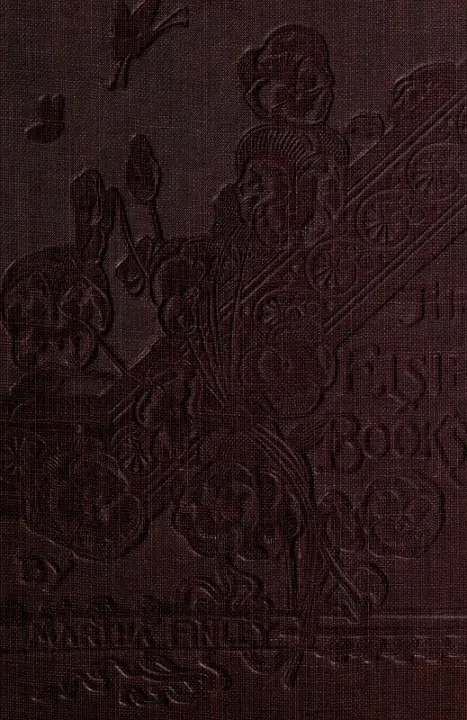
Elsie’s Friends at Woodburn
Martha Finley

THE CLASSIC COLLECTION · 1882
"Mildred's Married Life and A Winter with Elsie Dinsmore" by Martha Finley is a novel written in the late 19th century. The narrative centers on Mildred, who has just embarked on her married life, exploring her joyful experiences with her husband, Dr. Charlie Landreth, while also reflecting on her tight-knit family dynamics. Themes of love, domestic happiness, and the responsibilities that come with newfound prosperity underlie the story, as Mildred navigates her roles as a wife and family member. The opening of the book introduces Mildred in her first winter of marriage, exuding happiness while enjoying the closeness of her family and her husband. She is depicted as a patient and caring partner, who lovingly adapts to her husband's less orderly habits. As they settle into their life together, the narrative balances their intimate moments with Mildred's charitable endeavors and her concerns about the responsibilities that wealth brings. Discussions regarding their financial situation reveal Mildred’s joyful surprise at her husband's hidden wealth, converging her desires to use their resources for good, highlighting her generosity and thoughtful nature. Overall, the beginning sets a warm and heartening tone that promises both personal and familial exploration throughout the story.
Introduction adapted from the source catalogue; source summaries may be automatically generated.
Free to read · English · 61,286 words · No account needed
MAKE TIME FOR A GOOD BOOK
On by default. Untick to stop anonymous reading totals. Each page counts after 10 seconds in view. How this works.
Anonymous counting is on unless you have switched it off.
“I want a sweet sense of Thy pardoning love,
That my manifold sins are forgiven;
That Christ as my Advocate pleadeth above,
That my name is recorded in Heaven.”
“Well, Annis, will you take a riding lesson this afternoon?” asked Mr. Dinsmore as they left the dinner-table; then seeing the little girl hesitate in her reply, “Ah, I think you are tired and would prefer a nap.”
“Yes, sir, I believe I should, if――” again she hesitated.
“If I will not feel hurt?” he asked with a smile. “No, not in the least. And I advise Elsie to try a siesta too. Then we older people shall have two bright little girls to help our enjoyment of the evening.”
Elsie thought it a very nice plan, and the two went away together to
carry it out.
“Your prescription seems to have worked well, Dinsmore,” was Dr. Landreth’s smiling remark as the two young faces showed themselves in the parlor shortly before tea, rosy, bright, and beaming with health and happiness.
“Yes; I find there is no other restorer of wearied nature equal to restful sleep,” Mr. Dinsmore said, regarding his little girl with his wonted look of proud, fond, fatherly affection. “Are you quite rested, daughter?” he asked, drawing her to his side.
“Yes, sir, I don’t believe I shall need any more sleep till after ten o’clock to-night,” she answered, looking straight into his eyes with an arch, sweet smile.
“Ah,” he said, with amusement, “quite an adroit way of putting a request to be allowed to stay up beyond the regular hour for retiring. Well, we’ll see about it when the time comes.”
“And Elsie will be contented with papa’s decision, whatever it may be,” added Rose, smiling affectionately upon the little girl.
“Are you not fond of going to bed early, Elsie?” asked the doctor.
“Yes, sir, generally; but I think it is very nice to stay up a little later sometimes, when papa is willing and I’m not sleepy.”
“And,” remarked Annis, “when the grown-up folks are playing games, or talking in a very interesting way, it does seem hard for little folks to have to go away and leave it all.”
“Yes,” said Mildred, “I can remember that I felt it so when I was a child. Yet I mean to train my boy to go to his bed at a regular and early hour, for I am convinced that it will be for his good.”
“I hope everybody wants to play with letters again to-night,” remarked Annis; “because I’ve hunted up some very hard words for Cousin Horace and Brother Charlie to make out.”
Your reading position is saved on this browser. Take it to another device with a library code. Reading pages adapt to text, rather than matching a printed edition.
Martha Finley

Martha Finley

Martha Finley
Martha Finley
BEHIND THE BOOK
This eBook is for the use of anyone anywhere in the United States and most other parts of the world at no cost and with almost no restrictions whatsoever. You may copy it, give it away or re-use it under the terms of the Project Gutenberg License included with this eBook or online at www.gutenberg.org. If you are not located in the United States, you will have to check the laws of the country where you are located before using this eBook. Read the source licence.
The original source file, including credits and licence, is retained by this library. Request an original-format copy at no charge. Please include the book title and Project Gutenberg identifier #67058.
KEEP YOUR CURIOSITY GOING
Coulson Kernahan

Maurice Baring
Frances Wright
Cécile Tormay

Frederic Jesup Stimson

W. H. P. (William Henry Pope) Jarvis