THE CLASSIC COLLECTION✦A dead man’s diaryCLASSIC FREE BOOKS
A dead man’s diary
Coulson Kernahan
THE CLASSIC COLLECTION · 1912
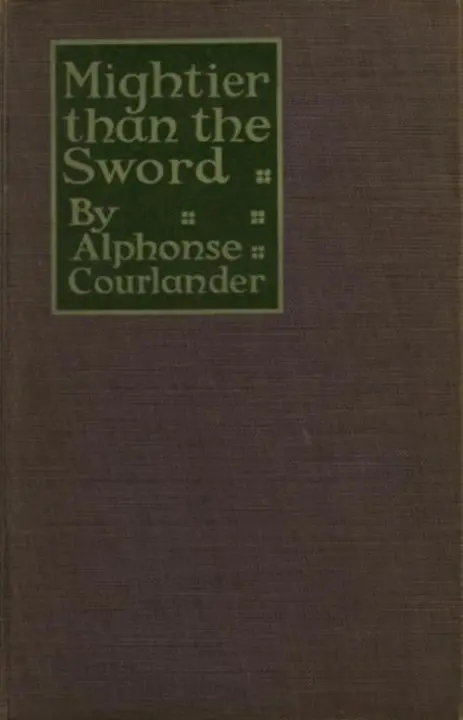
"Mightier than the Sword" by Alphonse Courlander is a novel written in the early 20th century. The story opens with Mr. Pride, a newspaper journalist, who frantically rushes through London to catch the last train home after an evening spent at a high-profile dinner event. It quickly becomes apparent that this work will delve into the life and challenges of journalists, as well as explore the dynamics within the bustling world of Fleet Street, where news and ambition intertwine. The opening of the novel introduces us to Tommy Pride as he navigates the complexities of life as a reporter. After a long day filled with interviews and social engagements, he finds himself in a rush, reflecting on the competitive and often precarious nature of his profession. Through his interactions with fellow journalists in the lift and on the train, we begin to see different attitudes towards their careers, from Pride's determination to succeed to the naivety of younger reporters like Cannock. He is also introduced as a character who finds solace in the familiarity of his routine, underscoring the stark contrast between the romantic notions of journalism and the gritty realities that accompany it. This opening effectively sets the stage for a narrative that promises to unpack the journalism profession during a transformative period in England's history.
Introduction adapted from the source catalogue; source summaries may be automatically generated.
Free to read · English · 97,354 words · No account needed
MAKE TIME FOR A GOOD BOOK
On by default. Untick to stop anonymous reading totals. Each page counts after 10 seconds in view. How this works.
Anonymous counting is on unless you have switched it off.
"My name's Quain," he said, as they were drinking their cups of tea. "Humphrey Quain." He waited longingly, hoping that she would understand why he had told her his name.
She drooped her eyes; everything she did was exaggerated in Humphrey's imagination. She gave him her name as if she were yielding up part of herself to him.
"Mine is Filmer."
It was terribly unsatisfactory just to know that.
"I suppose you'll think me rude ..." he began.
"Oh! you must guess...."
"I never could. I should guess wrong."
"Try," she coaxed. "It begins with L."
He guessed Lily the second time, and she corrected him. "You're nearly right," she said, "it's Lilian."
"Lilian," he echoed, admiringly.
"It's a hateful name," she pouted.
"It's a lovely name," he said.
"Do you really think so?"
"Rather!"
"Why?" she smiled again.
What an absurd question to ask. Why, because--but how could Humphrey
tell her, when they had hardly known each other for a quarter of an
hour.
"I hope you didn't think it rude of me stopping you like that," he
ventured, after a pause.
"Oh no ... though I suppose you think it's dreadful of me to be sitting
with you like this."
To tell the truth, Humphrey considered the whole thing was extraordinarily dashing--that he should be sitting facing her over a cup of tea; to have learnt her name--Lilian Filmer--Lilian, beautiful name!--and to be carrying it off so calmly.
"Not at all," he said.
Her next words fell like a shower of cold water over him.
"You're such a boy," she said, with her eyes smiling indulgently at him.
He resented that, of course. "I'm twenty-one," he said loudly. "You're not more than twenty-one, I'm sure."
"Perhaps I'm not," she answered, taking a tiny watch from her bosom.
She sighed. "I must go."
"Look here," said Humphrey, "are we going to meet again?"
"What do you want to see me again for?"
"I just want to," Humphrey said. "I'm all alone."
"Alone in London," she laughed. "Tragic boy ... oh, how miserable you look. Don't you like being called a boy?"
"I don't mind what you call me, so long as you'll let me see you again. To-morrow's Saturday...."
"Oh! I can't manage to-morrow."
"Well, on Sunday, then."
"I never go out on Sundays."
"On Monday," said Humphrey, desperately.
She considered the matter. "I know I'm engaged on Monday evening."
"We'll have lunch together."
"Very well," she said.
And, after that, they shook hands quite formally, and parted in Fleet Street. He had been in heaven for twenty minutes.
There were three days to Monday.
Lilian!
Your reading position is saved on this browser. Take it to another device with a library code. Reading pages adapt to text, rather than matching a printed edition.
BEHIND THE BOOK
This eBook is for the use of anyone anywhere in the United States and most other parts of the world at no cost and with almost no restrictions whatsoever. You may copy it, give it away or re-use it under the terms of the Project Gutenberg License included with this eBook or online at www.gutenberg.org. If you are not located in the United States, you will have to check the laws of the country where you are located before using this eBook. Read the source licence.
The original source file, including credits and licence, is retained by this library. Request an original-format copy at no charge. Please include the book title and Project Gutenberg identifier #55535.
KEEP YOUR CURIOSITY GOING
Coulson Kernahan

Maurice Baring
Frances Wright
Cécile Tormay

Frederic Jesup Stimson

W. H. P. (William Henry Pope) Jarvis