THE CLASSIC COLLECTION✦A dead man’s diaryCLASSIC FREE BOOKS
A dead man’s diary
Coulson Kernahan
THE CLASSIC COLLECTION · 1912
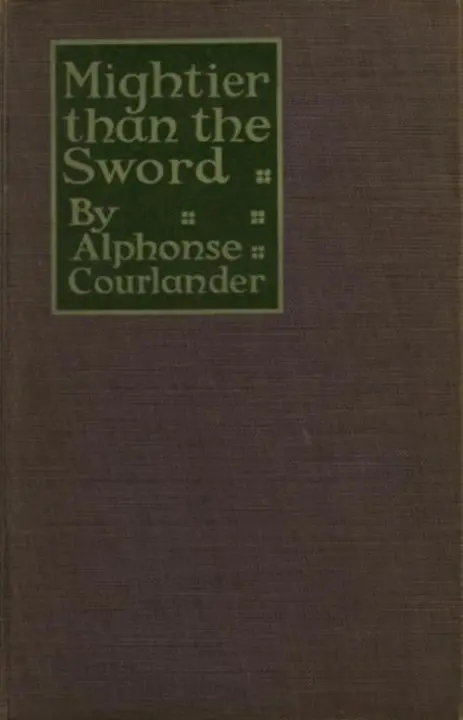
"Mightier than the Sword" by Alphonse Courlander is a novel written in the early 20th century. The story opens with Mr. Pride, a newspaper journalist, who frantically rushes through London to catch the last train home after an evening spent at a high-profile dinner event. It quickly becomes apparent that this work will delve into the life and challenges of journalists, as well as explore the dynamics within the bustling world of Fleet Street, where news and ambition intertwine. The opening of the novel introduces us to Tommy Pride as he navigates the complexities of life as a reporter. After a long day filled with interviews and social engagements, he finds himself in a rush, reflecting on the competitive and often precarious nature of his profession. Through his interactions with fellow journalists in the lift and on the train, we begin to see different attitudes towards their careers, from Pride's determination to succeed to the naivety of younger reporters like Cannock. He is also introduced as a character who finds solace in the familiarity of his routine, underscoring the stark contrast between the romantic notions of journalism and the gritty realities that accompany it. This opening effectively sets the stage for a narrative that promises to unpack the journalism profession during a transformative period in England's history.
Introduction adapted from the source catalogue; source summaries may be automatically generated.
Free to read · English · 97,354 words · No account needed
MAKE TIME FOR A GOOD BOOK
On by default. Untick to stop anonymous reading totals. Each page counts after 10 seconds in view. How this works.
Anonymous counting is on unless you have switched it off.
That afternoon, as he was returning from some engagement, he saw the girl with the smile coming towards him again. Afar off, it seemed, he was aware of her coming. It was as if her presence sent silent messages to him, vibrating through the air. Long before she appeared he had looked expectantly before him, knowing that she would approach him. Something in his mind linked up this neat blue-clad figure with the episode of the morning, and the little registry office, and Wratten saying, with that radiant smile of his, "I think I am going to be happy at last."
And, quite on the impulse of the moment, he made up his mind. She passed him, and left him all a-quiver with excitement, and then he turned and overtook her. His heart was beating quickly in the rhapsody of it all. She stopped, noticing him at her side, hesitating, nervous.
"I say...."
"Oh!" She smiled, and he saw her cheeks flush with colour, and at once he noted her wonderfully slender throat and the mysterious beauty of her breathing.
He was tongue-tied for a moment. She had stopped and he was speaking to her, and he was lost in the miracle of those few seconds, when he realized that in all the loneliness of this vast London, they had met and spoken at last. They stood in a little island of their own making, while people coming and going broke in a hurried surge all about them. The newsboys ran up Fleet Street calling the hour of the latest race, and, above all, came the noise and restlessness of the traffic beating up and down the street.
"I say..." Humphrey began, "it's awfully rude of me to stop you like
this...."
She smiled again. "Not at all," she said, in a gentle voice.
"Could you tell me if Mr Beaver happens to be in the office now?" he
asked.
"I don't think he is," she said. "Why not come up and see?"
"N--no--it doesn't really matter." Humphrey laughed nervously. "I shall see him this evening. We dig together, you know."
"Then it doesn't matter...?" she said.
"It doesn't matter," Humphrey agreed.
He waited forlornly: now she would pass away again, always elusive, just flitting in and out of his life like this, a disturbing factor.
But still she waited, and Humphrey was emboldened.
"I say ..." he stammered. "Won't you come and have a cup of tea?"
She glanced upwards at the clock.
"Do come," he said, half turning to lead the way. "There's a Lyons just
near here."
"Oh, well ..." she laughed and followed him.
Your reading position is saved on this browser. Take it to another device with a library code. Reading pages adapt to text, rather than matching a printed edition.
BEHIND THE BOOK
This eBook is for the use of anyone anywhere in the United States and most other parts of the world at no cost and with almost no restrictions whatsoever. You may copy it, give it away or re-use it under the terms of the Project Gutenberg License included with this eBook or online at www.gutenberg.org. If you are not located in the United States, you will have to check the laws of the country where you are located before using this eBook. Read the source licence.
The original source file, including credits and licence, is retained by this library. Request an original-format copy at no charge. Please include the book title and Project Gutenberg identifier #55535.
KEEP YOUR CURIOSITY GOING
Coulson Kernahan

Maurice Baring
Frances Wright
Cécile Tormay

Frederic Jesup Stimson

W. H. P. (William Henry Pope) Jarvis