Europe and elsewhere
Mark Twain
THE CLASSIC COLLECTION · 1892
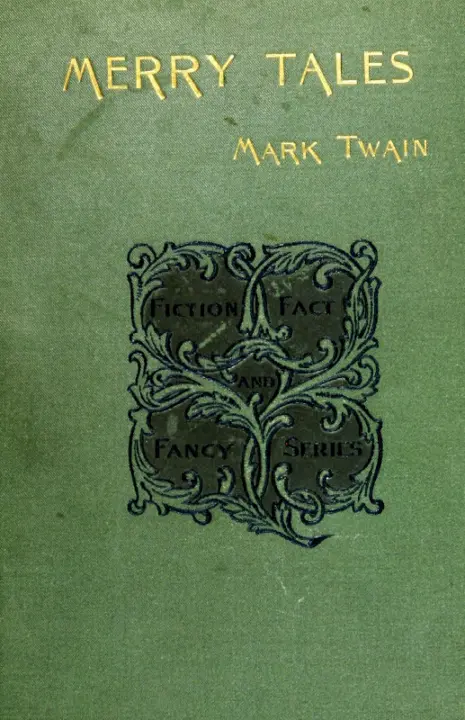
"Merry Tales" by Mark Twain is a collection of humorous short stories written in the late 19th century. The stories encapsulate Twain's signature wit and insightful commentary on human nature, often populated by relatable characters caught in peculiar or absurd situations. This compilation promises to entertain readers with Twain's clever observations and comical storytelling style. The opening of "Merry Tales" provides an introduction to the collection's purpose and context within American literature. It sets the stage for a humorous narrative through the editor's note that emphasizes a desire for accessible, quality literature that reflects American life, particularly highlighting Twain as a quintessential American humorist. The initial story, "The Private History of a Campaign That Failed," introduces readers to a ragtag group of misfit soldiers, their initial excitement about war, and the ensuing comical misadventures that accompany their naive aspirations. Twain captures the absurdity and folly of the characters as they navigate the realities of military life, hinting at deeper themes tied to human folly and the irony of war.
Introduction adapted from the source catalogue; source summaries may be automatically generated.
Free to read · English · 38,132 words · No account needed
MAKE TIME FOR A GOOD BOOK
On by default. Untick to stop anonymous reading totals. Each page counts after 10 seconds in view. How this works.
Anonymous counting is on unless you have switched it off.
“Mortimer, it says, ‘Während eines Gewitters entferne man Metalle, wie z. B., Ringe, Uhren, Schlüssel, etc., von sich und halte sich auch nicht an solchen Stellen auf, wo viele Metalle bei einander liegen, oder mit andern Körpern verbunden sind, wie an Herden, Oefen, Eisengittern u. dgl.’ What does that mean, Mortimer? Does it mean that you must keep metals about you, or keep them away from you?”
“Well, I hardly know. It appears to be a little mixed. All German advice is more or less mixed. However, I think that that sentence is mostly in the dative case, with a little genitive and accusative sifted in, here and there, for luck; so I reckon it means that you must keep some metals about you.”
“Yes, that must be it. It stands to reason that it is. They are in the nature of lightning-rods, you know. Put on your fireman’s helmet, Mortimer; that is mostly metal.”
I got it and put it on,—a very heavy and clumsy and uncomfortable thing on a hot night in a close room. Even my night-dress seemed to be more clothing than I strictly needed.
“Mortimer, I think your middle ought to be protected. Won’t you buckle on your militia sabre, please?”
I complied.
“Now, Mortimer, you ought to have some way to protect your feet. Do please put on your spurs.”
I did it,—in silence,—and kept my temper as well as I could.
“Mortimer, it says, ‘Das Gewitter läuten ist sehr gefährlich, weil die Glocke selbst, sowie der durch das Läuten veranlasste Luftzug und die Höhe des Thurmes den Blitz anziehen könnten.’ Mortimer, does that mean that it is dangerous not to ring the church bells during a thunder-storm?”
“Yes, it seems to mean that,—if that is the past participle of the nominative case singular, and I reckon it is. Yes, I think it means that on account of the height of the church tower and the absence of Luftzug it would be very dangerous (sehr gefährlich) not to ring the bells in time of a storm; and moreover, don’t you see, the very wording—”
“Never mind that, Mortimer; don’t waste the precious time in talk. Get the large dinner-bell; it is right there in the hall. Quick, Mortimer dear; we are almost safe. Oh, dear, I do believe we are going to be saved, at last!”
Our little summer establishment stands on top of a high range of hills, overlooking a valley. Several farm-houses are in our neighborhood,—the nearest some three or four hundred yards away.
Your reading position is saved on this browser. Take it to another device with a library code. Reading pages adapt to text, rather than matching a printed edition.
BEHIND THE BOOK
This eBook is for the use of anyone anywhere in the United States and most other parts of the world at no cost and with almost no restrictions whatsoever. You may copy it, give it away or re-use it under the terms of the Project Gutenberg License included with this eBook or online at www.gutenberg.org. If you are not located in the United States, you will have to check the laws of the country where you are located before using this eBook. Read the source licence.
The original source file, including credits and licence, is retained by this library. Request an original-format copy at no charge. Please include the book title and Project Gutenberg identifier #60900.
KEEP YOUR CURIOSITY GOING
Cécile Tormay

Moritz Busch
Coulson Kernahan
John L. Ransom

Maurice Baring
Frances Wright