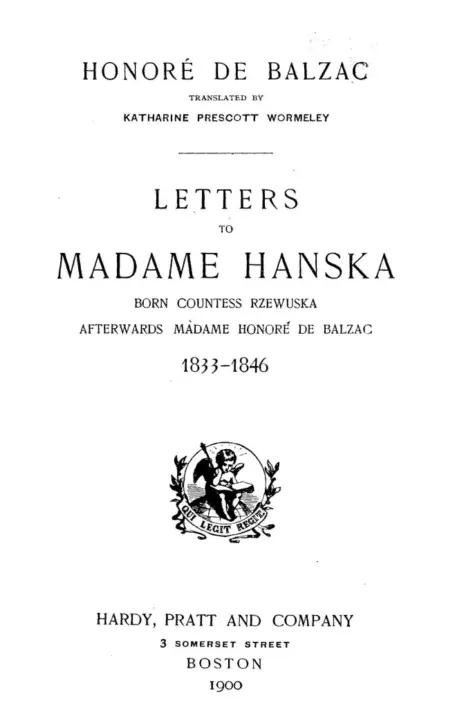
Letters to Madame Hanska, born Countess Rzewuska, afterwards Madame Honoré de Balzac, 1833-1846
Honoré de Balzac
THE CLASSIC COLLECTION · 1851
"Mercadet: A Comedy in Three Acts" by Honoré de Balzac is a play written in the mid-19th century that delves into the intricacies of financial speculation and social aspirations in Parisian society. The narrative revolves around the central character, Mercadet, a speculative businessperson struggling with the weight of his mounting debts while aiming to secure a prosperous marriage for his daughter, Julie. The tension between wealth, poverty, and social expectations plays a critical role as Mercadet navigates between creditors and potential suitors for his daughter. At the start of the play, we are introduced to the Mercadet household, where the servants discuss their fears regarding their master’s financial ruin. As tension builds, Mercadet enters, exhibiting a mix of charm and desperation. He is determined to impress potential creditors through a lavish dinner in hopes of marrying Julie off to a wealthy suitor, the Comte de la Brive, while manipulating his relationships with various creditors. Throughout the unfolding scenes, Mercadet's colorful rhetoric about money and morality highlights his precarious situation as he juggles the needs of his family with the demands of his debtors, setting the stage for comedic and dramatic confrontations ahead.
Introduction adapted from the source catalogue; source summaries may be automatically generated.
Free to read · English · 23,997 words · No account needed
MAKE TIME FOR A GOOD BOOK
On by default. Untick to stop anonymous reading totals. Each page counts after 10 seconds in view. How this works.
Anonymous counting is on unless you have switched it off.
Mericourt
Did I not tell you as much?
Mercadet
I never doubted it.
De la Brive
A chateau--
Mercadet
Good--
De la Brive
And salt marshes, which can be worked as soon as the administration
gives permission. They would yield enormous returns!
Mercadet
Ah, sir, why have we been so late in becoming acquainted! Your land,
then, must be on the seashore.
De la Brive
Without half a league of it.
Mercadet
And it is situated?
De la Brive
Near Bordeaux.
Mercadet
You have vineyards, then?
De la Brive No! fortunately not, for the disposal of wines is a troublesome matter, and, moreover, the cultivation of the vine is exceedingly expensive. My estate was planted with pine trees by my grandfather, a man of genius, who was wise enough to sacrifice himself to the welfare of his descendants. Besides, I have furniture, which you know--
Mercadet
Sir, one moment, a man of business is always careful to dot his i's.
De la Brive (under his voice)
Now we're in for it!
Mercadet With regard to your estate and your marshes,--I see all that can be got out of these marshes. The best way of utilizing them would be to form a company for the exploitation of the marshes of the Brive! There is more than a million in it!
De la Brive
I quite understand that, sir. They need only to be thrown upon the
market.
Mercadet (aside)
These words indicate a certain intelligence in this young man. (Aloud)
Have you any debts? Is your estate mortgaged?
Mericourt
You would not think much of my friend if he had not debts.
De la Brive
I will be frank, sir, there is a mortgage of forty-five thousand
francs on my estate.
Mercadet (aside) An innocent young man! he might easily-- (Rising from his seat. Aloud) You have my consent; you shall be my son-in-law, and are the very man I would choose for my daughter's husband. You do not realize what a fortune you possess.
De la Brive (to Mericourt)
This is almost too good to be true.
Mericourt (to De la Brive)
He is dazzled by the good speculation which he sees ahead.
Mercadet (aside) With government protection, which can be purchased, salt pits may be established. I am saved! (Aloud) Allow me to shake hands with you, after the English fashion. You fulfill all that I expected in a son- in-law. I plainly see you have none of the narrowness of provincial land-holders; we shall understand each other thoroughly.
De la Brive
You must not take it in bad part, sir, if I, on my part, ask you--
Your reading position is saved on this browser. Take it to another device with a library code. Reading pages adapt to text, rather than matching a printed edition.
Honoré de Balzac
Honoré de Balzac
Honoré de Balzac
Honoré de Balzac
BEHIND THE BOOK
This eBook is for the use of anyone anywhere in the United States and most other parts of the world at no cost and with almost no restrictions whatsoever. You may copy it, give it away or re-use it under the terms of the Project Gutenberg License included with this eBook or online at www.gutenberg.org. If you are not located in the United States, you will have to check the laws of the country where you are located before using this eBook. Read the source licence.
The original source file, including credits and licence, is retained by this library. Request an original-format copy at no charge. Please include the book title and Project Gutenberg identifier #14246.
KEEP YOUR CURIOSITY GOING
Maurice Baring
W. B. (William Butler) Yeats
Edward Martyn

John Brougham & Charlotte Brontë
Marguerite Merington
Leonid Andreyev