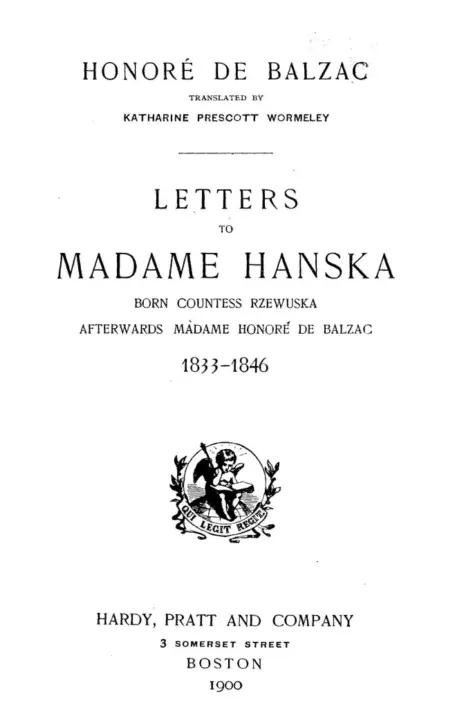
Letters to Madame Hanska, born Countess Rzewuska, afterwards Madame Honoré de Balzac, 1833-1846
Honoré de Balzac
THE CLASSIC COLLECTION · 1851
"Mercadet: A Comedy in Three Acts" by Honoré de Balzac is a play written in the mid-19th century that delves into the intricacies of financial speculation and social aspirations in Parisian society. The narrative revolves around the central character, Mercadet, a speculative businessperson struggling with the weight of his mounting debts while aiming to secure a prosperous marriage for his daughter, Julie. The tension between wealth, poverty, and social expectations plays a critical role as Mercadet navigates between creditors and potential suitors for his daughter. At the start of the play, we are introduced to the Mercadet household, where the servants discuss their fears regarding their master’s financial ruin. As tension builds, Mercadet enters, exhibiting a mix of charm and desperation. He is determined to impress potential creditors through a lavish dinner in hopes of marrying Julie off to a wealthy suitor, the Comte de la Brive, while manipulating his relationships with various creditors. Throughout the unfolding scenes, Mercadet's colorful rhetoric about money and morality highlights his precarious situation as he juggles the needs of his family with the demands of his debtors, setting the stage for comedic and dramatic confrontations ahead.
Introduction adapted from the source catalogue; source summaries may be automatically generated.
Free to read · English · 23,997 words · No account needed
MAKE TIME FOR A GOOD BOOK
On by default. Untick to stop anonymous reading totals. Each page counts after 10 seconds in view. How this works.
Anonymous counting is on unless you have switched it off.
The preceding, Julie and Mme. Mercadet.
Julie
Come, mother, I am sure that Adolphe has triumphed over all obstacles.
Mme. Mercadet
My dear, M. Minard has asked of you the hand of Julie. What answer
have you given him?
Mercadet (going to the desk)
It is for him to say.
Mercadet (aside)
How can I tell her? My heart is breaking.
Julie
What have you got to say, Adolphe?
Minard
Mademoiselle--
Julie
Mademoiselle! Am I no longer Julie to you? Oh, tell me quickly. You
have settled everything with my father, have you not?
Minard
Your father has shown great confidence in me. He has revealed to me
his situation; he has told me--
Julie
Go on, please go on--
Mercadet
I have told him that we are ruined--
Julie
And this avowal has not changed your plans--your love--has it,
Adolphe?
Minard (ardently) My love! (Mercadet, without being noticed, seizes his hand.) I should be deceiving you--mademoiselle--(speaking with great effort)--if I were to say that my intentions are unaltered.
Julie
Oh! It is impossible! Can it be you who speak to me in this strain?
Mme. Mercadet
Julie--
Minard (rousing himself) There are some men to whom poverty adds energy; men capable of daily self-sacrifice, of hourly toil; men who think themselves sufficiently recompensed by a smile from a companion that they love--(checking himself). I, mademoiselle am not one of these. The thought of poverty dismays me. I--I could not endure the sight of your unhappiness.
Julie (bursting into tears and flinging herself into the arms of her
mother)
Oh! Mother! Mother! Mother!
Mme. Mercadet
My daughter--my poor Julie!
Minard (in a low voice to Mercadet)
Is this sufficient, sir?
Julie (without looking at Minard) I should have had courage for both of us. I should always have greeted you with a smile, I should have toiled without regret, and happiness would always have reigned in our home. You could never have meant this, Adolphe. You do not mean it.
Minard (in a low voice)
Let me go--let me leave the house, sir.
Mercadet
Come, then. (He retires to the back of the stage.)
Minard
Good-bye--Julie. A love that would have flung you into poverty is a
thoughtless love. I have preferred to show the love that sacrifices
itself to your happiness--
Julie
No, I trust you no longer. (In a low voice to her mother) My only
happiness would have been to be his.
Justin (announcing visitors)
M. de la Brive! M. de Mericourt!
Mercadet
Take your daughter away, madame. M. Minard, follow me. (To Justin) Ask
them to wait here for a while. (To Minard) I am well satisfied with
you.
Your reading position is saved on this browser. Take it to another device with a library code. Reading pages adapt to text, rather than matching a printed edition.
Honoré de Balzac
Honoré de Balzac
Honoré de Balzac
Honoré de Balzac
BEHIND THE BOOK
This eBook is for the use of anyone anywhere in the United States and most other parts of the world at no cost and with almost no restrictions whatsoever. You may copy it, give it away or re-use it under the terms of the Project Gutenberg License included with this eBook or online at www.gutenberg.org. If you are not located in the United States, you will have to check the laws of the country where you are located before using this eBook. Read the source licence.
The original source file, including credits and licence, is retained by this library. Request an original-format copy at no charge. Please include the book title and Project Gutenberg identifier #14246.
KEEP YOUR CURIOSITY GOING
Maurice Baring
W. B. (William Butler) Yeats
Edward Martyn

John Brougham & Charlotte Brontë
Marguerite Merington
Leonid Andreyev