
Two Women, 1862; a Poem
Constance Fenimore Woolson
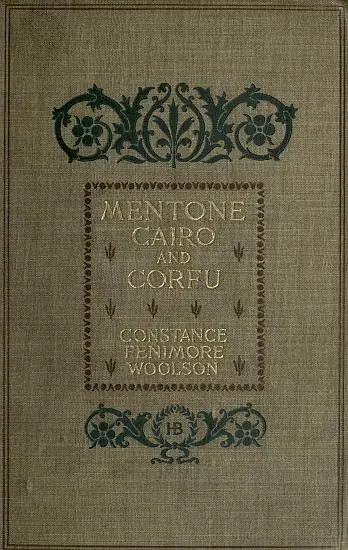
THE CLASSIC COLLECTION · 1895
"Mentone, Cairo, and Corfu" by Constance Fenimore Woolson is a collection of travel sketches written in the late 19th century. The work chronicles the author's experiences and observations as she visits three distinct Mediterranean destinations: Mentone, Cairo, and Corfu, each portrayed vividly through a blend of narrative and reflection. The sketches bring to life the cultures, landscapes, and notable interactions with diverse characters, likely featuring characters like Mrs. Trescott, her daughter Janet, and Professor Mackenzie among others. At the start of the collection, Woolson introduces readers to Mentone, detailing the arrival of a group of travelers, including herself through her character Jane Jefferson. They settle into a hotel in the picturesque town, and the narrative captures their appreciation of the sunny environment, local quirks, and the captivating views of the Mediterranean. The characters engage in lively discussions about the beauty of their surroundings, the importance of the sun, and the fascinating history of the area, all while encountering humorous interactions and insights about each other, setting an inviting tone for the adventures and observations that follow in Cairo and Corfu.
Introduction adapted from the source catalogue; source summaries may be automatically generated.
Free to read · English · 72,794 words · No account needed
MAKE TIME FOR A GOOD BOOK
On by default. Untick to stop anonymous reading totals. Each page counts after 10 seconds in view. How this works.
Anonymous counting is on unless you have switched it off.
It was eleven o'clock in the morning when our steamer reached her anchorage before the island town. Immediately she was surrounded by small boats, whose crews were perfectly lawless, demanding from strangers whatever they thought they could get, and obtaining their demands, because there was no way to escape them except by building a raft. Upon reaching land one forgets the extortion, for the windows of the hotel overlook the esplanade, and this open space amiably offers to persons who are interested in first impressions a panoramic history of two thousand five hundred years in a series of striking mementos. Let me premise that as regards any solid knowledge of these islands, only a contemptible smattering can be obtained in a stay so short as mine. Corfu and her sisters have borne a conspicuous part in what we used to call ancient history. Through the Roman days they appear and reappear. In the times of the Crusaders their position made them extremely important. Years of study could not exhaust their records, nor months of research their antiquities. To comprehend them rightfully one must indeed be an historian, an archaeologist, and a painter at one and the same time, and one must also be good-natured. Few of us can hope to unite all these. The next best thing, therefore, is to go and see them with whatever eyes and mind we happen to possess. Good-nature will perhaps return after the opening encounter with the boatmen is over.
From our windows, then, we could note, first, the Citadel, high on its rock, three hundred feet above the town. The oldest part of the present fortress was erected in 1550; but the site has always been the stronghold. Corinthians, Athenians, Spartans, Macedonians, and Romans have in turn held the island, and this rock is the obvious keep. Later came four hundred years of Venetian control, and I am ashamed to add that the tokens of this last-named period were to me more delightful than any of the other memorials. I say "ashamed," for why should one be haunted by Venice in Greece? With the Parthenon to look forward to, why should the lion of St. Mark, sculptured on Corfu facades, be a thing to greet with joy? Many of us are familiar with the disconsolate figures of some of our fellow-countrymen and countrywomen in the galleries of Europe, tired and dejected tourists wandering from picture to picture, but finding nothing half so interesting as the memory of No. 4699 Columbus Avenue at home. I am afraid it is equally narrow to be scanning Corfu, Athens, Cairo, and the sands of the desert itself for something that reminds one of another place, even though that place be the enchanting pageant of a town at the head of the Adriatic. History, however, as related by the esplanade, pays no attention to these aberrations of the looker-on; its story goes steadily forward. The lions of St. Mark on the facades, and another memento of the Doges--namely, the statue of Count von der Schulenburg, who commanded the Venetian forces in the great defence of Corfu in 1716--these memorials have as companions various tokens of the English occupation, which, following that of Venice, continued through forty-nine years--that is, from 1815 to 1863. Before this there had been a short period of French dominion; but the esplanade, so far as I could discover, contains no memorial of it, unless Napoleon's phrase can stand for one--and I think it can. The souvenirs of the British rule are conspicuous. The first is the palace built for the English Governor, a functionary who bore the sonorous official name of Lord High Commissioner, a title which was soon shortened to the odd abbreviation "the Lord High." This palace is an uninteresting construction stretching stiffly across the water-side of the esplanade, and cutting off the view of the harbor. It is now the property of the King of Greece, but at present it is seldom occupied. While we were at Corfu its ghostliness was enlivened for a while; Prince Henry of Prussia was there with his wife. They had left their yacht (if so large a vessel as the Irene can be called a yacht), and were spending a week at the palace. An hour after their departure entrance was again permitted, and an old man, still trembling from the excitement of the royal sojourn, conducted us from room to room. All was ugly. Fading flowers in the vases showed that an attempt had been made to brighten the place; but the visitors must have been endowed with a strong natural cheerfulness to withstand with success such a mixture of the commonplace and the dreary as the palace presents. They had the magnificent view to look at, and there was always the graceful silhouette of the Irene out on the water. She could come up at any time and take them away; it was this, probably, that kept them alive.
Your reading position is saved on this browser. Take it to another device with a library code. Reading pages adapt to text, rather than matching a printed edition.
Constance Fenimore Woolson

Constance Fenimore Woolson

Constance Fenimore Woolson
Constance Fenimore Woolson
BEHIND THE BOOK
This eBook is for the use of anyone anywhere in the United States and most other parts of the world at no cost and with almost no restrictions whatsoever. You may copy it, give it away or re-use it under the terms of the Project Gutenberg License included with this eBook or online at www.gutenberg.org. If you are not located in the United States, you will have to check the laws of the country where you are located before using this eBook. Read the source licence.
The original source file, including credits and licence, is retained by this library. Request an original-format copy at no charge. Please include the book title and Project Gutenberg identifier #33367.
KEEP YOUR CURIOSITY GOING
Wilfrid Scawen Blunt
Wilfrid Scawen Blunt

E. W. (Edgar Watson) Howe
Francis Greenleaf Allinson & Anne C. E. (Anne Crosby Emery) Allinson
Cyrenus Cole

John Martineau