
Two Women, 1862; a Poem
Constance Fenimore Woolson
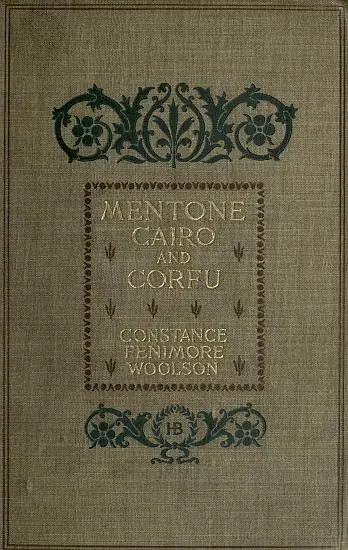
THE CLASSIC COLLECTION · 1895
"Mentone, Cairo, and Corfu" by Constance Fenimore Woolson is a collection of travel sketches written in the late 19th century. The work chronicles the author's experiences and observations as she visits three distinct Mediterranean destinations: Mentone, Cairo, and Corfu, each portrayed vividly through a blend of narrative and reflection. The sketches bring to life the cultures, landscapes, and notable interactions with diverse characters, likely featuring characters like Mrs. Trescott, her daughter Janet, and Professor Mackenzie among others. At the start of the collection, Woolson introduces readers to Mentone, detailing the arrival of a group of travelers, including herself through her character Jane Jefferson. They settle into a hotel in the picturesque town, and the narrative captures their appreciation of the sunny environment, local quirks, and the captivating views of the Mediterranean. The characters engage in lively discussions about the beauty of their surroundings, the importance of the sun, and the fascinating history of the area, all while encountering humorous interactions and insights about each other, setting an inviting tone for the adventures and observations that follow in Cairo and Corfu.
Introduction adapted from the source catalogue; source summaries may be automatically generated.
Free to read · English · 72,794 words · No account needed
MAKE TIME FOR A GOOD BOOK
On by default. Untick to stop anonymous reading totals. Each page counts after 10 seconds in view. How this works.
Anonymous counting is on unless you have switched it off.
At last those famous lines were actualities, for surely this was the sea of the Jumblies, and those heights without doubt were "the hills of Chankly Bore." (There are people, I believe, who do not care for the Jumblies. There are persons who do not care for Alice in Wonderland, nor for Brer Rabbit, when he played on his triangle down by the brook.)
The sea which I saw was of a miraculously blue tint; in the distance the cliffs of a mountainous island rose boldly from the water, their color that of a violet pansy; a fishing-boat with red sails was crossing the foreground; over all glittered an atmosphere so golden that it was like that of sunset in other lands, though the sky, at the same time, had unmistakably the purity of early morning. Later, on the deck, during the broadly practical time of after breakfast, this view, instead of diminishing in attraction, grew constantly more fair. The French novelist of to-day, Paul Bourget, describes Corfu as "so lovely that one wants to take it in one's arms!" Another Frenchman, who was not given to the making of phrases, no less a personage than Napoleon Bonaparte, has left upon record his belief that Corfu has "the most beautiful situation in the world." What, then, is this beauty? What is this situation?
First, there is the long and charming approach, with the snow-capped mountains of Albania, in European Turkey, looming up against the sky at the end; then comes the landlocked harbor; then the picturesque old town, its high stone houses, all of creamy hue, crowded together on the hill-side above the sea-wall, with here and there a bell-tower shooting into the blue. Below is the busy, many-colored port. Above towers the dark double fortress on its rock. And, finally, the dense, grove-like vegetation of the island encircles all, and its own mountain-peaks rise behind, one of them attaining a height of three thousand feet. There are other islands of which all this, or almost all, can be said--Capri, for instance. But at Corfu there are two attributes peculiar to the region; these are: first, the color; second, the transparency. Although the voyage from Brindisi hardly occupies twelve hours, the atmosphere is utterly unlike that of Italy; there is no haze; all is clear. Some of us love the Italian haze (which is not in the least a mist), that soft veil which makes the mountains look as if they were covered with velvet. But a love of this softness need not, I hope, make us hate everything that is different. Greece (and Corfu is a Greek island) seemed to me all light--the lightest country in the world. In other lands, if we climb a high mountain and stand on its bald summit at noon, we feel as if we were taking a bath in light; in Greece we have this feeling everywhere, even in the valleys. Euripides described his countrymen as "forever delicately tripping through the pellucid air," and so their modern descendants trip to this day. This dry atmosphere has an exciting effect upon the nervous energy, and the faces of the people show it. It has also, I believe, the defect of this good quality--namely, an over-stimulation, which sometimes produces neuralgia. In some respects Americans recognize this clearness of the atmosphere, and its influence, good and bad; the air of northern New England in the summer, and of California at the same season, is not unlike it. But in America the transparency is more white, more blank; we have little of the coloring that exists in Greece, tints whose intensity must be seen to be believed. The mountains, the hills, the fields, are sometimes bathed in lilac. Then comes violet for the plains, while the mountains are rose that deepens into crimson. At other times salmon, pink, and purple tinges are seen, and ochre, saffron, and cinnamon brown. This description applies to the whole of Greece, but among the Ionian Islands the effect of the color is doubled by the wonderful tint of the surrounding sea. I promise not to mention this hue again; hereafter it can be taken for granted, for it is always present; but for this once I must say that you may imagine the bluest blue you know--the sky, lapis lazuli, sapphires, the eyes of some children, the Bay of Naples--and the Ionian Sea is bluer than any of these. And nowhere else have I seen such dear, queer little foam sprays. They are so small and so very white on the blue, and they curl over the surface of the water even when the sea is perfectly calm, which makes me call them queer. You meet them miles from land. And all the shores are whitened with their never-ceasing play. It is a pygmy surf.
Your reading position is saved on this browser. Take it to another device with a library code. Reading pages adapt to text, rather than matching a printed edition.
Constance Fenimore Woolson

Constance Fenimore Woolson

Constance Fenimore Woolson
Constance Fenimore Woolson
BEHIND THE BOOK
This eBook is for the use of anyone anywhere in the United States and most other parts of the world at no cost and with almost no restrictions whatsoever. You may copy it, give it away or re-use it under the terms of the Project Gutenberg License included with this eBook or online at www.gutenberg.org. If you are not located in the United States, you will have to check the laws of the country where you are located before using this eBook. Read the source licence.
The original source file, including credits and licence, is retained by this library. Request an original-format copy at no charge. Please include the book title and Project Gutenberg identifier #33367.
KEEP YOUR CURIOSITY GOING
Wilfrid Scawen Blunt
Wilfrid Scawen Blunt

E. W. (Edgar Watson) Howe
Francis Greenleaf Allinson & Anne C. E. (Anne Crosby Emery) Allinson
Cyrenus Cole

John Martineau