
The Writing of News A Handbook with Chapters on Newspaper Correspondence and Copy Reading
Charles G. (Charles Griffith) Ross
THE CLASSIC COLLECTION · 1881
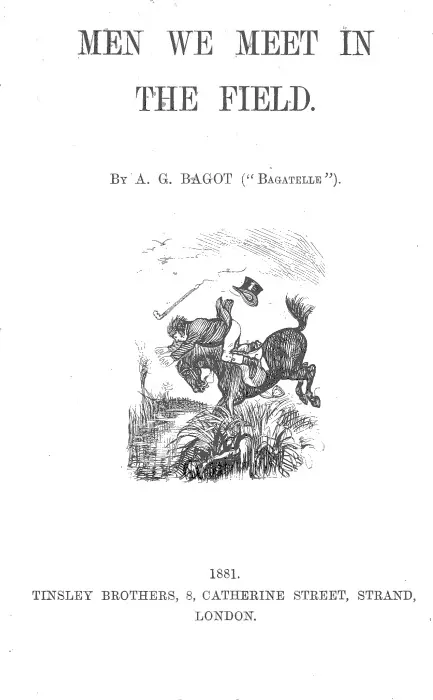
"Men We Meet in the Field; or, The Bullshire Hounds" by A. G. Bagot is a collection of character sketches related to the world of hunting, written in the late 19th century. The work offers an insightful perspective on the hunting community, specifically the personalities encountered in the Bullshire hunting field, including various roles such as the Master, Huntsman, Secretary, and local Farmers. Through these portrayals, readers can expect a lively exploration of the social dynamics and character traits displayed in the hunting circle. The opening of the work sets the stage by highlighting the unique environment of the hunting field as a lens through which human character is revealed. The author introduces the Bullshire Hounds, emphasizing that each character—whether a determined huntsman or a whimsical local farmer—reveals different aspects of their personality amidst the excitement and unpredictability of the hunt. Bagot notes the contrasts between individuals such as the young and old members of the hunting community, the exciting journey of a day out with hounds, and the underlying social commentary on the transformations in traditional hunting practices. Overall, the beginning encapsulates a vivid sense of camaraderie and rivalry that defines the hunting experience.
Introduction adapted from the source catalogue; source summaries may be automatically generated.
Free to read · English · 52,333 words · No account needed
MAKE TIME FOR A GOOD BOOK
On by default. Untick to stop anonymous reading totals. Each page counts after 10 seconds in view. How this works.
Anonymous counting is on unless you have switched it off.
"Harold, it's my idea the fox will make over the Swill," says Sir John to his brother, as they gallop along the grass. "There are two or three deuced stiff ploughs before we get there, and as you can't jump it we had better take the road and round by the bridge."
"Not I; I'm going with the hounds," replies Harold. "If they go over I
can but go in and out."
"Don't you be a fool," retorts the Master. "By Jove, I'm right! it is for the Swill," as the hounds swung to the left towards the line of pollards that denote the course of that "meandering streamlet."
"Hold hard, young gentlemen, hold hard," roars Tom, as they hang for a moment on the plough, and five or six reeking ponies get unpleasantly near his darlings. "You canna jump Swill; you must go round by t' bridge."
But they pay no heed to either him or paternal warning, and pound away over the plough towards the willows.
"Here, I'm dashed if some on 'em won't get drownded, for they'll have it, as sure as my name's Wilding," he continues.
The two Simms and a few adventurous spirits follow in the wake of the lads, while the rest of the field follow the Master to the bridge. As the hounds plunge in Tom gallops off for the same goal, saying: "This way, young gents, this way." He might as well have spared his breath, for Eton is not going to be beaten by Harrow, nor Winchester by Rugby, nor Clifton by any of them, and the rivals feel the honour of their schools to be at stake. Harold again heads the charge, and the young 'un makes a gallant effort, just getting his fore-legs on the opposite bank. Quick as thought the boy is over his head on terra firma, while the gray falls back into the brook. "Bravo," shout the rest of the field, "bravo!" and, as his horse scrambles out, Harold's heart swells with pride, and he says to his brother: "The dear old school bested them all."
Harrow, Rugby, Winchester, and Clifton, all go at it in a lump, and all four are splashing about together, when little Phillips, a lad of twelve, who has just completed his first half, at Marlborough, comes down, and handling his rat of a pony down the bank, the pair swim across, and out the other side they scramble, the urchin shouting at the top of his voice: "Hooray, Eton first, Marlborough second."
All, happily, manage, contrary to Tom's expectations, to escape being "drownded;" and, wet as they are, ride harder than ever to make up their "leeway."
Your reading position is saved on this browser. Take it to another device with a library code. Reading pages adapt to text, rather than matching a printed edition.
BEHIND THE BOOK
This eBook is for the use of anyone anywhere in the United States and most other parts of the world at no cost and with almost no restrictions whatsoever. You may copy it, give it away or re-use it under the terms of the Project Gutenberg License included with this eBook or online at www.gutenberg.org. If you are not located in the United States, you will have to check the laws of the country where you are located before using this eBook. Read the source licence.
The original source file, including credits and licence, is retained by this library. Request an original-format copy at no charge. Please include the book title and Project Gutenberg identifier #53691.
KEEP YOUR CURIOSITY GOING
Charles G. (Charles Griffith) Ross
Hannah Webster Foster

Emily Lawless
Edwin Hamlin Carr

Charles De Lano Hine
Andrew Ure