
The Writing of News A Handbook with Chapters on Newspaper Correspondence and Copy Reading
Charles G. (Charles Griffith) Ross
THE CLASSIC COLLECTION · 1881
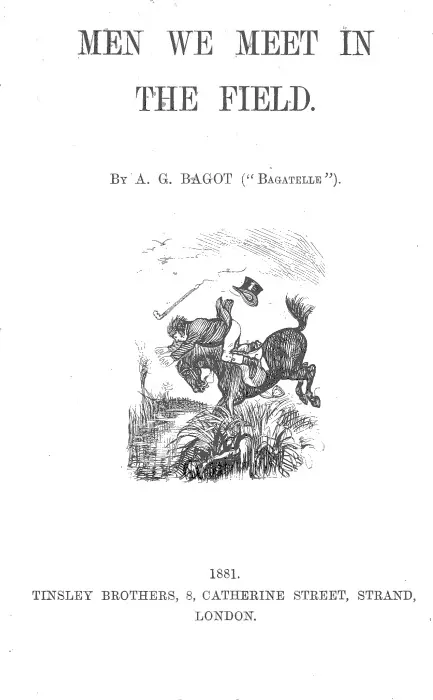
"Men We Meet in the Field; or, The Bullshire Hounds" by A. G. Bagot is a collection of character sketches related to the world of hunting, written in the late 19th century. The work offers an insightful perspective on the hunting community, specifically the personalities encountered in the Bullshire hunting field, including various roles such as the Master, Huntsman, Secretary, and local Farmers. Through these portrayals, readers can expect a lively exploration of the social dynamics and character traits displayed in the hunting circle. The opening of the work sets the stage by highlighting the unique environment of the hunting field as a lens through which human character is revealed. The author introduces the Bullshire Hounds, emphasizing that each character—whether a determined huntsman or a whimsical local farmer—reveals different aspects of their personality amidst the excitement and unpredictability of the hunt. Bagot notes the contrasts between individuals such as the young and old members of the hunting community, the exciting journey of a day out with hounds, and the underlying social commentary on the transformations in traditional hunting practices. Overall, the beginning encapsulates a vivid sense of camaraderie and rivalry that defines the hunting experience.
Introduction adapted from the source catalogue; source summaries may be automatically generated.
Free to read · English · 52,333 words · No account needed
MAKE TIME FOR A GOOD BOOK
On by default. Untick to stop anonymous reading totals. Each page counts after 10 seconds in view. How this works.
Anonymous counting is on unless you have switched it off.
"Delighted to see you, Mr. Simpson," said the Colonel, taking that gentleman's somewhat flabby hand, and introducing him to the others in turn. "Ah Jack, my boy, how are you? I have such a horse for you; but no spurs allowed, mind."
"All right, uncle," replied Jack, coming to the fire; "I'll remember. But how are you all? Florence, you are getting most abominably fat. Why, Milly, ain't you going to say How do you do to me?--not that way," as Mildred put out her hand. "I ask you, is that the way to welcome your long-lost cousin? Come to my arms"--a proceeding that he promptly tried to put into force, and had he not stumbled head over heels over Ethel, who from her position on the ground he had not noticed, would have succeeded in his endeavour.
As it was, like a drowning man, he clutched at the first thing that came to hand, which, happening to be Simpson's coat-tail, brought that worthy gentleman down with him, and cut short the polite little speech he was about to address to Mildred.
It was rather hard lines on the unfortunate individual, for all the way down in the train he had been (when Jack's eye was not upon him) rehearsing it, and now it was lost for ever.
"I beg your ten thousand pardons, Simpson," said Jack, struggling to his feet. "Why, it's Ethel. What on earth do you go and curl yourself up like a fox-terrier on the hearthrug for, and make people do these pantomime tricks over you? You nearly were the death of two of Her Majesty's most esteemed subjects."
"Heavy fall in shirtings," whispered the irrepressible Tom to Mildred, who was obliged to go out of the room, ostensibly to see the housekeeper, but in reality to hide her laughter.
"Not hurt, I hope?" asked the Colonel.
"No--ah--Colonel Vivian, I thank you; but I must apologise to Miss Vivian. It must have astonished her. Ah, she is gone," said Simpson, who was, if possible, of a more rosy hue than ever.
"Oh, Mildred's all right," put in Jack; "it's not the first time she has seen a man down by many a hundred, nor will it be the last if hounds run to-morrow. Which is my room, uncle? I'll show Simpson his too. It's nearly time to dress."
"You are in your old quarters, Jack, and Mr. Simpson is in the
bachelor's room, which, I hope, he will find comfortable," said his
uncle.
Your reading position is saved on this browser. Take it to another device with a library code. Reading pages adapt to text, rather than matching a printed edition.
BEHIND THE BOOK
This eBook is for the use of anyone anywhere in the United States and most other parts of the world at no cost and with almost no restrictions whatsoever. You may copy it, give it away or re-use it under the terms of the Project Gutenberg License included with this eBook or online at www.gutenberg.org. If you are not located in the United States, you will have to check the laws of the country where you are located before using this eBook. Read the source licence.
The original source file, including credits and licence, is retained by this library. Request an original-format copy at no charge. Please include the book title and Project Gutenberg identifier #53691.
KEEP YOUR CURIOSITY GOING
Charles G. (Charles Griffith) Ross
Hannah Webster Foster

Emily Lawless
Edwin Hamlin Carr

Charles De Lano Hine
Andrew Ure