
The Writing of News A Handbook with Chapters on Newspaper Correspondence and Copy Reading
Charles G. (Charles Griffith) Ross
THE CLASSIC COLLECTION · 1881
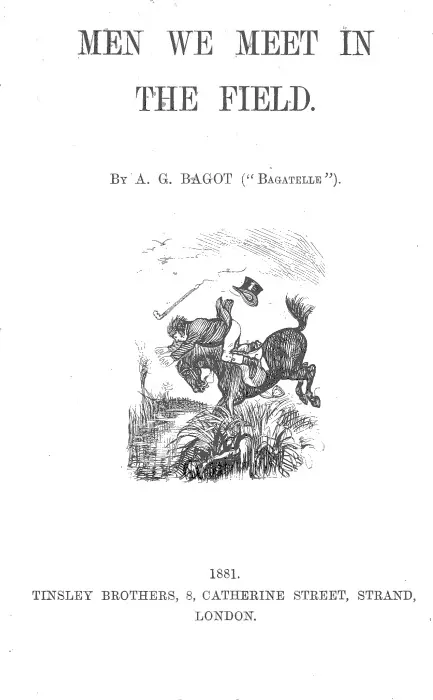
"Men We Meet in the Field; or, The Bullshire Hounds" by A. G. Bagot is a collection of character sketches related to the world of hunting, written in the late 19th century. The work offers an insightful perspective on the hunting community, specifically the personalities encountered in the Bullshire hunting field, including various roles such as the Master, Huntsman, Secretary, and local Farmers. Through these portrayals, readers can expect a lively exploration of the social dynamics and character traits displayed in the hunting circle. The opening of the work sets the stage by highlighting the unique environment of the hunting field as a lens through which human character is revealed. The author introduces the Bullshire Hounds, emphasizing that each character—whether a determined huntsman or a whimsical local farmer—reveals different aspects of their personality amidst the excitement and unpredictability of the hunt. Bagot notes the contrasts between individuals such as the young and old members of the hunting community, the exciting journey of a day out with hounds, and the underlying social commentary on the transformations in traditional hunting practices. Overall, the beginning encapsulates a vivid sense of camaraderie and rivalry that defines the hunting experience.
Introduction adapted from the source catalogue; source summaries may be automatically generated.
Free to read · English · 52,333 words · No account needed
MAKE TIME FOR A GOOD BOOK
On by default. Untick to stop anonymous reading totals. Each page counts after 10 seconds in view. How this works.
Anonymous counting is on unless you have switched it off.
At first folks shook their heads, and muttered "Quackery;" but one or two bad cases, which had been given over as hopeless by the principal, being successfully pulled through by the assistant, they began to think that after all there was something in the young fellow; and the surgical skill he displayed when, together with every other available medical man, he was called to the scene of the fearful railway accident at Billingdon, confirmed their opinion.
A year after this, old Johnstone died suddenly, and Wilson, after a brisk competition, bought his practice. Directly he felt himself his own master, he allowed his ideas a free scope, and consequently in a very short time his undoubted talent made itself known throughout the country-side, and the practice increased so enormously that, young and energetic as he was, he found it necessary to take an assistant, choosing after much deliberation the son of an old college chum and fellow-student.
"Why, Doctor, who'd have thought of seeing you to-day? I thought you were at Lorton all last night," exclaims Mr. Noble, Lord Slowboy's agent, who rides up as Sir John finishes his repartee.
"So I was, Noble," replies our M.D., "but her ladyship, I am thankful to say, let me off at half-past five; and, as I was just telling Sir John, there being nothing else for me to do this weather, I thought I would come out on the chance of a job in the field."
"I hope you may be disappointed, then, for once. What a blood-thirsty villain! Did you ever hear such a thing, Boulter?" says the Master to the Secretary, who has just arrived on a new steed.
"Hear what?" rejoins that worthy.
"Why," continues Sir John, "the Doctor here says he saw you pass his window on that new horse, and has come out to follow in your wake all day, as he feels convinced you will break your neck, leg, or arm, or do something which he can turn into a fee."
"Don't you believe it," interrupts Mr. Wilson with a laugh; "it would not pay me to mend you, for directly you got well you'd be dunning me for a subscription, and I might whistle for my fees. But look at Tom; he evidently thinks it is time to be moving. Who-ho, old lady" (to his horse), "who-ho," as old Tom, having got the signal, trots by with the pack, and, lifting his cap in response to the Doctor's greeting, says:
"Main glad to see you out, Doctor; hope we shall find a good 'un for
you."
Your reading position is saved on this browser. Take it to another device with a library code. Reading pages adapt to text, rather than matching a printed edition.
BEHIND THE BOOK
This eBook is for the use of anyone anywhere in the United States and most other parts of the world at no cost and with almost no restrictions whatsoever. You may copy it, give it away or re-use it under the terms of the Project Gutenberg License included with this eBook or online at www.gutenberg.org. If you are not located in the United States, you will have to check the laws of the country where you are located before using this eBook. Read the source licence.
The original source file, including credits and licence, is retained by this library. Request an original-format copy at no charge. Please include the book title and Project Gutenberg identifier #53691.
KEEP YOUR CURIOSITY GOING
Charles G. (Charles Griffith) Ross
Hannah Webster Foster

Emily Lawless
Edwin Hamlin Carr

Charles De Lano Hine
Andrew Ure