
The Writing of News A Handbook with Chapters on Newspaper Correspondence and Copy Reading
Charles G. (Charles Griffith) Ross
THE CLASSIC COLLECTION · 1881
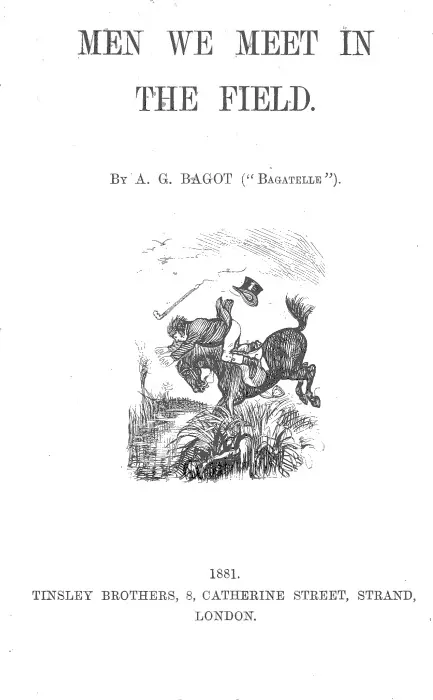
"Men We Meet in the Field; or, The Bullshire Hounds" by A. G. Bagot is a collection of character sketches related to the world of hunting, written in the late 19th century. The work offers an insightful perspective on the hunting community, specifically the personalities encountered in the Bullshire hunting field, including various roles such as the Master, Huntsman, Secretary, and local Farmers. Through these portrayals, readers can expect a lively exploration of the social dynamics and character traits displayed in the hunting circle. The opening of the work sets the stage by highlighting the unique environment of the hunting field as a lens through which human character is revealed. The author introduces the Bullshire Hounds, emphasizing that each character—whether a determined huntsman or a whimsical local farmer—reveals different aspects of their personality amidst the excitement and unpredictability of the hunt. Bagot notes the contrasts between individuals such as the young and old members of the hunting community, the exciting journey of a day out with hounds, and the underlying social commentary on the transformations in traditional hunting practices. Overall, the beginning encapsulates a vivid sense of camaraderie and rivalry that defines the hunting experience.
Introduction adapted from the source catalogue; source summaries may be automatically generated.
Free to read · English · 52,333 words · No account needed
MAKE TIME FOR A GOOD BOOK
On by default. Untick to stop anonymous reading totals. Each page counts after 10 seconds in view. How this works.
Anonymous counting is on unless you have switched it off.
And as Sir John, nodding to the Huntsman, says: "High field Gorse, Tom," James's face beams with pleasure, and, together with his father, he trots off to superintend the arrangements. "A chip of the old block" is the general verdict, as James, sending his "young 'un" at a low post and rails, which he hits hard all round, cuts off a corner, and canters on to the bottom end, where he remains as mute as a sphinx, merely telegraphing to Tom and his father that he was there. Just as the hounds are thrown in, a boy runs up to him and, with a grin, says: "Mayster, ay's theer; I'n sayd 'un. Ay's down at bottom end by t' ould stump."
"All right, Jim, my lad; you keep quiet. If he's there you shall have a bob," replies James, burning with impatience as he hears no sound save Tom's "Eleu, in, eleu 'ave at 'm. Eugh, boys."
"Blank, by the Lord Harry!" he ejaculates, as two or three hounds appear outside; and, turning to the boy, he asks: "My lad, are you sure you saw a fox?"
"I'n sayd 'un; ay's theer," is the reply. "Ay mun bay up stump."
"Here," cries James, "take my whip, and if you can get him out your bob
will be two-and-six."
The boy does not wait a moment, but, heedless of furze, dashes on to where the old ivy-covered stump stands, and is soon swarming up to the top. A crack of the whip, a scuffle, a shout from the lad of "Look out, mayster," and a fine old dog jumps out and makes off right under James's nose.
"Good lad," he says, as the boy returns with his whip; "here, catch." And while James utters a view holloa that would wake the dead, the lad, having spat upon it for luck, transfers half-a-crown to his pocket.
"All right, Tom; down the field and over the fence to the right. Come on, dad;" and Tom, getting his hounds on the line in a twinkling, the trio are hard at it.
"Pull that young 'un together," says old Simms as they neared the fence; "it's a big 'un." His old mare slips over as if it was child's play. Not so the "young 'un." Going like an express train, he never rises an inch, and James finds himself and the nag somewhat mixed up on the other side.
"That's a buster. No damage, eh?" says Tom.
Your reading position is saved on this browser. Take it to another device with a library code. Reading pages adapt to text, rather than matching a printed edition.
BEHIND THE BOOK
This eBook is for the use of anyone anywhere in the United States and most other parts of the world at no cost and with almost no restrictions whatsoever. You may copy it, give it away or re-use it under the terms of the Project Gutenberg License included with this eBook or online at www.gutenberg.org. If you are not located in the United States, you will have to check the laws of the country where you are located before using this eBook. Read the source licence.
The original source file, including credits and licence, is retained by this library. Request an original-format copy at no charge. Please include the book title and Project Gutenberg identifier #53691.
KEEP YOUR CURIOSITY GOING
Charles G. (Charles Griffith) Ross
Hannah Webster Foster

Emily Lawless
Edwin Hamlin Carr

Charles De Lano Hine
Andrew Ure