THE CLASSIC COLLECTION✦Impressions of great naturalistsCLASSIC FREE BOOKS
Impressions of great naturalists
Henry Fairfield Osborn
THE CLASSIC COLLECTION · 1915
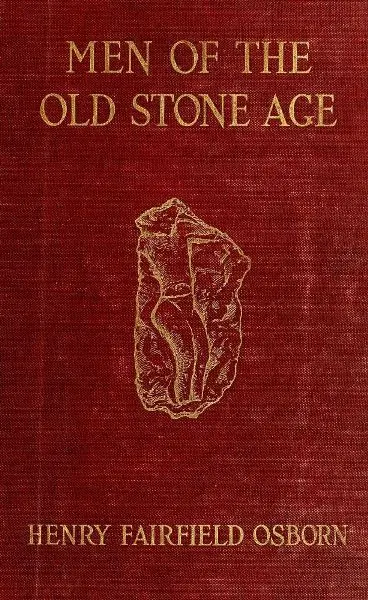
"Men of the Old Stone Age: Their Environment, Life and Art" by Henry Fairfield Osborn is a scientific publication written in the early 20th century. This work dives into the prehistoric human cultures of the Paleolithic era, focusing on their environment, lifestyle, and artistic expressions. Osborn aims to synthesize findings from various disciplines, including geology, paleontology, anthropology, and archaeology, to provide a comprehensive view of human evolution during this fascinating period. The opening of this volume establishes the author’s journey through the regions associated with early humans, guided by prominent archaeologists. Osborn reflects on the rich history of human habitation in Europe, stressing the depth of human evolution and the significant archaeological finds located in the area. He highlights the importance of interdisciplinary research to understand the relationship between early humans, their environment, and their cultural advancements, setting the stage for a detailed historical account of the Old Stone Age in subsequent chapters.
Introduction adapted from the source catalogue; source summaries may be automatically generated.
Free to read · English · 149,606 words · No account needed
MAKE TIME FOR A GOOD BOOK
On by default. Untick to stop anonymous reading totals. Each page counts after 10 seconds in view. How this works.
Anonymous counting is on unless you have switched it off.
Along the borders of these great ice-fields in both countries a cold and moist climate prevailed, for a prime condition of glaciation is the heavy precipitation of snow. In northern Europe, between the great Alpine and Scandinavian ice-fields of the third glaciation a cold climate undoubtedly prevailed; in the region of the Neckar River, near Cannstatt, is found a deposit known as 'mammoth loam,' which Koken believed to be contemporaneous with the period of the third glaciation, although the evidence is certainly not convincing.(41) Here are found fossil remains of the Scandinavian reindeer, also of two very important new arrivals in Europe from the tundra regions of the far northeast, animals which had wandered along the southern borders of the Scandinavian ice-sheet from the tundras of northern Russia and Siberia. This is the first appearance in western Europe of the woolly mammoth (E. primigenius) and the woolly rhinoceros (D. antiquitatis). In this 'mammoth loam' there also occur two species of horse, the giant deer (Megaceros), the stag, the wisent, and the Aurochs. If the woolly mammoth and the woolly rhinoceros actually entered eastern Germany at this time, they certainly retreated to the north with the approach of the warm temperate climate of the Third Interglacial Stage, because no trace of these animals has been found again in Europe until the advent of the fourth glaciation.
(=1=) Gaudry, 1890.1.
(=2=) Smith, G. E., 1912.1, p. 582.
(=3=) Op. cit.
(=4=) Munro, 1893.1.
(=5=) Osborn, 1910.1, pp. 306, 307.
(=6=) Geikie, J., 1894.1, pp. 329-336; 1914.1, p. 227.
(=7=) Dawkins, 1883.1, pp. 576-579.
(=8=) Geikie, J., 1914.1, p. 248.
(=9=) Reid, C., 1908.1.
(=10=) Desnoyers, 1863.1.
(=11=) Haug, 1911.1, p. 1807.
(=12=) Geikie, J., 1894.1, p. 682; 1914.1, p. 250.
(=13=) Dubois, 1894.1.
(=14=) Fischer, 1913.1.
(=15=) Schwalbe, 1899.1; 1914.1.
(=16=) Büchner, 1914.1.
(=17=) Volz, 1907.1.
(=18=) Elbert, 1908.1.
(=19=) Selenka, 1911.1.
(=20=) Pilgrim, 1913.1.
(=21=) Schwalbe, 1899.1, pp. 227, 228.
(=22=) Op. cit., p. 223.
(=23=) Schwalbe, 1914.1, pp. 601-606.
(=24=) Büchner, 1914.1, p. 129.
(=25=) Dubois, 1894.1, p. 14.
(=26=) Keith, 1912.1.
(=27=) Smith, G. E., 1912.1, p. 595.
(=28=) Op. cit.
(=29=) Rutot, 1907.1.
(=30=) Boule, 1913.1, pp. 266, 267.
(=31=) MacCurdy, 1905.1, pp. 468, 469.
(=32=) Geikie, J., 1914.1, p. 251.
(=33=) Op. cit., p. 255.
(=34=) Op. cit., p. 238.
(=35=) Schoetensack, 1908.1.
(=36=) Op. cit., pp. 25-43.
(=37=) Bonarelli, 1909.1.
(=38=) Penck, 1909.1.
(=39=) Geikie, J., 1914.1, p. 258.
(=40=) Op. cit., pp. 257-262.
(=41=) Schmidt, 1912.1, p. 181.
Your reading position is saved on this browser. Take it to another device with a library code. Reading pages adapt to text, rather than matching a printed edition.
BEHIND THE BOOK
This eBook is for the use of anyone anywhere in the United States and most other parts of the world at no cost and with almost no restrictions whatsoever. You may copy it, give it away or re-use it under the terms of the Project Gutenberg License included with this eBook or online at www.gutenberg.org. If you are not located in the United States, you will have to check the laws of the country where you are located before using this eBook. Read the source licence.
The original source file, including credits and licence, is retained by this library. Request an original-format copy at no charge. Please include the book title and Project Gutenberg identifier #43820.
KEEP YOUR CURIOSITY GOING
Cécile Tormay

Moritz Busch
John L. Ransom
Frances Wright
Cécile Tormay

Mabel Potter Daggett