THE CLASSIC COLLECTION✦Impressions of great naturalistsCLASSIC FREE BOOKS
Impressions of great naturalists
Henry Fairfield Osborn
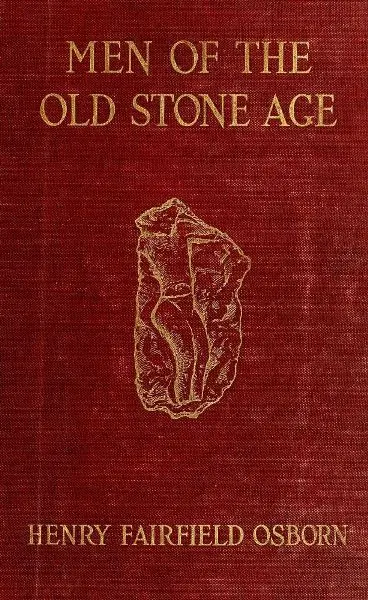
THE CLASSIC COLLECTION · 1915
"Men of the Old Stone Age: Their Environment, Life and Art" by Henry Fairfield Osborn is a scientific publication written in the early 20th century. This work dives into the prehistoric human cultures of the Paleolithic era, focusing on their environment, lifestyle, and artistic expressions. Osborn aims to synthesize findings from various disciplines, including geology, paleontology, anthropology, and archaeology, to provide a comprehensive view of human evolution during this fascinating period. The opening of this volume establishes the author’s journey through the regions associated with early humans, guided by prominent archaeologists. Osborn reflects on the rich history of human habitation in Europe, stressing the depth of human evolution and the significant archaeological finds located in the area. He highlights the importance of interdisciplinary research to understand the relationship between early humans, their environment, and their cultural advancements, setting the stage for a detailed historical account of the Old Stone Age in subsequent chapters.
Introduction adapted from the source catalogue; source summaries may be automatically generated.
Free to read · English · 149,606 words · No account needed
MAKE TIME FOR A GOOD BOOK
On by default. Untick to stop anonymous reading totals. Each page counts after 10 seconds in view. How this works.
Anonymous counting is on unless you have switched it off.
Hanno is a very common Carthaginian name, but recent writers think it not improbable that this Hanno was either the father or the son of that Hamilcar who led the great Carthaginian expedition to Sicily in 480 B. C. In the former case the Periplus might be assigned to a date about 520 B. C.; in the latter, some fifty years later.
The narrative was certainly extant at an early period, for it is cited in the work on Marvellous Narratives ascribed to Aristotle, which belongs to the third century B. C., and Pliny also expressly refers to it. The authenticity of the work is now generally conceded.
According to the narrative the farthest limit of Hanno's voyage, which was undertaken for purposes of colonization, brought him and his companions to an island containing a lake with another island in it which was full of wild men and women with hairy bodies, called by the interpreters gorillas. The Carthaginians were unable to catch any of the men but they caught three of the women, whom they killed, and brought their skins back with them to Carthage. "Pliny, indeed, adds that the skins in question were dedicated by Hanno in the temple of Juno at Carthage, and continued to be visible there till the destruction of the city. There can be no difficulty in supposing these 'wild men and women' to have been really large apes of the family of the chimpanzee, or pongo, several species of which are in fact found wild in western Africa, and some of them, as is now well known, attain a stature fully equal to that of man."
=Agassiz, L.=
1837.1 Discours prononcé à l'ouverture des séances de la Société Helvétique des Sciences Naturelles à Neuchâtel le 24 Juillet, 1837, par L. Agassiz, Président. Actes, Soc. Helvétique, Sci. nat., 22e Sess., 1837, pp. v-xxxii.
1840.1 Etudes sur les glaciers. Ouvrage accompagné d'un atlas de 32 planches. 8vo. Neuchâtel, 1840.
1840.2 On Glaciers and Boulders in Switzerland. Rept. 10th Meeting, Brit. Assoc. Adv. Sci., Glasgow, 1840, pp. 113, 114 (Trans. Sections).
=Alcalde del Rio, H.=
1912.1 Les cavernes de la région cantabrique (Espagne). (With Breuil and Sierra.) See Breuil, H., 1912.2.
1913.1 La Pasiega. (With Breuil and Obermaier.) See Breuil, H., 1913.1.
=Anthony, R.=
1910.1 L'encéphale de l'homme fossile de La Chapelle-aux-Saints. (With M. Boule.) C. R. Acad. Sci., Paris, tome 150, 1910, pp. 1458-1461.
1911.1 L'encéphale de l'homme fossile de La Chapelle-aux-Saints. (With M. Boule.) See Boule, M., 1911.1.
1912.1 L'encéphale de l'homme fossile de La Quina. C. R. Acad. Sci., Paris, tome 155, 1912, pp. 91-93.
=Arcelin, A.=
1869.1 L'Age du Renne en Mâconnais, etc. (With Ferry, H.) See Ferry, H.,
1869.1.
=d'Ault du Mesnil, G.=
Your reading position is saved on this browser. Take it to another device with a library code. Reading pages adapt to text, rather than matching a printed edition.
BEHIND THE BOOK
This eBook is for the use of anyone anywhere in the United States and most other parts of the world at no cost and with almost no restrictions whatsoever. You may copy it, give it away or re-use it under the terms of the Project Gutenberg License included with this eBook or online at www.gutenberg.org. If you are not located in the United States, you will have to check the laws of the country where you are located before using this eBook. Read the source licence.
The original source file, including credits and licence, is retained by this library. Request an original-format copy at no charge. Please include the book title and Project Gutenberg identifier #43820.
KEEP YOUR CURIOSITY GOING
Cécile Tormay

Moritz Busch
John L. Ransom
Frances Wright
Cécile Tormay

Mabel Potter Daggett