THE CLASSIC COLLECTION✦The poems of Thomas Gordon HakeCLASSIC FREE BOOKS
The poems of Thomas Gordon Hake
Thomas Gordon Hake
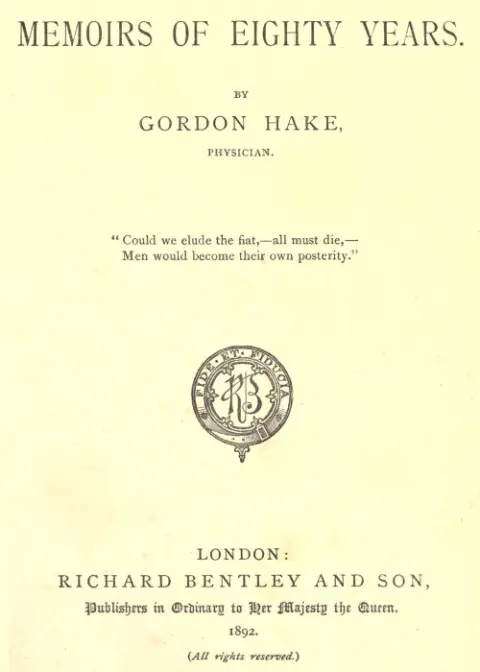
THE CLASSIC COLLECTION · 1892
"Memoirs of Eighty Years" by Thomas Gordon Hake is a personal memoir written in the late 19th century. The book reflects on the author's long life, discussing his birth, family history, education, and various relationships that shaped his experiences. It offers a deep exploration of his childhood and early experiences, blending personal anecdotes with observations on society and culture. At the start of the memoir, Hake introduces himself and provides a glimpse into his early years, beginning with his birth in Leeds and the mention of his father's early death. He reflects on the complexities of family, noting the tradition and sometimes dubious origins of his lineage. He describes his encumbrances with education, the mischief he engaged in with his siblings, and the impactful influence of his mother. As Hake navigates through his childhood memories, he sets the stage for a life filled with evocative experiences, friendships, and the unfolding drama of growing up in a rapidly changing society.
Introduction adapted from the source catalogue; source summaries may be automatically generated.
Free to read · English · 80,079 words · No account needed
MAKE TIME FOR A GOOD BOOK
On by default. Untick to stop anonymous reading totals. Each page counts after 10 seconds in view. How this works.
Anonymous counting is on unless you have switched it off.
This led to a correspondence between the neighbours, which ended for a time in Schiff convincing Capponi that no cruelty was practised, and that the operations on animals were painless.
However, Schiff had many animals; the municipality had ordered the police to supply the professor with all stray dogs, for which they could discover no owner. There was one dog amongst these that would bay the moon in spite of every effort to silence its superstitious moanings; and the enemy hearing this, interviewed Capponi again, and told him that Schiff was known to torture his dogs in the night season.
Capponi, in his palace opposite, had only too surely heard those midnight
wailings.
The appointment of Professor Schiff to a chair of physiology and to the hospital was a Government one; his diagnosis of disease was regarded as remarkably rapid and successful. At his house, which was graced by Madame Schiff and her daughter, ladies of high culture, I met many interesting persons, one especially, a Moscow lady, who every year went to St. Petersburg, thence to Florence, thence to the Isle of Wight, where she had grandchildren at school and where she visited her friends, Lord and Lady Cottenham.
I speak of this lady because her love of our country almost amounted to a passion. The people, she said, were so kind; strangers would stop to help her from a railway carriage! Then the Isle of Wight, how lovely! Fuchsias flowering in the hedgerows, and climbing up the cottage walls!
As in Germany the “Vicar of Wakefield” is in every cottage, so, she said, is “Paradise Lost” in every Russian home.
I wish that I could give her name.
The last I heard of Professor Schiff was that his enemies had prevailed, and that he had returned to Berne, welcomed by his own people.
In the November of this year, I revised “Ecce Homo,” and composed the “Double Soul,” both of which are in “New Symbols.” I also wrote “Lucilla, the First Saved,” at that time, a favourite of the good and gifted Christina Rossetti.
It was at this period that I was engaged on “The Sculptor” (M. Angelo). I sat in the Hall of Niobe for the manner, and stood in the Chapel of the Medici for the matter, of this little poem. I sent it as aforesaid, to Rossetti, who was at Kelmscott.
“Pythagoras,” too, was of this period.
In February, 1874, I wrote an article on some of Professor Schiff’s work, and sent it to Dr. Anstey, to be inserted in The Practitioner, in which it shortly appeared, giving much satisfaction to Schiff himself.
Your reading position is saved on this browser. Take it to another device with a library code. Reading pages adapt to text, rather than matching a printed edition.
BEHIND THE BOOK
This eBook is for the use of anyone anywhere in the United States and most other parts of the world at no cost and with almost no restrictions whatsoever. You may copy it, give it away or re-use it under the terms of the Project Gutenberg License included with this eBook or online at www.gutenberg.org. If you are not located in the United States, you will have to check the laws of the country where you are located before using this eBook. Read the source licence.
The original source file, including credits and licence, is retained by this library. Request an original-format copy at no charge. Please include the book title and Project Gutenberg identifier #57738.
KEEP YOUR CURIOSITY GOING

Charles G. (Charles Griffith) Ross
Hannah Webster Foster

Emily Lawless
Edwin Hamlin Carr

Charles De Lano Hine
Andrew Ure