THE CLASSIC COLLECTION✦The poems of Thomas Gordon HakeCLASSIC FREE BOOKS
The poems of Thomas Gordon Hake
Thomas Gordon Hake
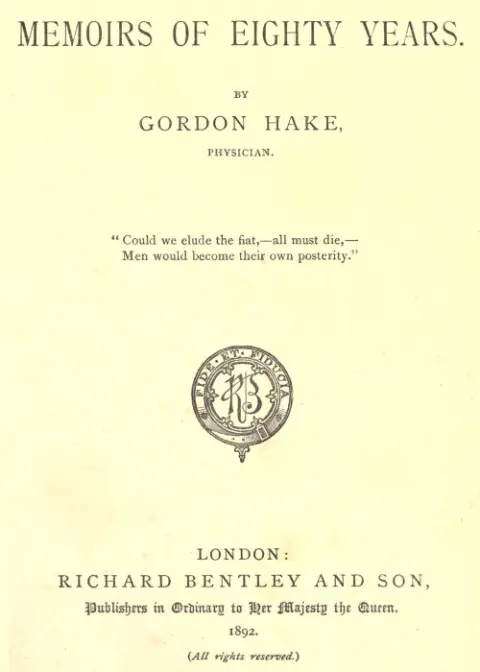
THE CLASSIC COLLECTION · 1892
"Memoirs of Eighty Years" by Thomas Gordon Hake is a personal memoir written in the late 19th century. The book reflects on the author's long life, discussing his birth, family history, education, and various relationships that shaped his experiences. It offers a deep exploration of his childhood and early experiences, blending personal anecdotes with observations on society and culture. At the start of the memoir, Hake introduces himself and provides a glimpse into his early years, beginning with his birth in Leeds and the mention of his father's early death. He reflects on the complexities of family, noting the tradition and sometimes dubious origins of his lineage. He describes his encumbrances with education, the mischief he engaged in with his siblings, and the impactful influence of his mother. As Hake navigates through his childhood memories, he sets the stage for a life filled with evocative experiences, friendships, and the unfolding drama of growing up in a rapidly changing society.
Introduction adapted from the source catalogue; source summaries may be automatically generated.
Free to read · English · 80,079 words · No account needed
MAKE TIME FOR A GOOD BOOK
On by default. Untick to stop anonymous reading totals. Each page counts after 10 seconds in view. How this works.
Anonymous counting is on unless you have switched it off.
It was in September, ’73; I had much worldly business on hand for present time, and much that was prospective. I was sixty-three years old, yet in my prime; for I felt as if what Montaigne said was my case: every man thinks he has twenty years more to live—and I have done it, so at eighty-three, I have yet twenty before me! Yet, four days ago, December 4, ’91, was the third anni-re-versary of my broken leg, which will imprison me (without hard labour, unless word-picking and hemp-picking are one) for the term of my natural life!
Henry’s stay with me in Florence was short, but he went over the galleries with me, and the walks, then returned to Germany, while I settled myself down in pleasant rooms on the Lungarno Acciajoli (No. 18), overlooking river, bridges, heights of Boboli, Bellosguardo, and St. Miniato, my new and cheerful winter home, the air bright, the temperature 68° F., sun shining all day on my delightful windows.
What walks I thence took; often to the Boboli Gardens, whence falls on the vision a superb view of the city with its various tints of brown and white, so chaste, so compact, as to look like a massive cameo!
And I walked to all the old places, to Fiesole and back, the walk of many hours, but enchanting all the way; now past the villa of Walter Savage Landor, now the Villa Palmieri, the scene of the Decameron.
Then the walk over the Viale, then the walk along the sweet, soft Certosa Road, the monastery now inhabited by a single monk, the caretaker of the past. These walks and many others made Florence an ideal native land.
Then I settled down to my table to take stock of my work. I had, while at Bath, received many reviews of my last volume, always favourable; and I now contemplated a further adventure.
During a visit to Kelmscott, I wrote “Reminiscence,” a poem describing the manor-house, the river, and surrounding scenery.
I took this to Florence with me, together with “Ecce Homo,” “The Exile,” and “Ortrud’s Vision;” there I added others, “The Painter,” “Michael Angelo,” and one or two besides, to my little store; and some I wrote on my return to London, the next year, making in all a dozen poems, which came out, not before 1876, as “New Symbols.”
My correspondence with Rossetti from Florence was constant; it was after his reading “The Painter” that he offered a suggestion to me to write “The Sculptor,” which I did, giving it the name of his idol, “Michael Angelo.”
Your reading position is saved on this browser. Take it to another device with a library code. Reading pages adapt to text, rather than matching a printed edition.
BEHIND THE BOOK
This eBook is for the use of anyone anywhere in the United States and most other parts of the world at no cost and with almost no restrictions whatsoever. You may copy it, give it away or re-use it under the terms of the Project Gutenberg License included with this eBook or online at www.gutenberg.org. If you are not located in the United States, you will have to check the laws of the country where you are located before using this eBook. Read the source licence.
The original source file, including credits and licence, is retained by this library. Request an original-format copy at no charge. Please include the book title and Project Gutenberg identifier #57738.
KEEP YOUR CURIOSITY GOING

Charles G. (Charles Griffith) Ross
Hannah Webster Foster

Emily Lawless
Edwin Hamlin Carr

Charles De Lano Hine
Andrew Ure