THE CLASSIC COLLECTION✦The poems of Thomas Gordon HakeCLASSIC FREE BOOKS
The poems of Thomas Gordon Hake
Thomas Gordon Hake
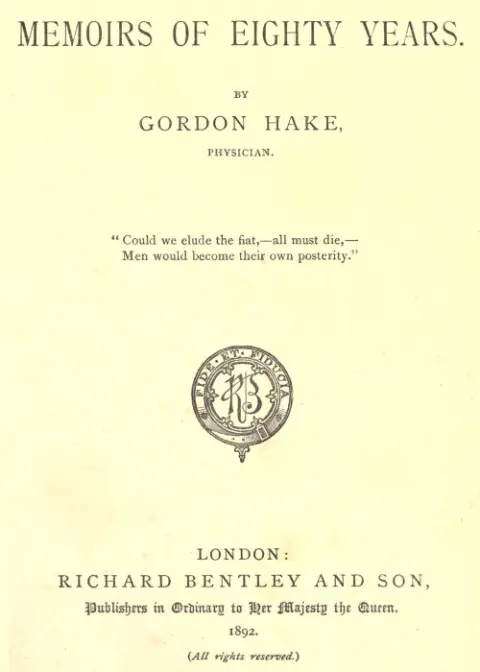
THE CLASSIC COLLECTION · 1892
"Memoirs of Eighty Years" by Thomas Gordon Hake is a personal memoir written in the late 19th century. The book reflects on the author's long life, discussing his birth, family history, education, and various relationships that shaped his experiences. It offers a deep exploration of his childhood and early experiences, blending personal anecdotes with observations on society and culture. At the start of the memoir, Hake introduces himself and provides a glimpse into his early years, beginning with his birth in Leeds and the mention of his father's early death. He reflects on the complexities of family, noting the tradition and sometimes dubious origins of his lineage. He describes his encumbrances with education, the mischief he engaged in with his siblings, and the impactful influence of his mother. As Hake navigates through his childhood memories, he sets the stage for a life filled with evocative experiences, friendships, and the unfolding drama of growing up in a rapidly changing society.
Introduction adapted from the source catalogue; source summaries may be automatically generated.
Free to read · English · 80,079 words · No account needed
MAKE TIME FOR A GOOD BOOK
On by default. Untick to stop anonymous reading totals. Each page counts after 10 seconds in view. How this works.
Anonymous counting is on unless you have switched it off.
There is, perhaps, no example of retrospective imagination (it is at once so dramatic, so poetic) like the opening words of Gloucester in the play of Richard III.
Before Shakespeare’s day, drama and poetry lived very much apart—one may say entirely separate in the Greek; no less so than chemical science and geology may do at the present time: Shakespeare, in much of his work, made them one.
“Grim-visaged war hath smoothed his wrinkled front;”
in this the action is dramatic, the verbal structure metaphoric.
The same is true of—
“Nor made to court an amourous looking-glass;”
while the words,
“He capers nimbly in a lady’s chamber,
To the lascivious pleasing of a lute,”
surpasses both, as not being metaphoric, yet poetic as well as dramatic.
Furthermore, the latter line—
“To strut before a wanton, ambling nymph,”
is most perfect in drama-poetic expression. It is exquisite in its contempt; it is ever visible in its movement; it is ludicrous too. Here lies the highest triumph of poetry, to do that which ordinary speech can barely effect in any single sentence—to attain to the most beautiful expression without a single metaphor; that is, by absolute simplicity of speech.
Of course, metaphor is a great resource in composition; it involves not only the fact, but its simile in one and the same epithet.
The line in Hamlet—
“Whose lightest word would harrow up thy soul,”
has as strong a simile in it, through “harrow up,” as is contained in the
expression—
“Thy matted and combined locks to part …
Like quills upon a fretful porcupine.”
But the last is pure poetry; the other is dramatic poetry.
Of course, pure poetry has the highest quality of all; it is so sincere, so convincing, that it requires no help to render it beautiful and effective.
The whole address in Hamlet delivered by the Ghost is free from metaphor with few exceptions towards the end, as—
“Make thy two eyes like stars dart from their spheres;”
also—
“Like quills upon a fretful porcupine.”
These two lines are the only exceptions. They are mighty, and at the very summit of human art, but in this respect do not actually reveal more than may be set forth in a pure simplicity of diction.
This great truth of truths was known to David and Solomon. It came to them as the only means through which the interests of a pure humanity could be enlarged on, and made to reach the heart.
Your reading position is saved on this browser. Take it to another device with a library code. Reading pages adapt to text, rather than matching a printed edition.
BEHIND THE BOOK
This eBook is for the use of anyone anywhere in the United States and most other parts of the world at no cost and with almost no restrictions whatsoever. You may copy it, give it away or re-use it under the terms of the Project Gutenberg License included with this eBook or online at www.gutenberg.org. If you are not located in the United States, you will have to check the laws of the country where you are located before using this eBook. Read the source licence.
The original source file, including credits and licence, is retained by this library. Request an original-format copy at no charge. Please include the book title and Project Gutenberg identifier #57738.
KEEP YOUR CURIOSITY GOING

Charles G. (Charles Griffith) Ross
Hannah Webster Foster

Emily Lawless
Edwin Hamlin Carr

Charles De Lano Hine
Andrew Ure