
The Writing of News A Handbook with Chapters on Newspaper Correspondence and Copy Reading
Charles G. (Charles Griffith) Ross
THE CLASSIC COLLECTION · 1894
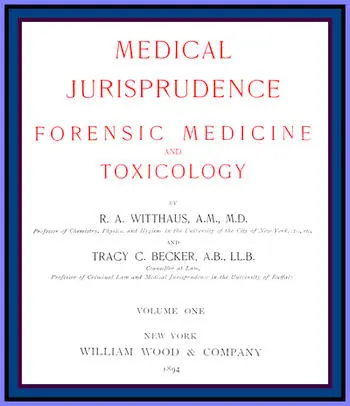
"Medical Jurisprudence, Forensic Medicine and Toxicology. Vol. 1" by R. A. Witthaus et al. is a scientific publication written in the late 19th century. This comprehensive work serves as a fundamental reference for the intersection of medicine and law, particularly focusing on how medical knowledge applies in legal contexts. The book explores various aspects of medical jurisprudence, forensic medicine, and toxicology, aimed at practitioners in both legal and medical fields, as well as scholars interested in legal medicine’s historical and practical significance. The opening of the volume sets the stage by delineating the key topics—medical jurisprudence, forensic medicine, and toxicology. It discusses the historical development of these fields, illustrating the evolution of the legal relationships between medical practitioners and the law. The introduction emphasizes the necessity for legal definitions regarding medical practice, the rights and duties of physicians, and the importance of providing expert testimony in legal cases. This section serves not only as an academic foundation but also as a practical guide for understanding the statutory landscape governing medical practice and its implications for both physicians and patients.
Introduction adapted from the source catalogue; source summaries may be automatically generated.
Free to read · English · 310,507 words · No account needed
MAKE TIME FOR A GOOD BOOK
On by default. Untick to stop anonymous reading totals. Each page counts after 10 seconds in view. How this works.
Anonymous counting is on unless you have switched it off.
[184] For general rules for the conduct of expert witnesses see infra.
[185] The principal classes of such subjects may, however, be briefly
stated as follows:
1. Causes of death; especially in cases of homicide, suicide, accident, etc., including poisoning.
2. Causes, nature, and extent of personal injuries, by violence,
accidents, explosions, railway disasters, collision between vessels,
etc.
3. Birth of infants; was infant born dead or alive; if dead, was death the result of natural causes or of internal violence; age of infant at the time of birth or death. Also causes of alleged sterility or pregnancy; time pregnancy has existed; also cases of alleged impotency.
4. Rape, abortion, bastardy, pederasty, onanism, masochism, and many other matters relating to the sexual organs.
5. Malpractice cases, involving the degree of care and skill usual, and that used in the case under investigation, and involving delicate questions as to the propriety of the treatment adopted, etc.
[186] See also 1 Bishop Crim. Law, sec. 36; Rex v. Romiski, 1 Moody, 19; Reg. v. Ellis, 2 Car. & K., 470.
[187] In such cases as these the patient would have a right of action in the civil courts for damages against the physician or surgeon, because he had taken wilful and wicked advantage of his professional relation to her, to do her a grievous wrong.
[188] The Pennsylvania courts at an early period refused to follow this common-law doctrine, and held that the moment the womb is instinct with life in embryo and the process of gestation has begun the crime may be perpetrated. Mills v. Com., 13 Pa. St., 631.
[189] 1 Bishop Crim. Law, sec. 217, citing Rex v. Williamson, 3 Car.
& P., 635.
[190] The same learned and philosophical text-writer (2 Bishop Crim. Law, sec. 664) compares the English and American cases and declares that the difference between them is more apparent than real.
[191] See Rice v. The State, 8 Mo., 561; Fairlee v. People, 11 Ill., 1; Holmes v. State, 23 Ala., 17; Rex v. Spilling, 2 M. & Rob., 107; Ferguson’s Case, 1 Lew., 181; Thomas v. Winchester, 2 Selden, N. Y. Court of App., 397; Com. v. Pierce, 138 Mass., 165, and cases cited; State v. Hahn, 38 Ark., 605; Wharton’s Crim. Law, sec. 1015; Elwell on Malpractice, etc., 238, 239.
[192] 1 Bishop Crim. Law, sec. 558, citing Groenvelt’s case, 1 Lord Raymond, 213; Rex v. Long, 4 C. & P., 398.
[193] See also Kelsey v. Hay, 84 Ind., 189; Small v. Howard, 128 Mass., 131; Gates v. Fleisher, 67 Wis., 286; Smothers v. Hanks, 34 Iowa, 286; Almond v. Nugent, 34 Iowa, 300; Haire v. Reese, 7 Phila. (Pa.), 138; Nelson v. Harrington, 72 Wis., 591.
[194] Ruddock v. Low, 4 F. & F., 519; Musser v. Chase, 29 Ohio St.,
577.
[195] See particularly Gieselman v. Scott, 25 Ohio St., 86; Lanphier v. Phipos, 8 C. & P., 475; Pym v. Roper, 2 F. & F., 783; Carpenter v. Blake, 60 Barb., 485, 50 N. Y., 696, 10 Hun, 358, 75 N. Y., 12; Leighton v. Sargent, 7 N. H., 460.
[196] Synonymous terms with “reasonable care” are “fair knowledge and skill,” Jones v. Angell, 95 Ind., 376; “ordinary care and skill,” Heath v. Glisan, 3 Oregon, 64.
Your reading position is saved on this browser. Take it to another device with a library code. Reading pages adapt to text, rather than matching a printed edition.
BEHIND THE BOOK
This eBook is for the use of anyone anywhere in the United States and most other parts of the world at no cost and with almost no restrictions whatsoever. You may copy it, give it away or re-use it under the terms of the Project Gutenberg License included with this eBook or online at www.gutenberg.org. If you are not located in the United States, you will have to check the laws of the country where you are located before using this eBook. Read the source licence.
The original source file, including credits and licence, is retained by this library. Request an original-format copy at no charge. Please include the book title and Project Gutenberg identifier #49027.
KEEP YOUR CURIOSITY GOING
Charles G. (Charles Griffith) Ross
Hannah Webster Foster

Emily Lawless
Edwin Hamlin Carr

Charles De Lano Hine
Andrew Ure