
The Writing of News A Handbook with Chapters on Newspaper Correspondence and Copy Reading
Charles G. (Charles Griffith) Ross
THE CLASSIC COLLECTION · 1894
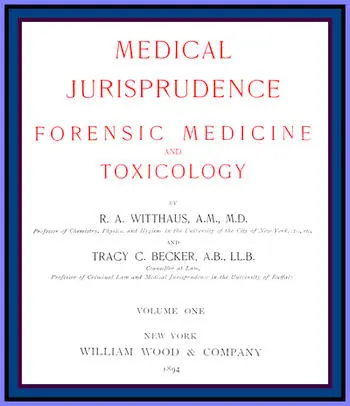
"Medical Jurisprudence, Forensic Medicine and Toxicology. Vol. 1" by R. A. Witthaus et al. is a scientific publication written in the late 19th century. This comprehensive work serves as a fundamental reference for the intersection of medicine and law, particularly focusing on how medical knowledge applies in legal contexts. The book explores various aspects of medical jurisprudence, forensic medicine, and toxicology, aimed at practitioners in both legal and medical fields, as well as scholars interested in legal medicine’s historical and practical significance. The opening of the volume sets the stage by delineating the key topics—medical jurisprudence, forensic medicine, and toxicology. It discusses the historical development of these fields, illustrating the evolution of the legal relationships between medical practitioners and the law. The introduction emphasizes the necessity for legal definitions regarding medical practice, the rights and duties of physicians, and the importance of providing expert testimony in legal cases. This section serves not only as an academic foundation but also as a practical guide for understanding the statutory landscape governing medical practice and its implications for both physicians and patients.
Introduction adapted from the source catalogue; source summaries may be automatically generated.
Free to read · English · 310,507 words · No account needed
MAKE TIME FOR A GOOD BOOK
On by default. Untick to stop anonymous reading totals. Each page counts after 10 seconds in view. How this works.
Anonymous counting is on unless you have switched it off.
Other unpleasant symptoms produced by currents in medical use may be mentioned for the sake of completeness, and also as an introduction to the more serious symptoms caused by stronger currents. Dizziness, vertigo, tinnitus, nausea, vomiting, and syncope are readily caused by even slight currents. The sensation of light in the eyes and the metallic taste in the mouth are the results of medical currents of ordinary strength when applied to the head or in its neighborhood, and stronger currents applied at greater distances cause these sensations. All the above symptoms may be readily caused by even slight currents, whether galvanic or faradic, passed through the head. The syncope thus produced is to be carefully differentiated from the syncope caused psychically by excitement or fear of the application of electricity. Hysterical women, and even persons who show no special signs of nervous instability, may faint at the suggestion of the application of electricity. I have seen a large, strong, well-built Italian man, perfectly sound physically, so far as could be detected, except some slight local neuralgia, faint from pure fright when the electricity was to be applied. But even the application of moderately severe shocks from the ordinary medical battery are not likely to produce serious results. These shocks are ordinarily caused by the opening or closing of the galvanic current, and are most severe when the current passes through some portion of the head. A still more powerful shock may be given by reversing the current in a galvanic battery by means of the commutator.
Passing on now to the consideration of the stronger currents, we come to those used for mechanical purposes, for electric lighting, electric railways, and other analogous objects. These currents start from dynamos or from storage batteries, and accidents are caused by them whenever they are diverted from their proper course and are caused to come in contact with or to pass through any portion of the human body in any considerable strength. Accidents not infrequently occur from direct contact with the batteries or dynamos, but still more frequently they are produced in their circuit along the wires or transmitters. They may also be caused, as some of the most fatal have been, by contact with metallic or other readily conducting objects which have themselves accidentally come in contact with some portion of an electric circuit (usually wires) and have diverted the whole, or more usually a portion, of the current to themselves. Thus was killed a young man in New York, the clerk in a store, who while lifting the metal-edged cover of a show-case brought it in contact with the charged wires of an electric light and received an immediately fatal shock. As a rule, those meeting with accidents from dynamos or electric machines directly are employees of electric companies, who are presumed to have more or less knowledge of the risk of carelessness, or they may be workers in institutions or factories in which such machines are in use. Many of the accidents due to wires also occur to linemen and other employees of electric, telephone, or telegraph companies or of electric railway companies in charge of wires or electric outfit. So long as the current transmitters and terminals (wires, etc.) are properly insulated and in their proper position in relation to other conductors, it is unusual for accidents to occur, except in cases of gross ignorance or carelessness. Unfortunately, however, proper insulation is not always accomplished, and frequently wires and other transmitters are removed from their proper positions by accidents and otherwise. So long as and wherever the system of overhead wires exists, if there be among these wires any which are the transmitters of strong electric currents, there is always a risk, and often a very serious one, that at some time or other one of these current-bearing wires will come into contact with some other non-current-bearing and ordinarily harmless wire in such a manner that the current of the first should be diverted, in whole or in part, on to the ordinarily innocuous wire, which thereby becomes at once charged and dangerous. Such an accident may be due to the displacement of either wire or to any other cause which brings the two in contact, either direct or indirect, at a point where the current-bearing wire is not sufficiently insulated. The current having once passed out of its proper circuit will, of course, follow the paths of best conduction, and may hence suddenly appear in unexpected quarters and produce the most dangerous and even fatal effects. It is accidents of this character which most frequently occur among the people who are neither employees of electric companies nor engaged in factories or buildings where electrical machines are employed.
Your reading position is saved on this browser. Take it to another device with a library code. Reading pages adapt to text, rather than matching a printed edition.
BEHIND THE BOOK
This eBook is for the use of anyone anywhere in the United States and most other parts of the world at no cost and with almost no restrictions whatsoever. You may copy it, give it away or re-use it under the terms of the Project Gutenberg License included with this eBook or online at www.gutenberg.org. If you are not located in the United States, you will have to check the laws of the country where you are located before using this eBook. Read the source licence.
The original source file, including credits and licence, is retained by this library. Request an original-format copy at no charge. Please include the book title and Project Gutenberg identifier #49027.
KEEP YOUR CURIOSITY GOING
Charles G. (Charles Griffith) Ross
Hannah Webster Foster

Emily Lawless
Edwin Hamlin Carr

Charles De Lano Hine
Andrew Ure