
The Writing of News A Handbook with Chapters on Newspaper Correspondence and Copy Reading
Charles G. (Charles Griffith) Ross
THE CLASSIC COLLECTION · 1894
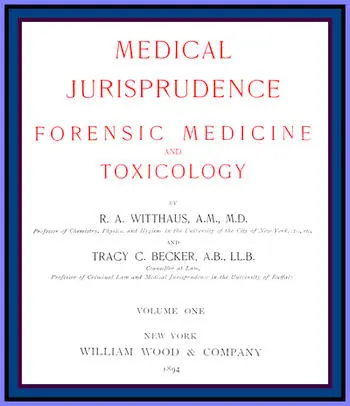
"Medical Jurisprudence, Forensic Medicine and Toxicology. Vol. 1" by R. A. Witthaus et al. is a scientific publication written in the late 19th century. This comprehensive work serves as a fundamental reference for the intersection of medicine and law, particularly focusing on how medical knowledge applies in legal contexts. The book explores various aspects of medical jurisprudence, forensic medicine, and toxicology, aimed at practitioners in both legal and medical fields, as well as scholars interested in legal medicine’s historical and practical significance. The opening of the volume sets the stage by delineating the key topics—medical jurisprudence, forensic medicine, and toxicology. It discusses the historical development of these fields, illustrating the evolution of the legal relationships between medical practitioners and the law. The introduction emphasizes the necessity for legal definitions regarding medical practice, the rights and duties of physicians, and the importance of providing expert testimony in legal cases. This section serves not only as an academic foundation but also as a practical guide for understanding the statutory landscape governing medical practice and its implications for both physicians and patients.
Introduction adapted from the source catalogue; source summaries may be automatically generated.
Free to read · English · 310,507 words · No account needed
MAKE TIME FOR A GOOD BOOK
On by default. Untick to stop anonymous reading totals. Each page counts after 10 seconds in view. How this works.
Anonymous counting is on unless you have switched it off.
CASE 8. Red, Parchmenty Skin, Cracks, etc. (Caspar, “Forensic Med.,” Vol. I., p. 307).—While a chimney-sweep was cleaning a chimney a fire was lighted below. Death. The entire skin was of a coppery red color, with yellow patches. No carbonization. Skin parchmenty, with fissures upon the edges of which the fat had melted and flowed out.
CASE 9. Asphyxia. Sooty Mucus, etc. (Caspar, “Forensic Med.,” Vol. I., p. 314).—Two children, æt. 3 and 7, burned; death from asphyxia. The youngest, the girl, burned externally; the boy was not. Post mortem in both showed the trachea to contain frothy and sooty mucus. Lungs and vessels of thorax and abdomen distended with dark and fluid blood. Brain congested, etc.
CASE 10. Burn of Body. Inflammation of Stomach (Amer. Jour. Med. Sciences, Jan., 1861, p. 137).—Superficial burn of lower part of body. Death on the thirteenth day. Post-mortem examination showed the stomach inflamed and the intestines also.
CASE 11. Accidental Scald. Pleurisy (Caspar, “Forensic Med.,” Vol. I., p. 312).—Female child, æt. 6; scalded with a pot of boiling coffee overturned upon the side of neck, right axilla, thorax, and right arm. Death on the eighth day. Post-mortem examination revealed inflammation of right pleura, pericardial effusion, etc. Body anæmic.
CASE 12. No Internal Lesion Found (Guy’s Hospital Reports, 1860, Vol. VI., p. 146).—Female, æt. 9. Burn of upper part of chest and arms by clothing taking fire. Death on the ninth day. Post-mortem examination revealed no lesion of the internal organs.
CASE 13. Cracks and Fissures of Skin (Caspar, “Forensic Med.,” Vol. I., p. 314).—Male, æt. 83. Clothing caught fire; death. Body carbonized. On right side were fissures opening into the abdomen; the viscera could be seen, etc.
CASE 14. Fissures, Vessels Crossing, etc. (Taylor, “Med. Jurisprudence,” Vol. I., p. 696).—Boy, æt. 2; death in three-quarters of an hour. On legs were fissures and lacerations near each knee. On right thigh a laceration 2¾ inches long, 1/6 inch deep and 1/4 inch wide; fatty tissue seen beneath. No blood effused; small vessels could be seen stretching across the fissures.
CASE 15. Brain Congested, etc. (Caspar, “Forensic Med.,” p. 316, Vol. I.).—Boy, æt. 1-1/2 years, set fire to his clothing. Death in 1½ days. Post-mortem examination showed congestion of the brain, inflammation of the trachea, engorgement of the lungs with hepatization of the lower part of the right lung.
CASE 16. Burn of Lower Part of Body. Death (same reference).—Woman, æt. 81; burn of lower part of body, including the gluteal region, the perineum and genital organs (external). Death after several days. Post-mortem examination showed the upper lobe of left lung in a stage of red hepatization, etc.
Your reading position is saved on this browser. Take it to another device with a library code. Reading pages adapt to text, rather than matching a printed edition.
BEHIND THE BOOK
This eBook is for the use of anyone anywhere in the United States and most other parts of the world at no cost and with almost no restrictions whatsoever. You may copy it, give it away or re-use it under the terms of the Project Gutenberg License included with this eBook or online at www.gutenberg.org. If you are not located in the United States, you will have to check the laws of the country where you are located before using this eBook. Read the source licence.
The original source file, including credits and licence, is retained by this library. Request an original-format copy at no charge. Please include the book title and Project Gutenberg identifier #49027.
KEEP YOUR CURIOSITY GOING
Charles G. (Charles Griffith) Ross
Hannah Webster Foster

Emily Lawless
Edwin Hamlin Carr

Charles De Lano Hine
Andrew Ure