
The Writing of News A Handbook with Chapters on Newspaper Correspondence and Copy Reading
Charles G. (Charles Griffith) Ross
THE CLASSIC COLLECTION · 1894
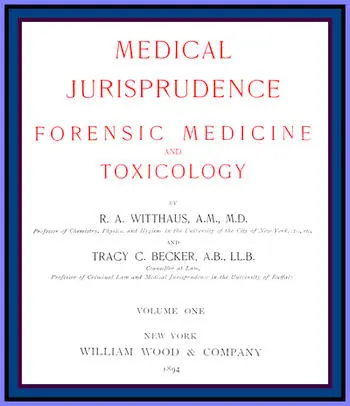
"Medical Jurisprudence, Forensic Medicine and Toxicology. Vol. 1" by R. A. Witthaus et al. is a scientific publication written in the late 19th century. This comprehensive work serves as a fundamental reference for the intersection of medicine and law, particularly focusing on how medical knowledge applies in legal contexts. The book explores various aspects of medical jurisprudence, forensic medicine, and toxicology, aimed at practitioners in both legal and medical fields, as well as scholars interested in legal medicine’s historical and practical significance. The opening of the volume sets the stage by delineating the key topics—medical jurisprudence, forensic medicine, and toxicology. It discusses the historical development of these fields, illustrating the evolution of the legal relationships between medical practitioners and the law. The introduction emphasizes the necessity for legal definitions regarding medical practice, the rights and duties of physicians, and the importance of providing expert testimony in legal cases. This section serves not only as an academic foundation but also as a practical guide for understanding the statutory landscape governing medical practice and its implications for both physicians and patients.
Introduction adapted from the source catalogue; source summaries may be automatically generated.
Free to read · English · 310,507 words · No account needed
MAKE TIME FOR A GOOD BOOK
On by default. Untick to stop anonymous reading totals. Each page counts after 10 seconds in view. How this works.
Anonymous counting is on unless you have switched it off.
=Delirium Tremens= is one of the commonest and must always be regarded as one of the most serious. It is well known to surgeons that a slight injury even, and often a severe one, is enough to provoke manifestations of this character in intemperate persons. The medico-legal question under these circumstances is this: Would the same amount of injury have been likely to cause death in a person of ordinary health and vigor? The law as applied to these cases has been stated by Lord Hale: “It is sufficient to prove that the death of a person was accelerated by the malicious acts of the person, although the former labored under a mental disease at the time of the act. The intent of the accused may often be judged by the character of the wound and the means of its infliction. Drunkenness of the victim admits of no excuse when his assailant is aware, or ought to have been aware, of the condition of his victim. It is held that the assailant ought to have known that violence of any kind to such a person is likely to be attended by dangerous results. It is known also that a wound which accelerates death causes death.” The commissioners who were appointed to define criminal law on the subject of homicide have thus expressed themselves: “Art. 3. It is homicide although the effect of the injury be merely to accelerate the death of one laboring under some previous injury or infirmity, for although if timely remedies or skilful treatment had been applied, death might have been prevented” (Taylor, p. 327).
=Death from Surgical Operations Necessitated by Gunshot Wound.=—The modern treatment of serious or so-called penetrating gunshot wounds where the cranium, thoracic viscera, or the abdominal viscera, especially the intestines, have been perforated one or more times, calls for surgical procedures which are of severity and danger in proportion to the gravity of the wound which necessitates them, and which, while they often save life, must necessarily often fail. Indeed, such operations may prove fatal upon the operating-table, i.e., patients may die before the conclusion of the operation. The question may, therefore, arise whether the person who inflicted the wound should be held responsible for his act, or whether by the intervention of the surgeon the responsibility may not at least be shifted from the shoulders of the accused. The law in this respect is explicit and regards such operation as the outcome of necessity and a legitimate part of treatment, so that if it be undertaken in good faith, with reasonable care and skill, the accused will be held responsible, be the result what it may. The question of necessity and the plan of operation are left to the judgment of the surgeon in charge. Considering the responsibility involved in such cases and the possibility of a suit being raised, we should always advise the operator to secure the counsel of other surgeons or practitioners in his vicinity. The verdict of such a counsel of talent will always stand. According to Lord Hale, when death takes place from an unskilful operation under such circumstances, and not from the wound, the responsibility of the prisoner naturally ceases, but the burden of proof that such has been unskilfully performed rests naturally with the defence. It is much better also in these cases that the primary responsibility be borne by one surgeon from the beginning of the case, though he may associate with himself as many others as he chooses, since the ends of justice have more than once been defeated by a division of such responsibilities. Should it be made to appear that the surgeon in charge has not availed himself of such means as are supposed to be in the hands of every competent practitioner and has neglected ordinary antiseptic precautions, it would not be difficult to show that the operation had been unskilfully performed, and the prisoner would naturally get the benefit of such defence. At the present date of writing there exists a large class of the profession who still continue to do surgery according to the views and practices of twenty or thirty years ago, and who, while perhaps carrying out some of the forms of antiseptic surgery, are still ignorant of its fundamental principles and consequently guilty of neglect, since there is now no reason why all should not practise them. The writer holds to the view that if it can be shown that these precautions were not adopted when others would have adopted them, it constitutes criminal neglect.
Your reading position is saved on this browser. Take it to another device with a library code. Reading pages adapt to text, rather than matching a printed edition.
BEHIND THE BOOK
This eBook is for the use of anyone anywhere in the United States and most other parts of the world at no cost and with almost no restrictions whatsoever. You may copy it, give it away or re-use it under the terms of the Project Gutenberg License included with this eBook or online at www.gutenberg.org. If you are not located in the United States, you will have to check the laws of the country where you are located before using this eBook. Read the source licence.
The original source file, including credits and licence, is retained by this library. Request an original-format copy at no charge. Please include the book title and Project Gutenberg identifier #49027.
KEEP YOUR CURIOSITY GOING
Charles G. (Charles Griffith) Ross
Hannah Webster Foster

Emily Lawless
Edwin Hamlin Carr

Charles De Lano Hine
Andrew Ure