
The Writing of News A Handbook with Chapters on Newspaper Correspondence and Copy Reading
Charles G. (Charles Griffith) Ross
THE CLASSIC COLLECTION · 1894
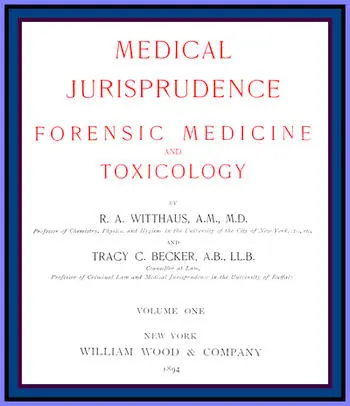
"Medical Jurisprudence, Forensic Medicine and Toxicology. Vol. 1" by R. A. Witthaus et al. is a scientific publication written in the late 19th century. This comprehensive work serves as a fundamental reference for the intersection of medicine and law, particularly focusing on how medical knowledge applies in legal contexts. The book explores various aspects of medical jurisprudence, forensic medicine, and toxicology, aimed at practitioners in both legal and medical fields, as well as scholars interested in legal medicine’s historical and practical significance. The opening of the volume sets the stage by delineating the key topics—medical jurisprudence, forensic medicine, and toxicology. It discusses the historical development of these fields, illustrating the evolution of the legal relationships between medical practitioners and the law. The introduction emphasizes the necessity for legal definitions regarding medical practice, the rights and duties of physicians, and the importance of providing expert testimony in legal cases. This section serves not only as an academic foundation but also as a practical guide for understanding the statutory landscape governing medical practice and its implications for both physicians and patients.
Introduction adapted from the source catalogue; source summaries may be automatically generated.
Free to read · English · 310,507 words · No account needed
MAKE TIME FOR A GOOD BOOK
On by default. Untick to stop anonymous reading totals. Each page counts after 10 seconds in view. How this works.
Anonymous counting is on unless you have switched it off.
In Matters of Common Experience Witnesses in General Often State Conclusions.—Moreover, in matters of common experience, the testimony of any witness, if carefully analyzed, often shows that he is sometimes allowed to draw, and state, his conclusions and inferences, instead of being required to confine his evidence simply to telling in the strictest possible way, and with the closest limitations, what he actually witnessed. A good illustration of this is the case of a person who sees a crime of homicide committed by shooting, and is called upon to testify in court. He would be allowed to testify that the defendant, if he could identify the prisoner at the bar as such, was the person whom he saw fire the shot, although he might not have examined him with close scrutiny, and might never have seen him before the crime. In saying that the defendant was the person who fired the shot, while he would be in terms testifying to a fact, he would still be drawing an inference, and giving an opinion, based upon his recollection of the person whom he saw engaged in the act of firing, and of the likeness or resemblance of such person to the prisoner at the bar, which would be a matter of comparison and of opinion. So, too, although he could not see the bullet take its course from the mouth of the gun and imbed itself in the body of the deceased, yet if he saw the firing, heard the explosion, saw the flash and smoke of the powder, observed the direction in which the accused pointed the weapon, and saw the deceased stagger and fall, he would be allowed to testify in answer to a direct question whether or not the accused shot the deceased. And, yet in making up that answer he would be testifying not simply to a matter of actual observation, but to a conclusion. As it is in reference to the question of identity so it is as to many other matters which come before our courts, in all of which the witnesses are permitted, without objection, to testify to conclusions and to give answers which are the result of inferences which they draw themselves, rather than a statement of their actual observations. The law is not a metaphysical but a practical science, limited and confined by the practical restrictions which experience has shown must be put upon it, in order to enable it to accomplish its object of administering justice between man and man. Men form such conclusions as have been indicated, instinctively and unconsciously, and it would be practicably impossible for them to narrate any occurrence without embodying in their narration some of these natural and unconscious conclusions. The law, therefore, includes among the matters which witnesses are permitted to characterize as facts, those daily and hourly inferences and deductions which all men are accustomed to make, and concerning which no two men who are properly constituted can greatly differ. It is true that this practice sometimes leads to error, but it has grown out of necessity. The greatest safeguard is, that upon the trial of a question of fact both sides are represented by counsel, and the opportunity which cross-examination offers to an advocate of even reasonable and ordinary skill is such, that these conclusions and inferences may be sifted down through the chain of observation, and the process of drawing these conclusions and inferences from a series of facts, tested in such a manner that the improbability, probability, or truth of any given inference or conclusion may be determined with substantial accuracy. The illustrations which have been given above exhibit the simplest form in which so-called direct testimony can be demonstrated to be not always positive and direct testimony, but somewhat a matter of inference. Other examples and illustrations of common occurrence will exhibit still more closely the line between actuality and opinion. At times it becomes essential to the determination of a question, that the courts should know whether or not a person was angry, whether or not he was intoxicated, or whether or not at a given time, when his mental status was under observation, he acted rationally or irrationally. Lay witnesses have for many years been permitted to testify from observation, and without possessing any special qualification to do so, as to the existence or non-existence of such conditions as those just mentioned in a person whose actions are under consideration. It is manifest that in making any such inferences the witnesses’ testimony is mainly a conclusion based on inference. Take the case of anger. How shall that be determined? It is difficult to describe anger. A loud voice, a flushed face, the use of bitter words, nervous, excitable, demonstrative action—all these symptoms might occur, or but few of them might occur. So, too, in the matter of intoxication. It is well known that some individuals exhibit the effects of intoxicants in an entirely different manner and degree from others. Some men who are very much intoxicated, so as to be quite incapable, in the eye of the law, of forming a criminal intent, or of contracting an obligation which would be valid, may still be able to walk perfectly straight, or to talk without much confusion. Others, whose walk and demeanor would indicate a considerable degree of intoxication, might be mentally clear and unruffled and even stimulated by intoxicants to precise mental co-ordination and reasoning. Again, there are persons, as to whom a witness, after stating that he had observed them, and after stating the particular matters and things in which such persons were engaged, might with apparent accuracy state that they acted rationally or irrationally, and yet such persons might nevertheless, upon further examination, be found to have been acting according to a particular custom or habit, or idiosyncrasy of long years’ standing. Thus it is apparent that in each of these cases, when the witness attempts to state what, out of necessity, the court treats as a fact—viz., whether a given person is or is not angry, or intoxicated, or irrational—the witness is really testifying to the result, in his own mind, of his observations of the condition and conduct of the person who is under investigation, when compared with a standard which the witness has erected for himself. Hence such results are really matters of opinion evidence, pure and simple. Other examples of a like character are found in statements as to weight, height, distance, speed, and the like, as to which men of common powers of observation, who are not strictly experts, are, because of convenience and necessity and the probability of reasonable and ordinary accuracy, commonly permitted to give their own judgment and conclusions as evidence.
Your reading position is saved on this browser. Take it to another device with a library code. Reading pages adapt to text, rather than matching a printed edition.
BEHIND THE BOOK
This eBook is for the use of anyone anywhere in the United States and most other parts of the world at no cost and with almost no restrictions whatsoever. You may copy it, give it away or re-use it under the terms of the Project Gutenberg License included with this eBook or online at www.gutenberg.org. If you are not located in the United States, you will have to check the laws of the country where you are located before using this eBook. Read the source licence.
The original source file, including credits and licence, is retained by this library. Request an original-format copy at no charge. Please include the book title and Project Gutenberg identifier #49027.
KEEP YOUR CURIOSITY GOING
Charles G. (Charles Griffith) Ross
Hannah Webster Foster

Emily Lawless
Edwin Hamlin Carr

Charles De Lano Hine
Andrew Ure