
The Writing of News A Handbook with Chapters on Newspaper Correspondence and Copy Reading
Charles G. (Charles Griffith) Ross
THE CLASSIC COLLECTION · 1894
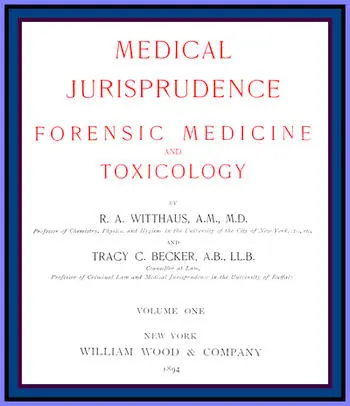
"Medical Jurisprudence, Forensic Medicine and Toxicology. Vol. 1" by R. A. Witthaus et al. is a scientific publication written in the late 19th century. This comprehensive work serves as a fundamental reference for the intersection of medicine and law, particularly focusing on how medical knowledge applies in legal contexts. The book explores various aspects of medical jurisprudence, forensic medicine, and toxicology, aimed at practitioners in both legal and medical fields, as well as scholars interested in legal medicine’s historical and practical significance. The opening of the volume sets the stage by delineating the key topics—medical jurisprudence, forensic medicine, and toxicology. It discusses the historical development of these fields, illustrating the evolution of the legal relationships between medical practitioners and the law. The introduction emphasizes the necessity for legal definitions regarding medical practice, the rights and duties of physicians, and the importance of providing expert testimony in legal cases. This section serves not only as an academic foundation but also as a practical guide for understanding the statutory landscape governing medical practice and its implications for both physicians and patients.
Introduction adapted from the source catalogue; source summaries may be automatically generated.
Free to read · English · 310,507 words · No account needed
MAKE TIME FOR A GOOD BOOK
On by default. Untick to stop anonymous reading totals. Each page counts after 10 seconds in view. How this works.
Anonymous counting is on unless you have switched it off.
Wounds and injuries of the varieties we are considering, affecting the spine and spinal cord, are generally accidental, less often homicidal, and almost never suicidal.
=Wounds of the thorax caused by incising, puncturing, or blunt instruments.= These wounds are most often punctured wounds; contused wounds are common and incised wounds are not rare. They are perhaps most often homicidal in origin or at least inflicted by another, and the accidental origin of these wounds is probably the least common.
Incised or punctured non-penetrating wounds of the thoracic wall are rarely grave. Bleeding, as a rule, is not serious, though it may be quite free. Such wounds may be accompanied by emphysema, though not penetrating, owing to the movements of the chest and a valve-like action of the edges of the wound. Contused wounds of the thorax are more dangerous, especially if the violence was great, owing to the complicating fracture of the ribs, rupture of the thoracic viscera, etc.
FRACTURE OF THE RIBS is a common result of contusions of the chest. It is more dangerous when due to a direct blow or injury, as then the splintering occurs internally and may wound the lungs, heart, or large vessels, while with fracture from indirect violence, from compression of the chest, the splintering of the ribs occurs externally. Fracture of the upper ribs requires more force than that required to fracture the lower ones, and consequently the former is the more dangerous. The diagnosis of fracture of the ribs is generally quite easy by means of crepitus felt or heard, false motion, local tenderness, etc. FRACTURE OF THE STERNUM may be serious if depressed on account of the wounding of the viscera behind it. Devergie[668] cites such a case where the depressed portion of the sternum produced a transverse non-penetrating wound of the heart about an inch in length, which had caused death in thirteen days. Simple fracture of the sternum without displacement of the fragments is rarely serious unless injury of the thoracic viscera is produced by the same violence. Wounds or injuries of the thorax are grave or not according as they penetrate or injure the thoracic viscera or do not do so. A wound may just penetrate the thoracic wall without wounding the thoracic viscera, and is then serious as a rule only when followed by inflammation. In fact, many of the penetrating wounds of the thorax wounding the viscera are only grave on account of consecutive inflammation. We have already seen that various characteristics of wounds of the thorax, especially of stab-wounds, enable us to determine the kind of weapon used, its size, sharpness, etc., and sometimes to identify the weapon itself. In much the same way we can often determine whether the wound was suicidally or homicidally inflicted. The cause of death in wounds of the thorax may be directly due to the wounding of one or more of the thoracic viscera, or it may be due to the inflammation occasioned by it. Wounds of the lower part of the thorax may involve at the same time the thoracic cavity proper and its contained viscera, the diaphragm and the abdomen and its viscera. This is the order in which the different parts would be met with in a wound from behind forward; the order might be the reverse of this in a wound from before backward. Penetrating wounds of the thorax may involve the lungs, heart, or great blood-vessels. Of these, the lungs are most often injured, which is easily accounted for by the greater size of the lungs. In =wounds of the lungs= the immediate danger is from hemorrhage. The hemorrhage appears externally through the wound and from the mouth, being coughed up. Where the lungs are injured by a blow, fall, or crush without external injury, blood appears in the mouth only. The blood coughed up from the lungs is bright red and frothy, and it may also be frothy at the external wound. Hemorrhage from the external wound may be slight, especially if the wound is oblique and acts as a valve. In wounds of the lungs most of the blood may collect in the pleura or in the lungs, and thus, by compression from without or by displacement by the blood within it, prevents air from entering the lungs and produces asphyxia, which may be fatal. More or less dyspnœa usually occurs at first. Emphysema is generally present in the cellular tissues, but this latter symptom may also occur at times with non-penetrating wounds of the chest. If death does not occur speedily from hemorrhage by compression of the lungs or heart, there are good hopes of saving the patient, but the prognosis should be reserved. For even when the first effects of the wound of the lung are survived, the patient may die from the effects of inflammation, recurring hemorrhage, or a too sudden relaxation of regimen. Thus, for instance, if too much food, talking, or exertion are indulged in the case may on this account terminate fatally, and such aggravating causes of death may mitigate the sentence.
Your reading position is saved on this browser. Take it to another device with a library code. Reading pages adapt to text, rather than matching a printed edition.
BEHIND THE BOOK
This eBook is for the use of anyone anywhere in the United States and most other parts of the world at no cost and with almost no restrictions whatsoever. You may copy it, give it away or re-use it under the terms of the Project Gutenberg License included with this eBook or online at www.gutenberg.org. If you are not located in the United States, you will have to check the laws of the country where you are located before using this eBook. Read the source licence.
The original source file, including credits and licence, is retained by this library. Request an original-format copy at no charge. Please include the book title and Project Gutenberg identifier #49027.
KEEP YOUR CURIOSITY GOING
Charles G. (Charles Griffith) Ross
Hannah Webster Foster

Emily Lawless
Edwin Hamlin Carr

Charles De Lano Hine
Andrew Ure