
The Writing of News A Handbook with Chapters on Newspaper Correspondence and Copy Reading
Charles G. (Charles Griffith) Ross
THE CLASSIC COLLECTION · 1894
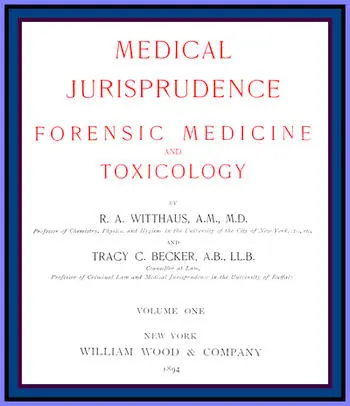
"Medical Jurisprudence, Forensic Medicine and Toxicology. Vol. 1" by R. A. Witthaus et al. is a scientific publication written in the late 19th century. This comprehensive work serves as a fundamental reference for the intersection of medicine and law, particularly focusing on how medical knowledge applies in legal contexts. The book explores various aspects of medical jurisprudence, forensic medicine, and toxicology, aimed at practitioners in both legal and medical fields, as well as scholars interested in legal medicine’s historical and practical significance. The opening of the volume sets the stage by delineating the key topics—medical jurisprudence, forensic medicine, and toxicology. It discusses the historical development of these fields, illustrating the evolution of the legal relationships between medical practitioners and the law. The introduction emphasizes the necessity for legal definitions regarding medical practice, the rights and duties of physicians, and the importance of providing expert testimony in legal cases. This section serves not only as an academic foundation but also as a practical guide for understanding the statutory landscape governing medical practice and its implications for both physicians and patients.
Introduction adapted from the source catalogue; source summaries may be automatically generated.
Free to read · English · 310,507 words · No account needed
MAKE TIME FOR A GOOD BOOK
On by default. Untick to stop anonymous reading totals. Each page counts after 10 seconds in view. How this works.
Anonymous counting is on unless you have switched it off.
The diagnosis of concussion of the brain from alcoholism is sometimes a matter of medico-legal interest or importance. Concussion may be so slight as to simulate intoxication. The history often clears the case up. The history of a blow or a fall or the presence of marks of violence on the head indicates concussion, though the blow or fall may not have caused the symptoms, which may be due to alcoholism. The odor of the breath may indicate alcoholism, but here too we may have both present and the concussion may be responsible for the symptoms. Or again the alcohol may have been given as a heart stimulant after the accident. This combination often occurs. If there is no odor in the breath, the presumption is in favor of concussion. As mistakes are still not infrequently made in diagnosis, those cases in which there is any ground for doubt should be carefully watched for developments. In general, the existence of concussion is more often overlooked than the coexisting alcoholism, so that if there is any doubt in a given case it should be treated as one of cerebral injury. The injury which causes the concussion in such cases is often due to the alcoholism. We may be able to verify this supposition if the injury is such as would be likely to be caused by a fall. There may be nothing found in the brain after death to distinguish between concussion and alcoholism. A bruise on the head only indicates a probability of concussion, for the bruise and alcoholism may both be present, the former perhaps due to the latter. The presence of alcohol in the stomach would indicate the existence of alcoholism.
Another effect of an injury which has caused concussion of the brain is an extravasation or effusion of blood. Extravasation of blood in or on the brain is one of the commonest causes of death from injury to the head. It may occur with or without marks of external injury. A person suffering from such an extravasation of blood may recover from the first effects of the injury, and at a varying time afterward the symptoms may return and increase so as to result fatally. In such a case the opening of the bleeding vessel may have become plugged until some exertion, emotion, or excitement on the part of the injured person has loosened the plug. A hemorrhage may have ceased from partial syncope and return with a stronger heart action due perhaps to the administration of alcohol. This effusion may occur on the surface of the brain in connection with a superficial laceration of the brain or just beneath or outside the dura mater and not involving the brain directly. The latter cases are almost always due to the effects of violence, though there is at least one case of apparently spontaneous rupture of the middle meningeal artery. The violence which causes a rupture of the branches of this artery may be so slight as to leave no bruise or so severe as to cause fracture of the skull. The most important symptom of such extradural hemorrhage is a period of consciousness after recovery from the first effects of the injury, then stupor may appear and deepen into coma. A subdural hemorrhage may cause almost the same symptoms, though the injury is usually such as has produced a depressed fracture. This hemorrhage is most often due to the rupture of a number of small vessels under the fracture, though if one larger vessel is ruptured it is most often the middle cerebral. A thin layer of hemorrhage in connection with a superficial laceration of the brain is of frequent occurrence with or without the other two forms of intracranial hemorrhage. If the brain is lacerated we may have convulsions in addition to other symptoms. Death occurring during or soon after a prize-fight may occur from some of the above classes of intracranial extravasations. It may be questioned whether the blows or a fall caused the hemorrhage. It is generally due to a fall in such cases, but may be due to blows, but the guilt is the same unless the fall was accidental. As the result of severe traumatism the vessels of the interior of the cerebrum may be ruptured or hemorrhage may occur into the ventricles of the brain. In such cases the symptoms will resemble those of ordinary apoplexy, only the cause is different from the latter and the injury is usually so severe as to leave no doubt as to the existence of a traumatism. The following question may arise in cases of intracranial hemorrhage and especially in the latter class of such cases, i.e., in cerebral hemorrhage:
Your reading position is saved on this browser. Take it to another device with a library code. Reading pages adapt to text, rather than matching a printed edition.
BEHIND THE BOOK
This eBook is for the use of anyone anywhere in the United States and most other parts of the world at no cost and with almost no restrictions whatsoever. You may copy it, give it away or re-use it under the terms of the Project Gutenberg License included with this eBook or online at www.gutenberg.org. If you are not located in the United States, you will have to check the laws of the country where you are located before using this eBook. Read the source licence.
The original source file, including credits and licence, is retained by this library. Request an original-format copy at no charge. Please include the book title and Project Gutenberg identifier #49027.
KEEP YOUR CURIOSITY GOING
Charles G. (Charles Griffith) Ross
Hannah Webster Foster

Emily Lawless
Edwin Hamlin Carr

Charles De Lano Hine
Andrew Ure