
The Writing of News A Handbook with Chapters on Newspaper Correspondence and Copy Reading
Charles G. (Charles Griffith) Ross
THE CLASSIC COLLECTION · 1894
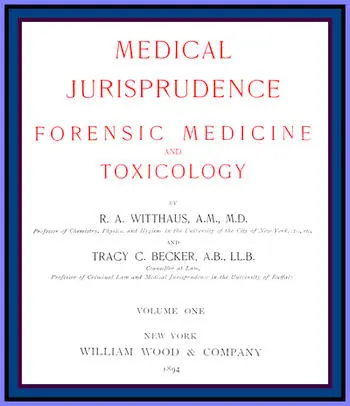
"Medical Jurisprudence, Forensic Medicine and Toxicology. Vol. 1" by R. A. Witthaus et al. is a scientific publication written in the late 19th century. This comprehensive work serves as a fundamental reference for the intersection of medicine and law, particularly focusing on how medical knowledge applies in legal contexts. The book explores various aspects of medical jurisprudence, forensic medicine, and toxicology, aimed at practitioners in both legal and medical fields, as well as scholars interested in legal medicine’s historical and practical significance. The opening of the volume sets the stage by delineating the key topics—medical jurisprudence, forensic medicine, and toxicology. It discusses the historical development of these fields, illustrating the evolution of the legal relationships between medical practitioners and the law. The introduction emphasizes the necessity for legal definitions regarding medical practice, the rights and duties of physicians, and the importance of providing expert testimony in legal cases. This section serves not only as an academic foundation but also as a practical guide for understanding the statutory landscape governing medical practice and its implications for both physicians and patients.
Introduction adapted from the source catalogue; source summaries may be automatically generated.
Free to read · English · 310,507 words · No account needed
MAKE TIME FOR A GOOD BOOK
On by default. Untick to stop anonymous reading totals. Each page counts after 10 seconds in view. How this works.
Anonymous counting is on unless you have switched it off.
As furnishing some evidence which may help to distinguish between suicide and homicide in the origin of wounds, the question may be asked, WHAT WAS THE POSITION OF THE VICTIM WHEN INJURED OR DYING? and also, WHAT WERE THE RELATIVE POSITIONS OF THE VICTIM AND ASSAILANT?
The position of the victim at the moment of the injury is sometimes indicated by the position of the wound, the direction of its tract, and the direction from the wound of the blood on the body and clothes. On the neck or extremities the course and form of the wound may indicate the position of these parts when the wound was inflicted, for sometimes in flexions of these parts the skin lies in folds, and a wound inflicted when these parts were so flexed would be irregular, wavy, or zig-zag. Further, the position and movement of these parts necessary to restore directness to the wound may indicate the position of the parts when the wound was inflicted. The examination of the relative positions of the wound in the clothes and the body may help to indicate the position of the body when wounded. The position of the blood on the body and the direction of the blood from the wound, whether below or at the sides, etc., tends to show the position of the body when bleeding. Thus if the body was at any time in the erect position, some of the blood-stains will be vertically below the wound, or if the victim was lying on the back then the stain would be at the sides only and not below the wound, except such stains as indicate that they were produced by arterial jets. Few suicides cut the throat in the recumbent position; therefore it may be considered in the light of an indication of homicide if the blood-stains show that the victim was not erect after the wound was inflicted. It is well also to note the form, direction, and obliquity of the blood-spot. This would indicate, by comparison with the wound, the relative position of the wounded person and the blood-spot, and thus show whether the body had been moved or not, as, for instance, by the murderer for the purpose of robbery. The force of the bleeding is also indicated by the form of the spot, and this would indicate how rapidly death probably ensued. This fact might thus help us to judge whether the victim probably died where he was wounded, and whether other and remote blood-spots would not be presumptive of murder. If the victim is found in night-clothes, this fact would help to show that he was lying down when wounded. The medical evidence as to the position of the victim when injured is, therefore, circumstantial and not very positive; that in regard to the relative position of the victim and assailant is even less positive. We presuppose in this question that the case is one of murder. We are not to prove murder or refute suicide. We can rarely be positive as to the relative position of the assailed and the assailant. A wound in the back may be caused by some one in front with an arm behind. The direction of the wound would indicate this, for if the assailant is right-handed and inflicts a wound on the back from in front, a stab-wound would almost always be directed from left to right, an incised wound from right to left, both from above downward. With a left-handed murderer the direction would most likely be from right to left and from above downward for a stab-wound, and from left to right and from above downward for an incised wound. If the assailant were at the back of the victim and wounded him in front, the direction of these wounds would be the opposite of the above, i.e., from right to left for a stab-wound and from left to right and from above downward for an incised wound with a right-handed assailant and vice versa with a left-handed assailant. These wounds occur more commonly than those of the back, and are especially noticeable in incised wounds of the throat. In the case of these incised wounds of the throat inflicted from behind, the direction from left to right and from above downward resembles that of self-inflicted wounds in the same situation. As a general rule, wounds are on the same side of the victim that the assailant was; the facts given above help to show us the exceptions. Thus a wound on one side is presumptive that the murderer was on that side, or possibly at the front or back and only exceptionally on the opposite side. The presence of wounds on one side only may help to confirm the testimony of a witness that the victim was against a wall or some other obstacle which protected the other side. The question of the relative position of the combatants in duels and the nature of the weapons used as shown by the wounds has sometimes come up, especially in other countries, to determine whether the combat was regular and fair.
Your reading position is saved on this browser. Take it to another device with a library code. Reading pages adapt to text, rather than matching a printed edition.
BEHIND THE BOOK
This eBook is for the use of anyone anywhere in the United States and most other parts of the world at no cost and with almost no restrictions whatsoever. You may copy it, give it away or re-use it under the terms of the Project Gutenberg License included with this eBook or online at www.gutenberg.org. If you are not located in the United States, you will have to check the laws of the country where you are located before using this eBook. Read the source licence.
The original source file, including credits and licence, is retained by this library. Request an original-format copy at no charge. Please include the book title and Project Gutenberg identifier #49027.
KEEP YOUR CURIOSITY GOING
Charles G. (Charles Griffith) Ross
Hannah Webster Foster

Emily Lawless
Edwin Hamlin Carr

Charles De Lano Hine
Andrew Ure