
The Writing of News A Handbook with Chapters on Newspaper Correspondence and Copy Reading
Charles G. (Charles Griffith) Ross
THE CLASSIC COLLECTION · 1894
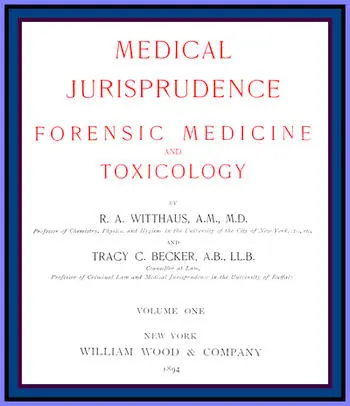
"Medical Jurisprudence, Forensic Medicine and Toxicology. Vol. 1" by R. A. Witthaus et al. is a scientific publication written in the late 19th century. This comprehensive work serves as a fundamental reference for the intersection of medicine and law, particularly focusing on how medical knowledge applies in legal contexts. The book explores various aspects of medical jurisprudence, forensic medicine, and toxicology, aimed at practitioners in both legal and medical fields, as well as scholars interested in legal medicine’s historical and practical significance. The opening of the volume sets the stage by delineating the key topics—medical jurisprudence, forensic medicine, and toxicology. It discusses the historical development of these fields, illustrating the evolution of the legal relationships between medical practitioners and the law. The introduction emphasizes the necessity for legal definitions regarding medical practice, the rights and duties of physicians, and the importance of providing expert testimony in legal cases. This section serves not only as an academic foundation but also as a practical guide for understanding the statutory landscape governing medical practice and its implications for both physicians and patients.
Introduction adapted from the source catalogue; source summaries may be automatically generated.
Free to read · English · 310,507 words · No account needed
MAKE TIME FOR A GOOD BOOK
On by default. Untick to stop anonymous reading totals. Each page counts after 10 seconds in view. How this works.
Anonymous counting is on unless you have switched it off.
Master Not Liable for Services Rendered Servant without Special Contract.—In the case of master and servant, while at common law as between a master and servant the master was bound to provide medicine and food for the servant when the servant was an inmate of the master’s house, this is an obligation which a third person could not enforce, and the master can only be held liable for services rendered to the servant, upon proof of a specific contract with him to pay for them.
Case of Crain v. Baudouin Considered.—The case of Crain v. Baudouin, supra, affords an interesting discussion before the highest court of New York State, as to the question as to how far a father calling a physician for an adult child for whom he is not bound to provide, although lying sick at the father’s house, can be held liable for the services rendered upon such call. In that case the plaintiff attended as a physician upon the daughter of the defendant, who was sick at his house. The daughter was of full age, married and living with her husband, but was brought from that of her husband to that of her father in order that she might be under the care of her mother. Defendant was present when plaintiff made his calls, gave the latter a history of the patient’s illness, and received directions as to her treatment. He told others of the frequency and length of the plaintiff’s visits, and of his opinion of the case, without any disclaimer of liability. The Court held, however, that these facts were insufficient to imply a promise on the father’s part to pay for the services, and that the additional facts that the defendant consented to the calling in of a consulting physician, and that a bill was sent in by the plaintiff, unless acknowledged and acquiesced in by defendant, or that he had before this employed other physicians, were also insufficient to raise an implication of law of such a promise to pay. The plaintiff relied in his argument upon the fact that the patient was a daughter of the defendant, but the Court held that any presumption which might arise from this had the daughter been under age, was overcome by the fact that she was past a majority, and was married and lived with her husband and children. The plaintiff also relied to support his cause of action upon the interest exhibited by the defendant in the course of treatment pursued, and the other facts as to the presence of the defendant when the plaintiff made his professional calls alone and in consultation; his receiving directions as to treatment; his recognition to others of the fact that the plaintiff was in attendance; his reciting to others a knowledge of the frequency and length of the visits of plaintiff without any disclaimer on the part of the defendant of liability. The Court said as to these facts: “It is true that particular acts will sometimes give rise to particular obligations, duties and liabilities. But the party whose acts are thus to affect him must be in such predicament as that those acts have, of legal necessity, a significance attached to them, at the time, which he may not afterward repel.... It has been held that a special request by a father to a physician to attend upon his son, then of full age but lying sick at the father’s house, raised no implied promise on the part of the father to pay for the services rendered.” See Boyd v. Sappington, 4 Watts (Pa.), 247; and so in Veitch v. Russell, 3 Ad. & Ell. (N. S.), 927, it is said: “A physician attends in every case on request; that fact alone is not enough for the inference of a special contract;” and see Sellen v. Norman, 4 Carr. & P., 284. Still less where there has been no special request by the father to the physician, and no more than acquiescence in his calls. As it would be unnatural for the parent of an invalid child, though legally emancipated, or for an intimate and confidential friend of hers, not to know the rise and course of her malady, not to be interested in the state of it as disclosed at any time to skilled inspection, not to be so anxious as to be in waiting when scientific skill was to be applied for its cure, not to be ready to receive directions for treatment in the intervals; so it is not to be implied in the one case more than in the other that, from these manifestations, because unaccompanied with an express repudiation of liability, a liability may be implied. They are to be referred to natural affection and friendly sympathy, rather than to an acquiescence in the rendition of a personal benefit, or counted as acts done under a sense of legal obligation.” The Court further said that “even if it should be assumed that the usage exists that the physician called to consult with him who is in attendance, with the consent of the person who has employed the latter, is in contemplation of law in the hire of that person, still the assent of the defendant to the calling in of the consulting physician, and his expression of desire to be present when he came—until he is shown to have employed the plaintiff—is a basis too weak for an implication of law, that he promised to pay his consultation fees. Still less it is a fact from which to imply a promise to pay the plaintiff.” This case is, however, close to the border line, and it may be well criticised and denied its apparent full weight of authority, notwithstanding the very great learning and ability of the learned Judge Folger, who wrote the opinion, upon the ground that it appears that the father had as a witness expressly denied calling in the plaintiff or authorizing anybody to call him in, or authorizing the employment of a consulting physician, and that on the trial the Court had found upon the whole testimony in the case that the defendant had never employed the plaintiff. Taking the decision as a whole it cannot be regarded as determining that upon such a set of circumstances as is there disclosed, the father could not in any event have been held liable, but rather that the trial court having found upon the whole testimony that the defendant was not liable, having witnesses before it fully able to judge of their capability, the appellate court could not say as a matter of law that a finding in favor of the defendant should be overruled. This case is considered here at some length chiefly for the purpose of affording an illustration to physicians and surgeons which will suggest to them the advisability of care in ascertaining in all cases who is responsible for their charge for services. See also Bradley v. Dodge, 45 How Pr. (N.Y.), 57; Smith v. Riddick, 5 Jones (N. C.), 42.
Your reading position is saved on this browser. Take it to another device with a library code. Reading pages adapt to text, rather than matching a printed edition.
BEHIND THE BOOK
This eBook is for the use of anyone anywhere in the United States and most other parts of the world at no cost and with almost no restrictions whatsoever. You may copy it, give it away or re-use it under the terms of the Project Gutenberg License included with this eBook or online at www.gutenberg.org. If you are not located in the United States, you will have to check the laws of the country where you are located before using this eBook. Read the source licence.
The original source file, including credits and licence, is retained by this library. Request an original-format copy at no charge. Please include the book title and Project Gutenberg identifier #49027.
KEEP YOUR CURIOSITY GOING
Charles G. (Charles Griffith) Ross
Hannah Webster Foster

Emily Lawless
Edwin Hamlin Carr

Charles De Lano Hine
Andrew Ure