
The Writing of News A Handbook with Chapters on Newspaper Correspondence and Copy Reading
Charles G. (Charles Griffith) Ross
THE CLASSIC COLLECTION · 1894
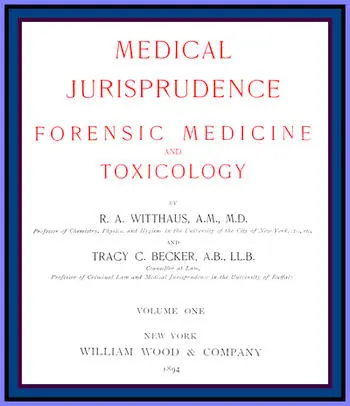
"Medical Jurisprudence, Forensic Medicine and Toxicology. Vol. 1" by R. A. Witthaus et al. is a scientific publication written in the late 19th century. This comprehensive work serves as a fundamental reference for the intersection of medicine and law, particularly focusing on how medical knowledge applies in legal contexts. The book explores various aspects of medical jurisprudence, forensic medicine, and toxicology, aimed at practitioners in both legal and medical fields, as well as scholars interested in legal medicine’s historical and practical significance. The opening of the volume sets the stage by delineating the key topics—medical jurisprudence, forensic medicine, and toxicology. It discusses the historical development of these fields, illustrating the evolution of the legal relationships between medical practitioners and the law. The introduction emphasizes the necessity for legal definitions regarding medical practice, the rights and duties of physicians, and the importance of providing expert testimony in legal cases. This section serves not only as an academic foundation but also as a practical guide for understanding the statutory landscape governing medical practice and its implications for both physicians and patients.
Introduction adapted from the source catalogue; source summaries may be automatically generated.
Free to read · English · 310,507 words · No account needed
MAKE TIME FOR A GOOD BOOK
On by default. Untick to stop anonymous reading totals. Each page counts after 10 seconds in view. How this works.
Anonymous counting is on unless you have switched it off.
Body of criminal dying in State prison or jail, or who was executed, may be delivered to medical college or physician, etc., for dissection, unless deceased or kindred request to be buried (R. L., ch. 13, sec. 2).
Body of person dying in the State, which is not claimed by relatives, notice having been given, shall be delivered to medical school unless ten voters of the town object to such disposition in writing (Laws, 1893, ch. 254).
Coroner to hold inquest, etc. (Md. Code, art. 22, secs. 3, 4).
Shall bury the body when necessary at public expense (Md. Code, art.
22, sec. 7).
Removal, etc., from graveyard, etc. (except potter’s field), of a body is a misdemeanor (Md. Code, art. 27, secs. 133, 134).
Medical examiners shall hold inquest, etc. (Pub. Stat., ch. 26, secs.
10, 11).
And shall deliver it to relatives or friends, or if no one claims it, to overseer of poor etc., for burial (Laws, 1887, ch. 310).
Body shall not be buried in city or town or removed therefrom without a permit (Laws, 1888, ch. 306).
Body of one dying of infectious disease shall not be transported without permit, and only in a sealed case (Laws, 1883, ch. 124, sec. 2).
Body shall not be cremated without permit and inquest by medical examiner, or within forty-eight hours after death, unless death was occasioned by contagious disease (Laws, 1885, ch. 265, sec. 4).
Overseers of poor, mayor and alderman of city, or superintendent of State alms-house, may deliver body of person required to be buried at public expense, to any physician or surgeon or medical college unless deceased requested to be buried, or relative request burial or claim it, or deceased was a stranger or traveller (Laws, 1891, ch. 185).
Body of criminal executed shall be delivered for dissection to a medical college if requested; if not, to friends or relatives, or, if none, to any physician or surgeon (Pub. Stat., ch. 202, sec. 8).
Removal of body unlawfully from grave is punishable, or buying, selling, or possessing for such purpose, is punishable (Pub. Stat., ch. 207, secs. 47, 48).
Concealing birth of child which, if born alive, would be a bastard, is punishable (Pub. Stat., ch. 207, sec. 11).
Seizing dead body on execution is punishable (Pub. Stat., ch. 207, sec.
46).
Body of a prisoner shall be buried by sheriff at town expense if not claimed by relatives or friends (Pub. Stat., ch. 220, sec. 31).
Justice of the peace to hold inquest, etc. (How. Am. Stat., vol. 2,
sec. 9,583 et seq.).
And shall bury the body at the State or town expense (How. Am. Stat.,
vol. 3, sec. 9,593).
Woman concealing death of issue which, if born alive, would be a bastard, is punishable (How. Am. Stat., vol. 3, sec. 9,284).
Your reading position is saved on this browser. Take it to another device with a library code. Reading pages adapt to text, rather than matching a printed edition.
BEHIND THE BOOK
This eBook is for the use of anyone anywhere in the United States and most other parts of the world at no cost and with almost no restrictions whatsoever. You may copy it, give it away or re-use it under the terms of the Project Gutenberg License included with this eBook or online at www.gutenberg.org. If you are not located in the United States, you will have to check the laws of the country where you are located before using this eBook. Read the source licence.
The original source file, including credits and licence, is retained by this library. Request an original-format copy at no charge. Please include the book title and Project Gutenberg identifier #49027.
KEEP YOUR CURIOSITY GOING
Charles G. (Charles Griffith) Ross
Hannah Webster Foster

Emily Lawless
Edwin Hamlin Carr

Charles De Lano Hine
Andrew Ure